You never change things by fighting the existing reality.
To change something, build a new model that makes the existing model obsolete.
—R. Buckminster Fuller
The blockchain is a decentralized data structure with internal consistency maintained through consensus reached by all the users on the current state of the network. It’s an enabling technology that resolved the Byzantine generals’ problem (message communication between untrusted parties) and opened up a new horizon of possibilities for trustless transactions and exchange of information. If the Internet democratized the peer-to-peer exchange of information, then the blockchain has democratized the peer-to-peer exchange of value. We begin this chapter by exploring how transactions work between users on the Bitcoin network.
This entails a technical discussion of structures of a block and a transaction. We then dive into the role of wallets and user addresses. After talking about wallets, we shift our focus to Simple Payment Verification (SPV) implemented in the Bitcoin network. SPV allows us to understand why blocks have a peculiar structure and more important, how the Bitcoin network can retain efficiency despite the network scaling at a high rate. Finally, we conclude our discussion by talking about hard and soft forks in the blockchain. We present the implications of forks in the context of forward compatibility for merchants and users involved in running the Bitcoin-core code.
Transaction Workflow
The central purpose of the Bitcoin protocol is to allow transactions to occur over the network between users in a decentralized manner. We have been talking about small fragments of the protocol to build up background. Now we can integrate those concepts into a single framework and explore the blockchain. The ultimate result of mining is increasing the number of blocks as the network evolves over time. To understand how transactions occur between two users (Alice and Bob), we first need to understand the structure of blocks that hold the transactions. In the simplest terms, the blockchain is a collection of blocks bound by two main principles:
• Internal consistency: There are a few design principles inherent to the functioning of each block that make the blocks internally consistent. For instance, each block links to the previous one in the chain and has a creation timestamp. Such mechanisms
in the blockchain allow it to be an internally coherent data structure that can keep a consistent record of transactions.
© Vikram Dhillon, David Metcalf, and Max Hooper 2017
15
V. Dhillon et al., Blockchain Enabled Applications, https://doi.org/10.1007/978-1-4842-3081-7_3
Chapter 3 ■ Foundations oF BloCkChain
• Consensus on transactions: The concept of mining described in Chapter 2 is just one implementation for verifying transactions; there are different methods where no
brute-force hashing is involved. However, in every one of these implementations,
there is a scheme of reaching consensus on the transactions that have transpired
during some interval in the network. We can generalize this verification of
transactions for a decentralized system by either using some sort of PoW or a similar strategy that pools transactions that are then checked by users on the network.
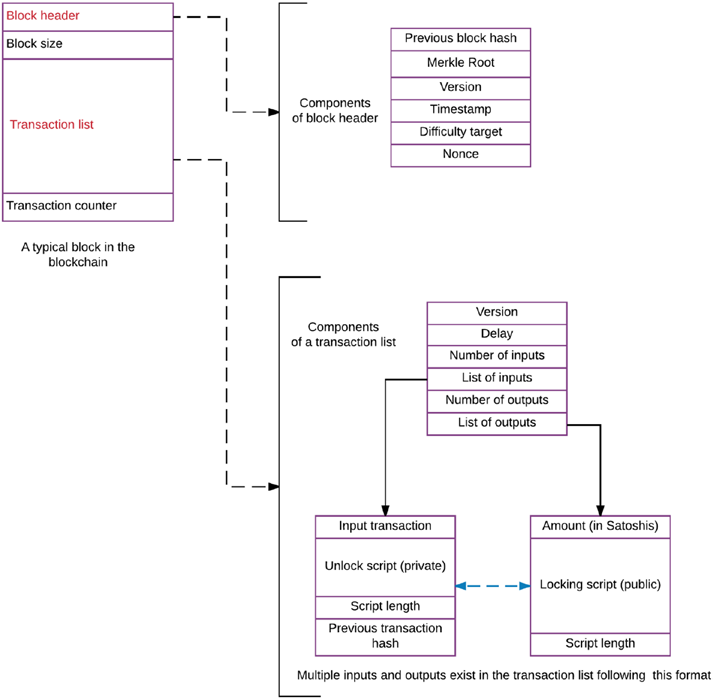
A transaction is essentially a data structure carried on a block, but how exactly? To discover the process, let’s look at the complete structure of a block in Figure 3-1. Each block has at least two unique components: the block header, which contains a unique hash (called the merkle root) that uniquely identifies a block, and the transaction list, which contains new transactions. Note that each block contains the same amount of transactions in the list, but the precise transactions between users are different. This is because only one block wins the mining race every ten minutes on the blockchain, other candidates are rejected, and the race starts again. In this simplified model, there are only two other components of a block: the block size, which is kept consistent for the entire network, and a counter for the number of transactions in each block. Here, we focus more on the block header and the transaction list.
The block header contains a few standard components, such the as difficulty target and the nonce discussed previously. It also contains the version number of the Bitcoin core-code that the winning miner is running. The timestamp is also a unique feature of every block, as it unmistakably identifies one particular block in the network. The header also contains a hash from the previous block in the chain, and a special hash that identifies this block called the merkle root. We discuss how this special hash comes to be later in this chapter.
■ Proof of life recently, there were rumors that Julian assange, the Wikileaks founder, had died. assange recently did an ask Me anything session on reddit and responded to the rumors by reading the most recent block hash from the blockchain to prove that he was indeed alive. the block was created only ten minutes earlier, so this could not have been a prerecording, thus proving beyond any shadow of a doubt that assange was alive. this was the first time the block hash found a use in a sense of popular culture, and assange called it a proof of life.
16
Chapter 3 ■ Foundations oF BloCkChain
Figure 3-1. Simplified overview of the structure of a block
The block header and transaction list are the two components that stay unique to every block. The block header is made up of several smaller parts, the most peculiar of which is the merkle root, a hash that uniquely identifies a block. The header contains the hash of the previous block, the nonce used to create that particular block, and the difficulty of the network. These are standard mining components that we discussed previously. Each block also contains a list of transactions. Aside from the actual transactions, the transaction list also contains a few components that are crucial to how a block will accept the transaction. For instance, the lock time delay dictates when a transaction can be accepted into a block. Finally, the list contains all the transactions accepted into this block as a series of signed inputs and outputs that ensure the transfer of Bitcoins from the sender to the receiver.
There are several new terms and concepts introduced here and we will go through all of them now.
We already talked about the block header and the concepts of timestamp on a block, the merkle root, and a hash from the previous block. Now we focus on the components of the transaction list. Let’s begin with the delay. The proper technical term is lock time delay, which refers to the time after which a transaction can be accepted into a block. The precise mechanism involves the use of a parameter called blockheight, which increases as more blocks are added to the blockchain. A given transaction remains locked and unverified until the blockheight specified for that transaction is exceeded.
17
Chapter 3 ■ Foundations oF BloCkChain
Next is the concept of transaction inputs and outputs. The foundational unit of a transaction is called an unspent transaction output (UTXO), which can have a value given in Satoshis. Similar to how a dollar can be split into 100 cents, Bitcoin can be divided into an eight-decimal unit called Satoshis. A UTXO is a unit of currency controlled by users (the users are also known as owners) and recorded on the blockchain. More precisely, UTXO is really the currency balance, or the unspent currency present in the Bitcoin economy.
The entire network accepts UTXO as currency and whenever a user receives Bitcoin, the amount is recorded on the blockchain as a UTXO. Essentially, the Bitcoin belonging to a user can be spread across several transactions and many blocks as UTXO. As a result, there is no defined concept of stored balance for a particular user, but only UTXOs spread across the network possessed by the owners. The idea of an account balance is actually created for a user by the wallet software, which searches the blockchain and collects all the UTXO belonging to a particular address. We discuss the concepts of wallets and addresses shortly.
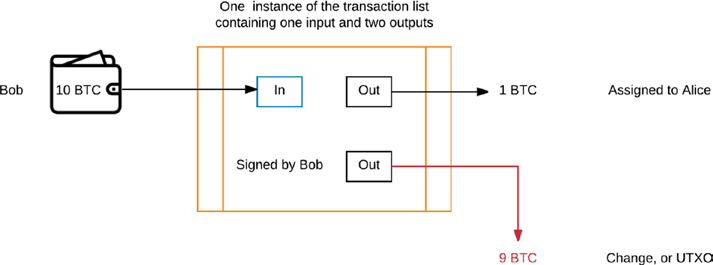
To understand UTXO properly, we need to talk about the concept of change. The idea is very simple, actually. Think about the last time you bought groceries and paid with cash. You probably got some change back that was left over from your payment. UTXOs have a similar concept, as shown in Figure 3-2. Every transaction is split into a portion that is spent and locked (assigned) to another user, and a portion that gets returned back to the original user, just like the change that you would get from shopping. In a transaction, UTXOs that are consumed by the transaction are called the inputs, and the UTXOs created by a transaction are called the outputs. The example in Figure 3-2 illustrates a similar scenario, where Bob wants to send one BTC to Alice, but in the process, the ten BTC owned by Bob are split into two parts: the one BTC sent to Alice, which is now assigned to her, and the nine BTC that are returned to Bob in the form of UTXOs. Both of these components are recorded on the blockchain because they are a part of a transaction, as shown in Figure 3-2.
Figure 3-2. Format of a UTXO in the transaction list
In this example, Bob wants to send one BTC to Alice, and Figure 3-2 shows how this transaction occurs.
The BTC owned by Bob is used as the input of the transaction and the output is two parts, one sent to Alice for one BTC and the second one returned as change back to Bob. It should be noted here that the initial transaction, the newly assigned transaction, and the change are recorded on the blockchain as the input and output.
Now that we have a better grasp of UTXOs, let’s talk about how transactions are assigned from one user to another. This involves the use of private–public key pairs that lock and unlock the transactions. The process works as follows:
• A user, Alice, initiates a transaction that she wants to send to Bob.
• Alice uses her private key to sign the transaction.
• The transaction is broadcast on the network and anyone can use Alice's public key to verify that the transaction originated from her.
18
Chapter 3 ■ Foundations oF BloCkChain
• Bob receives the transaction after it has been verified on the network and propagated to him.
• Bob unlocks the transaction using his private key. The transaction was signed with a script such that only the recipient could unlock the transaction and assign it to
themselves.
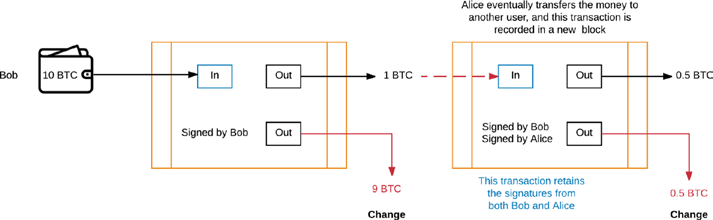
We mention that the transaction locking and unlocking mechanisms use a script, so what is this script? The Bitcoin protocol uses a minimal, bare-bones, Turing-incomplete programming language to manage transactions. Satoshi’s intention was to keep the programming logic very simple and largely off the blockchain whenever possible. A script is attached to every transaction and it contains instructions on how the user receiving Bitcoins can access them. Essentially, the sender needs to provide a public key that anyone on the network can use to determine that the transaction did indeed originate from the address contained in the script, and a signature to show that the transaction was signed by using the sender’s private key. Without the private–public key pair authorization, transactions between users would not occur. Let’s complete the picture that we started to create with the UTXOs, shown in Figure 3-3.
Figure 3-3. Transactions on the blockchain
Conceptually, it might be bizarre to consider transactions on the network as UTXOs being spread across hundreds of blocks, but this process is exactly how transactions are propagated across the network. In this example, Bob first initiated the transaction that was sent to Alice in which one BTC was assigned to Alice.
He received nine BTC in change as the unspent output. Alice further sends 0.5 BTC to another user and in doing so, she receives 0.5 back in change from her transaction. Notice that the first transaction was signed by Bob, who initiated the transaction, and then Alice signed the second transaction. In a sense, the output from the first transaction became an input for the second, so Bob’s signature was retained as proof of the first transaction and Alice’s signature now serves as the unlocking mechanism. This is how transactions can be tracked across the Bitcoin network from the origin to the final owner (final address). By using network addresses, the network retains a level of pseudonymity.
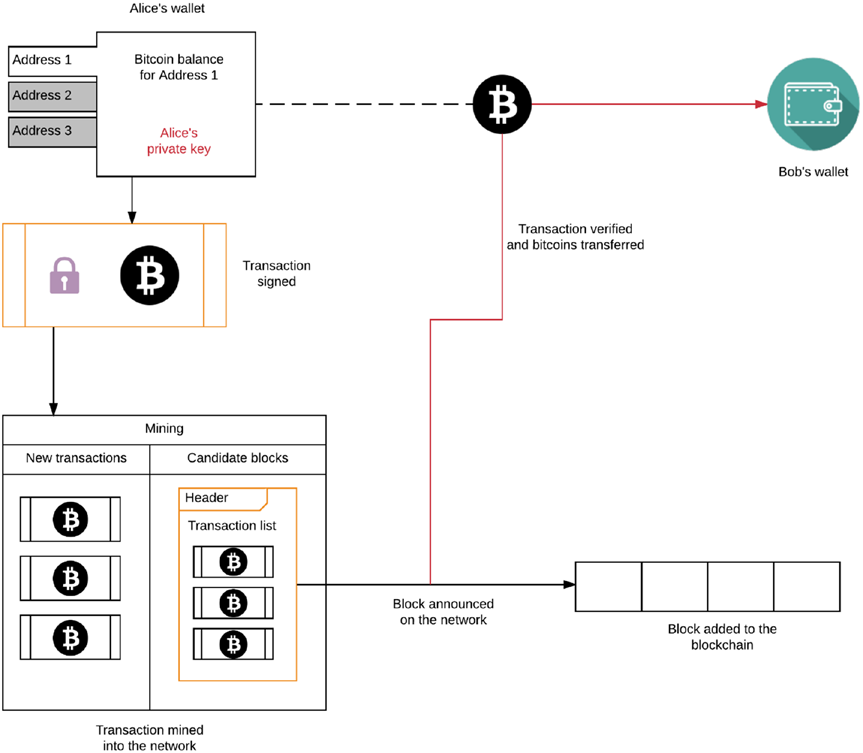
Now that we have talked about UTXOs, signatures, scripts, and how transactions are recorded, let’s integrate these concepts and review the workflow of a transaction between Alice and Bob, shown in Figure 3-4.
19
Chapter 3 ■ Foundations oF BloCkChain
Figure 3-4. Overview of a transaction on the network
Alice initiates the transaction from her wallet, which contains multiple addresses. Each address has a certain amount of Bitcoin balance (the sum of all UTXOs associated with that address) that can be used to create new transactions. The transaction is then signed using Alice’s private key and it enters the mining phase, where it will be packaged into a candidate block. As the mining concludes, the winning miner announces the block on the network and the block is included into the blockchain. The remaining transactions are thrown into the pool of transactions to be added. The transaction propagates to Bob, who can now use his private key to unlock the transaction output amount and use it. The ideas of UTXOs, signing, and script locking and unlocking provide deeper insights into how the blockchain remains internally consistent as a decentralized ledger.
20
Chapter 3 ■ Foundations oF BloCkChain
Figure 3-4 introduces the concept of the wallet, which can be used to initiate transactions. Wallets are now a standard part of the Bitcoin core-code and they mainly serve three purposes for the users:
• Create transactions: A user can create transactions easily with a graphical interface using the wallet.
• Maintain balance: The wallet software tracks all the UTXOs associated with an address and gives a user his or her final balance.
• Maintain multiple addresses: Within the wallet, a user can have multiple addresses and each address can be associated with certain transactions.
In a sense, addresses are the only means of ownership in the Bitcoin network. UTXOs and balances are associated with a particular address and a user can create as many addresses as her or she wants. We saw in Figure 3-4 that Alice had three addresses in her wallet, and each of the addresses can work with her private key. There are actually other types of wallets, aside from a software wallet. Figure 3-4 used a software wallet, but the process is similar for the other two main types, mobile wallets and a cold storage physical wallet.
Mobile wallets have largely been designed for the sake of convenience and as a gateway into the world of mobile payments using cryptocurrencies such as Bitcoin. These wallets often serve as an independent but miniaturized version of a complete wallet, and allow for access to balances and transactions on the go. The apps that work as wallets are often designed in an open source environment, so they are also helping bring developers and power users together in the community. Cold storage wallets are a more permanent method of storing Bitcoins over a long period of time. There have been instances where wallets got corrupted or the users couldn’t remember the key to unlocking those wallets, rendering their balance effectively useless. There is no recovery mechanism for a password on a wallet. The idea here is to create a new wallet, and send a transaction to a new address on that wallet. Now this wallet can be backed up and saved to a physical device such as a flash drive and stored away securely. Once that transaction has been verified on the blockchain, your Bitcoins are safe to be retrieved from the flash drive at any time. This can be done to prevent any accidents from happening and to keep your currency separate from the main wallet that you use to conduct transactions or mine for Bitcoins. Some developers have taken a step further and created paper wallets where the address is encoded in a QR code and a private key for that particular wallet is also printed on the paper in another QR code.
■ Note how can you actually see your transaction taking place on the Bitcoin network without having to write a script or code yourself to do it? in Bitcoin (and most cryptocurrencies), there is a feature called Blockchain explorer, usually a web site where all transactions are visible from the Bitcoin network. You can obtain all sorts of details about transactions, such as the origin of the transaction, the amount, the block hash, or how many verifications it received.
Simple Payment Verification
So far, we have talked about the structure of blocks, transaction lists, how transactions occur between users, and how they are recorded on the blockchain. Blocks are fundamentally data structures linked on the blockchain, and transactions can be thought of as property of that data structure. More precisely, in the case of blockchains, transactions are represented as leaves of a merkle tree. Hashes have been used throughout the Bitcoin protocol as a method for maintaining data consistency because a hash is very easy to verify and nearly impossible to reverse engineer. Building on these properties, we can tackle a very difficult technical challenge on the blockchain: How can we check if a particular transaction belongs to a block?
21
Chapter 3 ■ Foundations oF BloCkChain
Checking through an N number of items in a list would be very inefficient, so we cannot simply check every transaction in a blockchain containing millions of blocks to verify. This is where a merkle tree provides speed and efficiency.
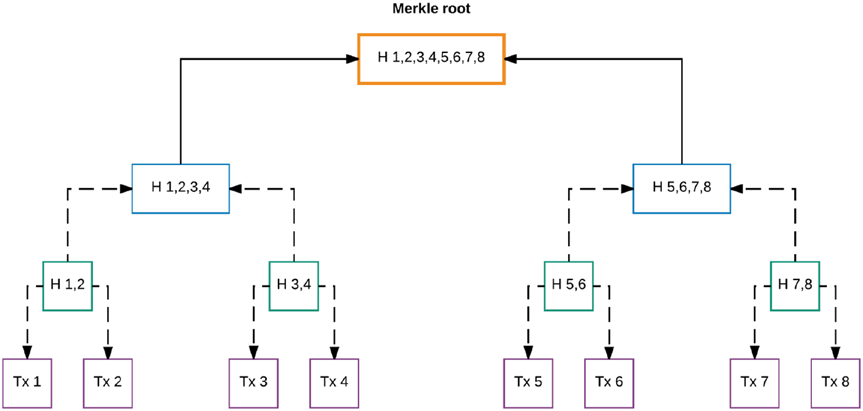
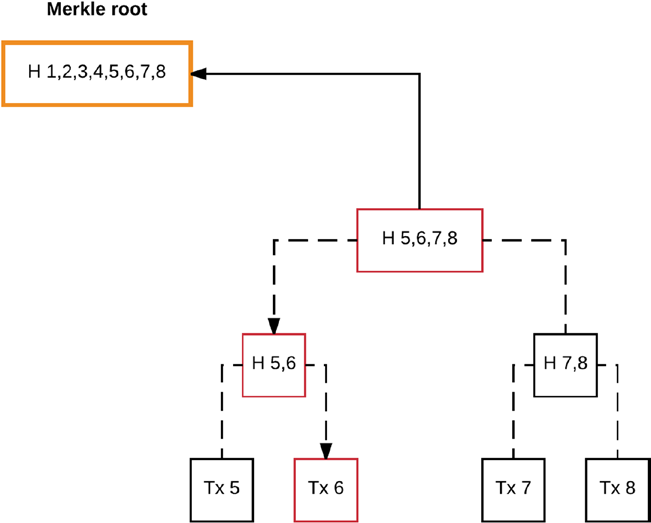
To visualize a merkle tree, refer to Figure 3-5. It is constructed from the transactions of a block to allow fast access for verification purposes. Let’s follow the example shown in Figure 3-5. In this case, there are eight transactions collected in a block and represented on a merkle tree. The lowest level is the transactions themselves, and they are abstracted to a higher level by hashing two transactions together and obtaining an output hash. This hash is combined with a second one and hashed again to abstract a higher level. This process is repeated until only two hashes are left. Notice that each level contains information about the level below, and finally the highest level holds a hash with information from the entire tree. This hash is called the merkle root. How would a merkle root assist in finding a transaction? Let’s run through the example shown in Figure 3-6 and try to find transaction 6 from the merkle tree. For starters, the merkle root allows us to skip the other half of the tree, and now our search is limited to transactions 5 through 8. The hashes guide the search further, allowing us to step into (reach) transaction 6 in just three steps. Compare this to searching through the whole tree, stepping into every level, and comparing every transaction to see if it is indeed transaction 6. That process would be more involved in terms of the steps taken and the time needed, and this becomes too exhausting if the search expands to millions of transactions.
Figure 3-5. Constructing a merkle root
The lowest level is formed from the transactions and the general idea is to keep hashing two elements together and retain some information about the level below. Ultimately, we are left with only two elements that are hashed together to form the merkle root.
When would searching for a transaction come in handy? Every new user to get started with the standard Bitcoin wallet client has to download the entire blockchain. Over time, the blockchain has increased in download size, recently reaching a few gigabytes. This can be intimidating to new users, who cannot use their wallets until the blockchain download is finished, and it might turn them away. To solve the problem of having to download a bloated blockchain with historic transactions, Satoshi came up with a solution called SPV. The rationale in SPV is to create a wallet client that downloads only the block headers instead of the entire blockchain. This new lightweight client can use the merkle root in the block headers to verify if a particular transaction resides in a given block. The precise mechanism requires the wallet to rely on a merkle 22
Chapter 3 ■ Foundations oF BloCkChain
branch and reach the specific transaction, much like the example shown in Figure 3-6. Currently, for Bitcoin, there is an alternative wallet client known as Electrum that implements SPV and allows new users to avoid the hassle of downloading the entire blockchain.
Figure 3-6. Finding a transaction using the merkle root
The root allows us to skip half of the tree during our search and the next level narrows down the search even further. Using the merkle root, we can reach the transaction in just three steps, which allows a very high operational efficiency that we would need in Bitcoin’s current network. The path to reaching transaction 6 is also known as a merkle branch, connecting the root to a leaf.
Blockchain Forks
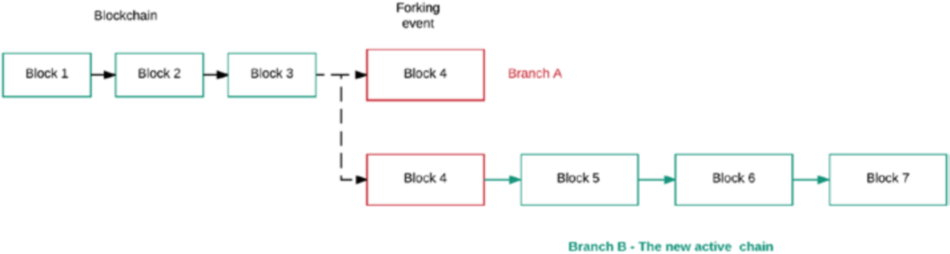
Here’s an interesting scenario to consider: Several miners are competing to solve the PoW and create a block. Incidentally, two miners find a valid value within a few seconds of each other and broadcast them to the network. What happens now? This situation is known as a fork, and it is completely normal on the Bitcoin network, especially as the network starts to scale and include thousands of miners. To resolve the fork, there are a few rules in place on the network, called the consensus rules. The tie creates two versions of the blockchain, and this tie is resolved when the next block is discovered. Some of the peers will be working on one version of the blockchain, and others will be working on the second version. When the next block is discovered, one of the chains will become longer due to the inclusion of this new block. This chain now becomes the active chain and the nodes will converge to the new chain. This process is visually illustrated in Figure 3-7.
23
Chapter 3 ■ Foundations oF BloCkChain
Figure 3-7. Fork in the chain
In this example, block 4 is discovered at the same time by two miners, but the tie is resolved when the next block is discovered on Branch B. This branch now becomes the active chain and all the nodes converge to using Branch B as the new active chain.
Normal forks on the blockchain are not a concerning event, because they are usually resolved within a matter of minutes. Soft and hard forks are an entirely different matter, however. These can occur in the case of upgrades to the Bitcoin core-code where a permanent split happens between nonupgraded nodes that cannot validate any newly created blocks and upgraded nodes that have begun creating blocks following the new consensus rules. Two entirely different types of blocks begin to appear on the network and the network is unable to converge on a single active chain until the nodes are upgraded to the new rules.
In this case, there are two possible outcomes. The first possibility is that the majority of the network switches over to the new rules (a soft fork), and the new rules allow for the carryover of some portion of the valid old blocks. The second alternative is that the old blocks remain invalid for the new nodes, and no old blocks are accepted in the network by the new nodes. This is a hard fork, where no forward compatibility exists and the old blocks will no longer be accepted by the new nodes. All the miners and nodes have to upgrade to the new software so that their blocks can be considered valid under the new rules. A hard fork can be chaotic and cause a problem for users and merchants that have created payment terminals and interfaces relying on the old rules for transactions. They have to upgrade their back-end software to be compatible with the new rules and ensure a smooth transition of incoming Bitcoins. A hard fork is not upcoming for the Bitcoin network, but developers have begun researching just how complex the process might be. We end our discussion of the blockchain forks here, but we return to it later. In the next chapters, we take a look at circumstances in which a hard fork might become necessary in the next generation of Bitcoin protocols.
Summary
In this chapter, we integrated the concepts of mining into the whole blockchain network. We described what a blockchain is and how it functions at a technical level. Then, we described the workflow of a transaction and tracking unspent transaction outputs. We talked about how transactions are put together and propagated on the blockchain and also mining software such as a wallet and mining client. Then, we put mining in the context of a proper network and showed how a transaction goes from being included in a block to being propagated. After that, we talked about the concept of SPV and the importance of merkle hashes and roots in Bitcoin. We ended the chapter with a discussion of blockchain forks and how they influence the network, which we revisit later in the book as well.
References
The main references used to prepare this chapter are the Bitcoin Developer Guide for discussions on UTXOs and block headers. Georg Becker’s work on Merkel Tree signatures was used to prepare the sections on Simple Payment Verification and Merkel roots.
24