Any sufficiently advanced technology is indistinguishable from magic.
—R. Buckminster Fuller
Ethereum is an open source, decentralized, blockchain platform with computational capabilities that reconstruct elementary currency exchange into a transfer of value between users via a scripting language.
Ethereum is widely recognized as a successor to the Bitcoin protocol, generalizing the original ideas and enabling a more diverse array of applications to be built on top of blockchain technology. Ethereum has two essential components. The first is a Turing-complete virtual processor that can load resources and execute scripts, called the Ethereum Virtual Machine (EVM). The second component is a token of value called Ether, which is the currency of the network used for user-to-user transactions or compensation to miners of the network. In this chapter, we begin our journey with an overview of Ethereum’s architecture in comparison to Bitcion, focusing on the EVM and Turing-completeness properties. Following the architecture, there is a short discussion on the accounts model in Ethereum, and account representation with Merkel-Patricia Trees. This will lead us to global state in Ethereum, account storage and gas, which is a spam-prevention mechanism in the network. Then, we deconstruct the notion of a smart contract enabled by EVM, the security concerns revolving around sandboxing executable code, and how the EVM pushes executable code (bytecode) to the blockchain. After that, we provide an introduction to Solidity, a programming language for writing smart contracts in Ethereum. We will explore the syntax of Solidity, and the common integrated development environments (IDEs) being used to work with it. Next, we focus on the World Computer model proposed using Ethereum and a few related decentralized technologies such as IPFS and Whisper. Then, we will look at the apps available in Ethereum. On the enterprise side, a particularly noteworthy development is the Blockchain-as-a-Service (BaaS) deployed on the Azure cloud by Microsoft. For the network, distributed apps (Dapps) are being built on top of Ethereum and published using other World-Computer components such as Mist.
Overview of Ethereum
It was around mid-2013 when a majority of the Bitcoin community was starting to flirt with the idea of other applications beyond simply currency. Soon, there was a flood of new ideas discussed in online forums.
Some common examples include domain registration, asset insurance, voting, and even Internet of Things (IoT). After the hype started to fade away, a more serious analysis of the Bitcoin protocol revealed severe limitations of potential applications that can be built on top of the blockchain.
© Vikram Dhillon, David Metcalf, and Max Hooper 2017
25
V. Dhillon et al., Blockchain Enabled Applications, https://doi.org/10.1007/978-1-4842-3081-7_4
Chapter 4 ■ UnpaCking ethereUm
A crucial point of debate was whether a full scripting language should be allowed within the blockchain or applications should be built with logic residing outside of the blockchain. There were two key issues that sparked this debate:
• The scripting language and OPCODES in the Bitcoin protocol were designed to be
very limited in functionality.
• The protocol itself was not general enough, and alternative currencies such as
Namecoin and others emerged specialized for one specific task. The big question at
the time was this: How can a protocol be generalized such that it becomes future—
compatible with applications that we know nothing about?
Eventually, two schools of thought emerged regarding scripting: Traditionally, Satoshi’s paper proposed keeping the scripting language very limited in functionality. This would avoid the security concerns of having executable code in the blockchain. In a sense, the blockchain executable code is limited to a handful of necessary primitives that update the distributed states. The second school of thought was championed by Vitalik, who thought of the blockchain as more than just a ledger. He envisioned the blockchain as a computational platform that can execute well-defined functions using contracts and arguments. The design of EVM allows for complete isolation of the executable code and safe execution of the applications built on top of the EVM. Let’s begin with the design principles and the core idea behind Ethereum.
■ Core idea instead of building a platform to support specific applications, in ethereum, we build to support a native programming language with extensibility to implement business logic on the platform using that language.
We return shortly to discuss the implications of this principle. In the meantime, let’s talk about another feature of Ethereum, consensus. We discussed the concept of consensus in earlier chapters: In PoW-based cryptocurrencies such as Bitcoin, the network awards miners who solve cryptographic puzzles to validate transactions and mine new blocks. Ethereum uses a different consensus algorithm called PoS. In a PoS
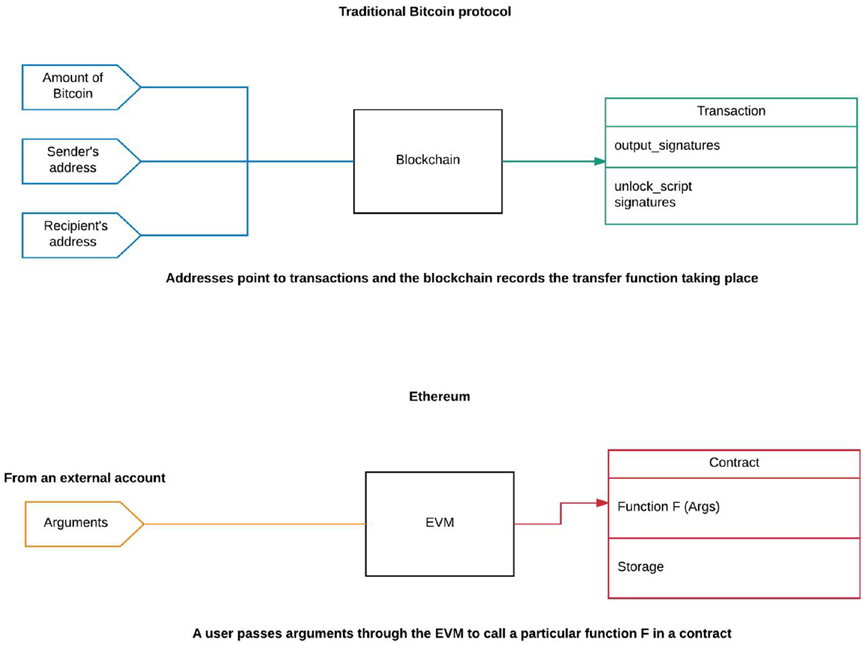
algorithm, the validator or creator of the next block is chosen in a pseudorandom manner based on the stake that an account has in the network. Therefore, if you have a higher stake in the network, you have a higher chance of being selected as a validator. The validator will then forge the next block and get a reward from the network. Here, the validator is truly forging a block (in the blacksmith sense of the term) instead of mining, because in PoS, the idea of hardware-based mining has been replaced by this virtual stake. To some extent, the rationale behind using PoS was due to the high-energy requirements of PoW algorithms that became a frequent complaint. Peercoin was the first cryptocurrency to launch with PoS, but more prominent recent PoS implementations can be seen in ShadowCash, Nxt, and Qora. The main differences between Bitcoin and Ethereum as protocols are highlighted in Figure 4-1.
26
Chapter 4 ■ UnpaCking ethereUm
Figure 4-1. Overview of Bitcoin and Ethereum as computational platforms In the Bitcoin protocol, addresses map the transactions from sender to receiver. The only program that runs on the blockchain is the transfer program. Given the addreses and the key signature, this program can transfer money from one user to another. Ethereum generalizes this concept by placing an EVM at every node so that verifiable code can be executed on the blockchain. Here, the general scheme is that an external account will pass arguments to a function and the EVM will direct that call to the appropriate contract and execute the function, granted the appropriate amount of Ether and gas are supplied. As a consequence, every transaction in Ethereum can be considered a function call. The function calls and transactions in Ethereum comply with PoS, which has a faster resolution time than the Bitcoin blockchain that relies on PoW. The security level of this process verified by the network is also very high.
Accounts in Ethereum
Accounts are a metastructure in Ethereum and the fundamental operational unit of the blockchain.
Accounts also serve as a model to store and track information on the users in the network. There are two types of accounts available on the network.
27
Chapter 4 ■ UnpaCking ethereUm
• User accounts: These are user-controlled accounts also known as external accounts.
These accounts have an Ether balance, are controlled by public–private key pairs,
and can send transactions, but have no associated code. All actions in the Ethereum
network are triggered by transactions intiated by external accounts. In the Bitcoin
protocols, we referred to these simply as addresses. The key difference between
accounts and addresses is the ability to contain and execute generalized code in
Ethereum.
• Contracts: This is essentially an account controlled by its own code. A contract account is the functional programmatic unit in Ethereum that resides on the
blockchain. This account has an Ether balance, has associated code, can execute
code when triggered by transactions recieved from other accounts, and can
manipulate its own persistent storage. (Every contract on the blockchain has its own storage that only it can write to; this is known as the contract's state.) Any member on the network can create an application with some arbritary rules, defining it as a contract.
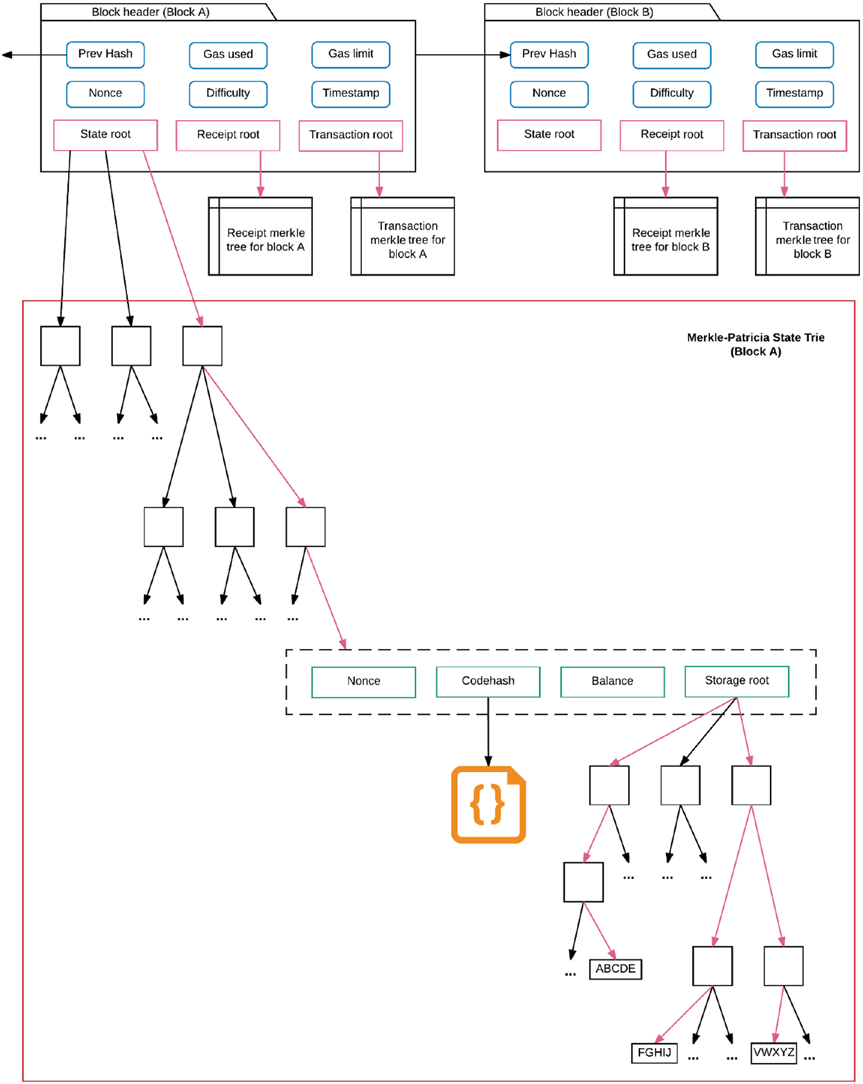
If accounts play such a key role, how are they represented on the blockchain? Accounts become an element of the merkle trees, which in turn are an element of every block header. Ethereum uses a modified form of the binary merkle trees called Merkle-Patricia trees. A complete explanation of the Merkle-Patricia tree (see http://www.emsec.rub.de/media/crypto/attachments/files/2011/04/becker_1.pdf) would be beyond the scope of this text, but a graphical synopsis is provided in Figure 4-2.
■ Note the two-account system explained here might not remain in ethereum for the long term. recently, there has been a push in the development community toward a one-account model, where user accounts are implemented by using contracts.
28
Chapter 4 ■ UnpaCking ethereUm
Figure 4-2. Overview of block headers and Merkle-Patricia trees for Block A and B
29
Chapter 4 ■ UnpaCking ethereUm
The block header contains a few standard definitions that broadcast the status of the network.
Additionally, every block header in Ethereum has three trees for three classes of objects: transactions (function calls), receipts (the results of a function call, recording the effect of each transaction), and state objects. We explore the Merkle-Patricia tree further with the state root, which contains account objects.
Binary trees are useful to manage transaction history, but the state has more components and needs to be updated more frequently. The balance of an account and the nonce for the network are often changed and therefore what is needed is a data structure where we can quickly calculate a new tree root after an insert, update, edit, or delete operation without needing to recompute the entire tree. This modified merkle tree allows for rapid queries to questions such as these: Does this account exist? Has this transaction been included in a particular block? What is the current balance of my account? The Merkle-Patricia tree shown in Figure 4-2 is two levels deep and has numerous branches. One of the branches points to a dashed box containing the four components that make up an account. The balance is only relavent for an external account, and similarly, the codehash (which holds executable code) is only applicable to contracts. The storage root actually contains data uploaded by a user to the blockchain or the internal storage space available to a contract that can be updated as that contract is executed.
State, Storage, and Gas
We briefly mentioned that a contract can manipulate its own storage and update the state, so what is a state?
Recall that in the Bitcoin protocol, data on users and transactions is framed and stored in the context of UTXOs. Ethereum employs a different design strategy of using a state object. Essentially, the state stores a list of accounts where each account has a balance, as well as blockchain-specific data (code and data storage).
A transaction is considered valid if the sending account has enough balance to pay for it (avoiding double spending), therefore the sending account is debited and the receiving account is credited with the value.
If the receiving account has code associated with it, the code will run when the transaction is received.
The execution of a contract or the code associated with an account can have different effects on the state: Internal storage could also be changed, or the code might even create additional transactions to other accounts.
Ethereum makes a distinction between state and history in the network. The state is essentially a snapshot of the current information regarding network state and accounts at a given time. On the other hand, history is a compilation of all the events that have taken place on the blockchain, such as function calls (transactions) and the changes brought about as a result (receipts). Most nodes in the Ethereum network keep a record of the state. More formally, the state is a data structure that contains key value mapping addresses to account objects. Each account object contains four values:
• Current nonce value
• Account balance (in Ethers)
• Codehash, which contains code in the case of contracts, but remains empty for
external accounts
• Storage root, which is the root of the Merkle-Patricia tree that contains code and data stored on the blockchain
30
Chapter 4 ■ UnpaCking ethereUm
Next, let’s talk about gas in Ethereum. Gas is the internal unit for keeping track of execution costs in Ethereum. In other words, it is a microtransaction fee for performing a computation on the blockchain. For a computational platform like Ethereum, this becomes crucial when running code because of the halting problem: One cannot tell whether a program will run indefinitely, or just has a long runtime. Gas puts a limiter on the runtime as the user has to pay for executing step-by-step instructions of a contract. The nature of microtransactions allows steps to be executed very inexpensively, but even those transations will add up for very long runtimes. Once the gas supplied for a contract is exhausted, the user would have to pay for more to continue. Special gas fees are also applied to operations that take up storage.
Operations like storage, memory, and processing all cost gas in the Ethereum network. Let’s talk about storage next. In Ethereum, external accounts can store data on the blockchain using contracts. A contract would manage the upload and storage process, but the data types that can be stored currently are very limited. A natural question then becomes: What are the limits on uploading content and information to the Ethereum blockchain? What would prevent the bloating of the blockchain? As it turns out, there are currently two mechanisms in place preventing a data overload:
• Gas limits per block that dictate how much gas can be spent per block on storage and computational operations
• Amount of money a user would have to spend to purchase the gas needed to store
data
The second limitation is usually a deterrent for users to store directly on the blockchain, as it becomes much more efficienct and economical to use a third-party decentralized serivce like STORJ (https://
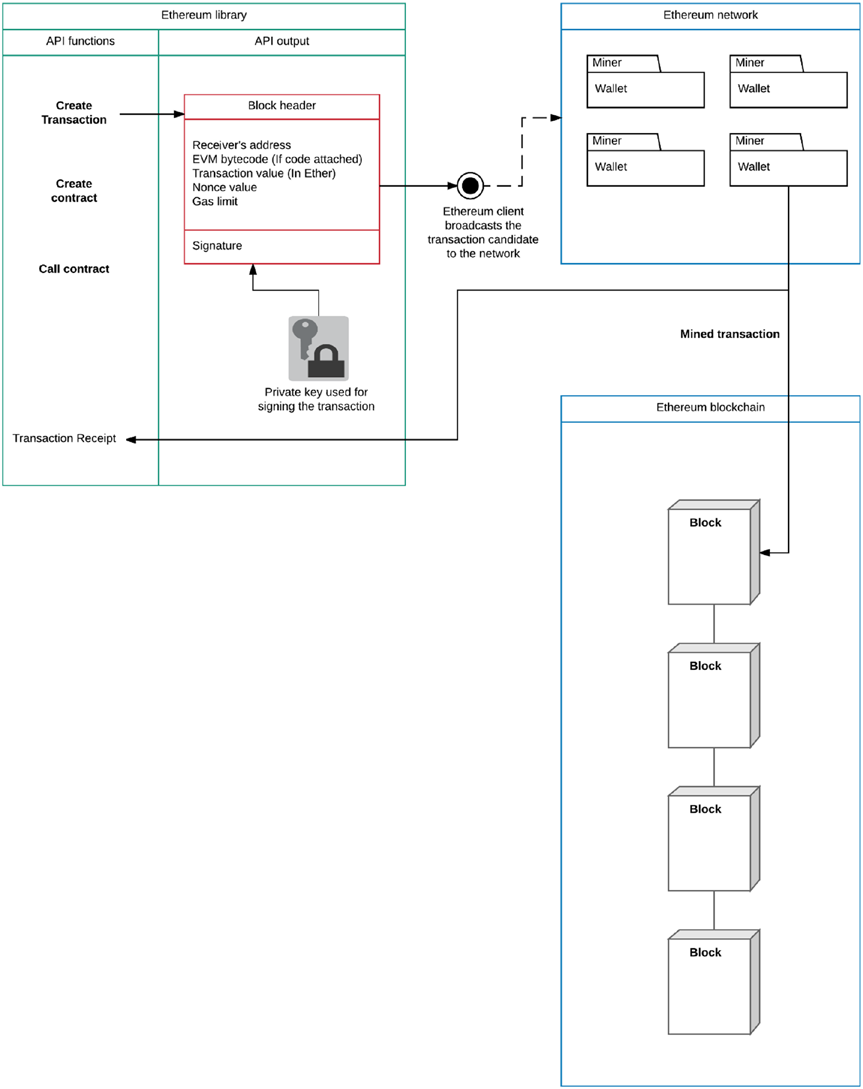
storj.io/) or IPFS (https://ipfs.io/) for the storage and hash the location in Ethereum to include it in a contract. In the future, new distributed storage applications will allow for all sorts of data files to be uploaded and included in contracts on the blockchain. Let’s summarize what we have discussed so far: We started with the differences between Bitcoin and Ethereum using accounts, charging gas for operations, storing data directly on the blockchain, allowing executable code on the blockchain, state objects, and Merkle-Patricia trees. Figure 4-3 below a simplified functional overview of the processes occuring in Ethereum.
31
Chapter 4 ■ UnpaCking ethereUm
Figure 4-3. A simplified overview of the Ethereum network
32
Chapter 4 ■ UnpaCking ethereUm
There are three important Ethereum components to discuss: the API, the network, and the blockchain.
The Ethereum JavaScript API (also known as web3.js) provides a large feature set for functionality such as constructing transactions and contracts, referring to functions, and storing receipts. An enhanced wallet client for Ethereum such as Mist (https://github.com/ethereum/mist) can take over several of these functions with a GUI. Once a candidate block is constructed, it is broadcast to the network by the Ethereum client. The validators on the network determine if the transactions are valid, and if any code (in the block) associated with a transaction or a contract is valid. Once the validation is complete, the validators execute the associated code and apply it to the current state. The block is broadcast to the network and a miner will forge the block, then the verified block is added to the blockchain. This step also creates transaction receipts for every transaction included in the block. The new block also provides updates to the state objects and relational links for the state from the current block to a new block.
■ Note What will prevent the ethereum network from being bloated by small unused contracts? Currently, there are no mechanisms to control the life span of a contract, however, there are a few proposals in the air about temporary subscription-based contracts. in the future, there might be two different types of contracts, one that has a permanent life span (which is significantly more expensive to create and compute), and the other one that operates until its subscription expires (cheaper and temporary; self-destructs after subscription runs out to prevent cluttering).
Ethereum Virtual Machine
Formally, EVM is the runtime environment for smart contracts in Ethereum. Contracts are written in a higher level language called Solidity and then compiled into bytecode using an interpreter in EVM. This bytecode is then uploaded to the blockchain using an Ethereum client. Contracts live on the blockchain in this executable bytecode form. The EVM is designed to be completely isolated from the environment and the rest of the network. The code running inside the EVM has no access to the network or any other processes; only after being compiled to bytecode do contracts have access to the external world and other contracts.
From an operational standpoint, the EVM behaves as a large decentralized computer with millions of objects (accounts) that have the ability to maintain an internal database, execute code, and talk to each other through message passing. This model is not yet complete, but in Ethereum, this concept is often referred to as the idea of a world computer. Let’s return to the topic of code execution and how it is intimately linked to consensus. EVM allows any user on the network to execute arbitrary code in a trustless environment where the outcome is fully deterministic and the execution can be guaranteed. The default execution environment and settings lead to stasis: Nothing happens on the network and the state of everything remains the same.
However, as we mentioned before, any user can trigger an action by sending a transaction from an external account. We can have two outcomes here: If the receiver is another external account, then the transaction will transfer some Ether but nothing else happens. However, if the receiver is a contract, then the contract becomes activated and executes the code within. Executing code within the network takes time, and the process is relatively slow and costly. For every step in the instructions, the user is charged gas for execution.
When a user initiates an execution through a transaction, they commit an upper limit for the maximum currency that they are willing to pay as gas for that contract or code.
33
Chapter 4 ■ UnpaCking ethereUm
■ Tip ethereum has recently begun the process of migrating over to a just-in-time virtual machine (Vm), which offers some optimizations in gas usage and performance.
What does it mean for the outcome of EVM to be deterministic? It is essential for each node to reach the identical final state given the same input for a contract method. Otherwise, each node that executes the contract code to validate the transaction would end with different results and no consensus would be possible. This is the deterministic nature of EVM that allows every node to reach consensus on execution of a contract and the same final state of accounts. The nodes executing a contract are similar to cogs synchronized to move inside of a clock, as they work in a harmonious fashion and reach the matching final state. A contract can also refer to other contracts, but it cannot directly access the internal storage of another contract. Every contract runs in a dedicated and private instance of the EVM where it only has access to some input data, its internal storage, the code of other contracts on the blockchain, and various blockchain parameters such as recent block hashes.
Every full node on the network executes the contract code simultaneously for each transaction. When a node is validating a block, transactions are executed sequentially, in the order specified by the block.
This is necessary because a block might contain multiple transactions that call the same contract, and the current state of a contract might depend on state modified by previous references during the code execution.
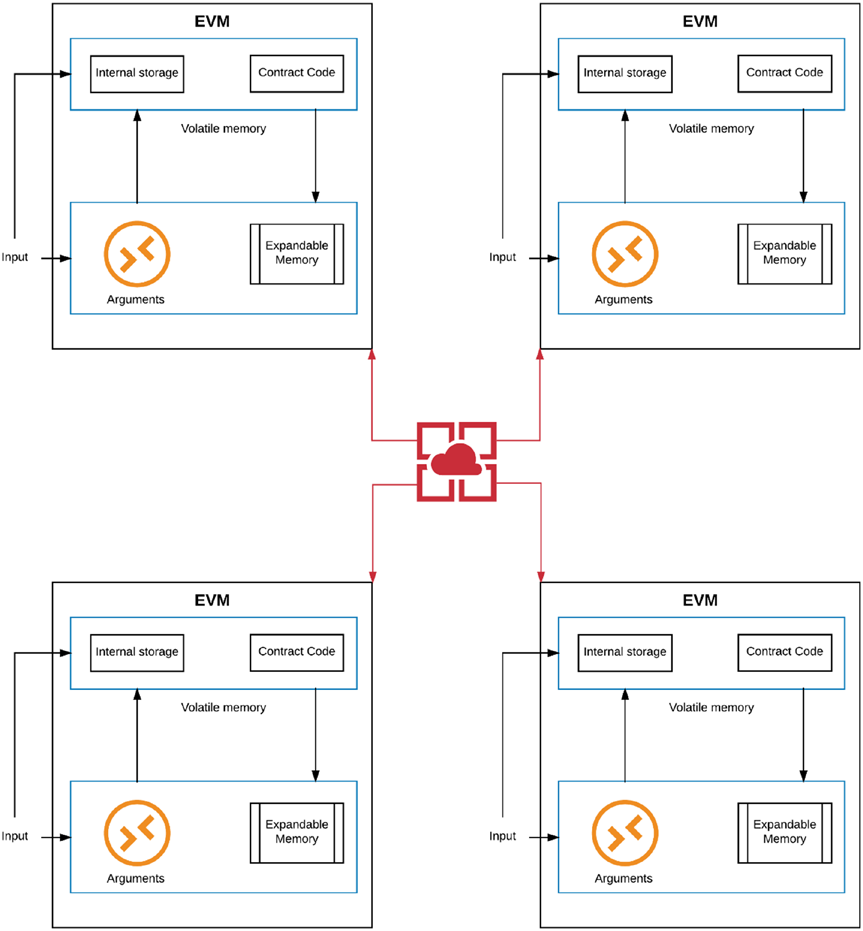
Executing contract code is relatively expensive, so when nodes receive a block, they only do a basic check on the transactions: Does the sending account have enough Ether to pay for gas? Does the transaction have a valid signature? Then, mining nodes perform the relatively expensive task of executing the transaction, including it in a block, and collecting the transaction fee as a reward. When a full node recieves a block, it executes the transactions in the block to independently verify the security and integrity of the transactions to be included in the blockchain. Let’s look at the EVM visually in Figure 4-4.
34
Chapter 4 ■ UnpaCking ethereUm
Figure 4-4. Four instances of Ethereum Virtual Machines (EVMs) running on four different nodes The four EVMs are synchronously executing a contract’s instructions and will arrive at the identical account state once the execution has been completed. This is due to the deterministic nature of the EVM, which allows the contract to reach consensus across the network at every step of instructions. The EVM has a very straightforward rationale: It has a single run loop that will attempt to execute the instruction one step at a time. Within this loop, the gas is calculated for each instruction and the allocated memory is expanded if necessary. The loop will continue until the EVM either recieves an exit code indicating successful execution or throws an exception such as out of gas.
35
Chapter 4 ■ UnpaCking ethereUm
Solidity Programming Language
Solidity is a higher level, object-oriented programming language for writing smart contracts in Etheruem.
Any code written in Solidity can be executed on the EVM after being compiled into bytecode, which is an instruction set for the EVM. How does the bytecode encode references to other functions and contracts that are called during execution? This is done using an application binary interface (ABI). In general, an ABI is the interface between two program modules: machine-level instructions and a human-readable higher level programming language. Let’s break down this answer into three components:
• Contract: A contract is simply higher level code defined in a formal language such as Solidity.
• Compiled contract: The contract is converted to bytecode to be executed on the EVM, adhering to the compiler specification. Note that function names and input
parameters get hashed and obfuscated during compilation. Therefore, for another
account to call a function, it must have access to the given function name and
arguments, and we need another layer that interfaces encoding into and out of the
bytecode.
• ABI: An ABI is a list of the contract’s function definition and arguments in JavaScript Object Notation (JSON) format. The function definitions and input arguments are
hashed into the ABI. This is included in the data of a transaction and interpreted
by the EVM at the target account. An ABI is necessary so that you can specify which
function in the contract to invoke, as well as get a guarantee that the function will return data in the format you are expecting.
Solidity (see https://solidity.readthedocs.io/en/develop/) has a new plug-in for Visual Studio (see https://marketplace.visualstudio.com/items?itemName=ConsenSys.Solidity) to help write smart contracts in a powerful IDE and deploy them to the Ethereum network. Our discussion of Solidity here is limited to covering the fundamentals, such as storing variables and creating a simple contract, so let’s get started.
/* defining a contract */
contract ExampleStorage {
uint storedNumber; //unsigned integer (uint) used to declare a state variable
/* Function set can modify the value of the state variable */
function set(uint x) {
storedNumber = x;
}
/* Function get can retrieve the value of state variable */
function get() constant returns (uint retVal) {
return storedData;
}
}
36
Chapter 4 ■ UnpaCking ethereUm
This storage contract allows a user to store an integer as a state variable storedNumber and then modify or retrieve its value using the get() and set() functions. Solidity also offers several advanced features available in modern programming languages such as inheritance (for contracts), function overloading, and class interfaces. Next, let’s look at a more complex example of a contract. This time we create a simple bank contract using Solidity:
// This bank contract allows deposits, withdrawals, and checking the balance
// 'contract' is a keyword to declare class similar to any other OOP
contract SimpleBank {
// 'mapping' is a dictionary that maps address objects to balances
// 'private' means that other contracts can't directly query balances
mapping (address => uint) private balances;
// 'public' makes externally readable by users or contracts on the blockchain
address public owner;
// Events trigger messages throughout the Ethereum network
event LogDepositMade(address accountAddress, uint amount);
// Constructor
function SimpleBank() {
// msg provides details about the message that's sent to the contract
// msg.sender is the address of contract creator
owner = msg.sender;
}
// Deposit Ether into the bank
// Returns the balance of the user after a deposit is made
function deposit() public returns (uint) {
// Add the value being deposited to the account balance
balances[msg.sender] += msg.value;
// Log the deposit that was just made
LogDepositMade(msg.sender, msg.value);
// Return the balance after the deposit
return balances[msg.sender];
}
// Withdraw Ether from bank
// withdrawAmount is the amount you want to withdraw
// Returns the balance remaining for the user
function withdraw(uint withdrawAmount) public returns (uint remainingBal) {
37
Chapter 4 ■ UnpaCking ethereUm
/* If the account balance is greater than amount requested for withdrawal, subtract it from the balance */
if(balances[msg.sender] >= withdrawAmount) {
balances[msg.sender] -= withdrawAmount;
// Increment the balance back to the original account on fail
if (!msg.sender.send(withdrawAmount)) {
balances[msg.sender] += withdrawAmount;
}
}
// Return the remaining balance after withdrawal
return balances[msg.sender];
}
// Return the balance of the user
// 'constant' prevents function from editing state variables;
function balance() constant returns (uint) {
return balances[msg.sender];
}
}
Although this contract has plenty of moving parts, it has a straightforward schematic: We start by declaring state variables and here we used an advanced data type called a mapping. Then, we declare an address variable used throughout the contract and an event logger. The constructor prepares the owner object to be usable and we attach the owner object to recieve messages in the form of return types from functions. There are three functions that follow the constructor that allow for the basic functions of a bank.
The deposit function adds the argument amount to the balance. The withdrawal function checks whether the requested amount is lower than the balance available for an account. If this is the case, the withdrawal is confirmed and the argument amount is subtracted from the balance. If there is not enough balance, the amount that was supposed to be withdrawn is added back to the account and the final balance is returned to the user. Finally, the last function allows us to return the balance of an account at a given time as requested by the contract.
World Computer
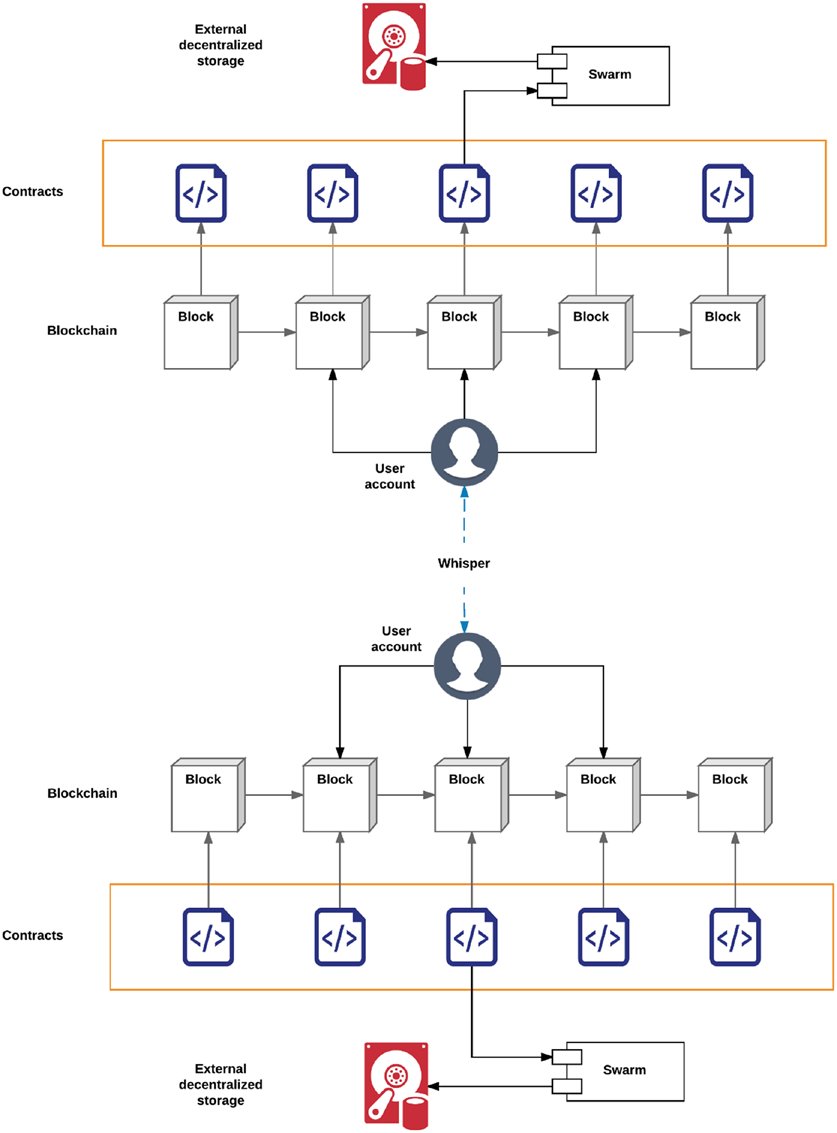
The Ethereum project has a grand vision of becoming a shared world computer with millions of accounts, powered by the blockchain, which becomes a back-end for smart-logging of communications. Contracts provide the decentralized logic to be executed and EVMs are the execution platform. Computation and processing are not enough, though; a computer must also be able to store information and allow for a mechanism for applications to communicate among each other. This world computer, depicted in Figure 4-5, would operate in an Internet 3.0 era, where servers are no longer needed due to the decentralized nature of information flow. In this ambitious endeavour, Ethereum is only one third of the project, so let’s introduce the other two components:
• Whisper: A message-passing protocol that allows decentralized applications and accounts on the blockchain to communicate with each other. This is different from
traditional message passing protocols where applications execute on the same
machine; here, the decentralized apps can execute on any node in the blockchain.
38
Chapter 4 ■ UnpaCking ethereUm
• Swarm: A decentralized data storage and distribution resource available to the Ethereum blockchain. Swarm is a peer-to-peer data sharing network where files
are addressed by the hash value of their content. This resource is very similar to
BitTorrent, where data can be fetched from multiple nodes (called peers) that host
small pieces of a file(s), and they are put together by the receiving party. Swarm’s most powerful feature is that if even a single node hosts a piece of data, it can be accessed from anywhere within the network. Currently, Swarm is in the early stages
of development and doesn’t specify one service (Storj, IPFS) that will provide
decentralized storage; however, Swarm does have the tools to handle storage and
hashed references to the data stored off-blockchain. Using Swarm makes it possible
to distribute data across the network to replicate redundancy in a decentralized
fashion without having to host any kind of server. Multiple nodes in the network
can be incentivized to replicate and store the data, much like a RAID configuration, eliminating the need for hosting servers in the network.
• Contracts: These are the final component of the world computer that we mentioend previously. They allow programmatic access to the blockchain and provide the
logical framework to power applications that will eventually run on the world
computer.
39
Chapter 4 ■ UnpaCking ethereUm
Figure 4-5. A layered approach to the world computer model in Ethereum
40
Chapter 4 ■ UnpaCking ethereUm
User accounts (or simply users) on the world computer are fundamental entities in the world computer, so users are the first layer. The second layer is the blockchain, which serves as a communication serial bus between the different components in the network. The third layer is the logical framework called smart contracts that reside on the blockchain, and provide the computational capabilities to the world computer.
Some of these contracts might require external storage for output and use Swarm to coordinate storage, which is the fourth layer. Finally, looking back at the first layer, we have the message passing protocol called Whisper to facilitate user-to-user or application-to-application communication.
More than a philosophical vision or a technological blueprint, the concept of a world computer and Internet 3.0 have some far-reaching implications for how content is controlled and distributed across the Web. Taylor Gerring from Ethereum spoke very eloquently about building this dream:
As economics of the Ethereum ecosystem mature such that open contracts for lowestrate storage develop, a free market of content hosting could evolve. Given the nature and dynamics of P2P applications, popular content will readily scale as the swarm shares, rather than suffering from the buckling load of siloed servers. The net result is that popular content is delivered faster, not slower.
This metamorphosis will offer developers an opportunity to build the next-generation of decentralized, private, secure, censorship-resistant platforms that return control to creators and consumers of the next best idea. Anyone with a dream is free to build on this new class of next-generation decentralized web services without owning a credit card or signing up for any accounts.
Although we are not told to or expected to, we have an imperative to cherish and improve the very shared resources that some wish to disturb, manipulate, and control. Just as no single person fully understands the emerging internet collective intelligence, we should not expect any single entity to fully understand or maintain perfectly aligned motives. Rather, we should rely on the internet to solve the problems of the internet.
Blockchain-as-a-Service
Microsoft recently announced a partnership with the Ethereum Foundation to launch a blockchain-based service on their cloud platform Azure. This Infrastructure-as-a-Service approach to offering fast and easy implementations of blockchain will allow developers to experiment with new features and deploy DApps at reduced costs. Marley Grey from the Azure Blockchain Engineering team described how Blockchain-as-a-Serivce (BaaS) will foster an ecosystem of DApps:
Microsoft and ConsenSys are partnering to offer Ethereum Blockchain as a Service (E-BaaS) on Microsoft Azure so Enterprise clients and developers can have a single-click cloud-based blockchain developer environment. The initial offering contains two tools that allow for rapid development of SmartContract based applications: Ether.Camp, an integrated developer environment, and BlockApps, a private, semiprivate Ethereum blockchain environment, can deploy into the public Ethereum environment.
“Ethereum Blockchain as a Service” provided by Microsoft Azure and ConsenSys allows for financial services customers and partners to play, learn, and fail fast at a low cost in a ready-made dev/test/production environment. It will allow them to create private, public and consortium based Blockchain environments using industry leading frameworks
very quickly, distributing their Blockchain products with Azure’s World Wide distributed 41
Chapter 4 ■ UnpaCking ethereUm
(private) platform. That makes Azure a great Dev/Test/Production Environment for Blockchain applications. Surrounding capabilities like Cortana Analytics (machine learning), Power BI, Azure Active Directory, O365 and CRMOL can be integrated into apps launching a new generation of decentralized cross-platform applications.
This initial update on BaaS was provided at the end of 2015 and currently a whole ecosystem of Blockchain Labs is flourishing within the Azure DevTest community. The DevTest Labs allow users and developers to explore and test a template designed for a specific use case. In addition, the platform began with Ethereum blockchains but recently more startups have started to build on Azure, offering new services such as Emercoin, which offered an SSH service, and PokiDot, with its healthcare-oriented blockchain called Dokchain. Over time, more startups have begun using Azure as the standard to run a blockchain and build applications on top.
With the integration of intelligent services such as Cortana, it might become easier to develop oracles that can sign incoming data from external streams (e.g., IoT devices) and provide a level of integrity.
■ Note two recent developments from microsoft in the BaaS space are noteworthy here. the first is introduction of Cryptlets, a secure middleware to interface with external events for building enterprise smart contracts. the second development is the Coco framework. an open-source system for building a high throughput network on top of a blockchain, where nodes and actors are explicitly declared and controlled. By design, Coco is compatible with any ledger protocol, and would allow enterprises to build production-ready blockchain networks.
Decentralized Applications
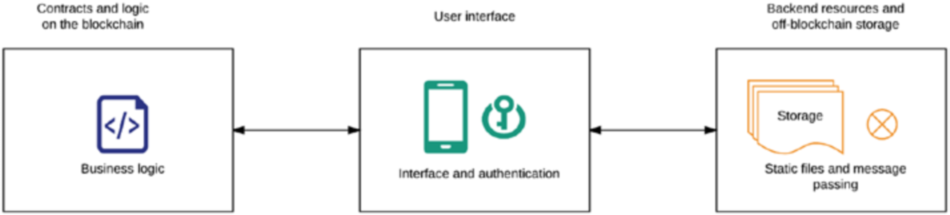
We alluded to DApps in our discussion of Whisper, but we will talk about them in more depth here. A DApp is a serverless application that runs on the Ethereum stack and interfaces with the end user via an HTML/JavaScript front end that can make calls to the back-end stack. Clasically, a mobile or web app has a back end running on centralized dedicated servers; however, a DApp has its back-end code running on a decentralized peer-to-peer network. The structure of a DApp is shown in Figure 4-6.
Figure 4-6. Structure of a DApp
The user interace is often written in HTML or JavaScript and it is the only component loaded on a user device. The interface makes back-end calls to the blockchain to execute a particular contract and also to the back-end resources such as Swarm or Whisper if external storage is needed or when the application needs to communicate with other apps.
42
Chapter 4 ■ UnpaCking ethereUm
If a traditional app is made up of a front end and a server running the back end, then a DApp running on the Ethereum stack would be made up from a front end and contracts running on the blockchain. DApps usually have their own set of associated contracts on the blockchain that are used to encode business logic and allow persistent storage of their consensus-critical state. Recall that all code on the Ethereum stack runs within an EVM that keeps track of step-by-step operations and charges gas to the owner of a contract. This prevents DApp developers from running too many operations on the blockchain or bloating it by storing data directly on the blockchain.
■ Note to briefly review, the ethereum stack is made of three components: the blockchain, Whisper, and Swarm. the front-end interface makes calls to the blockchain to specific contracts running the Dapp based on user actions.
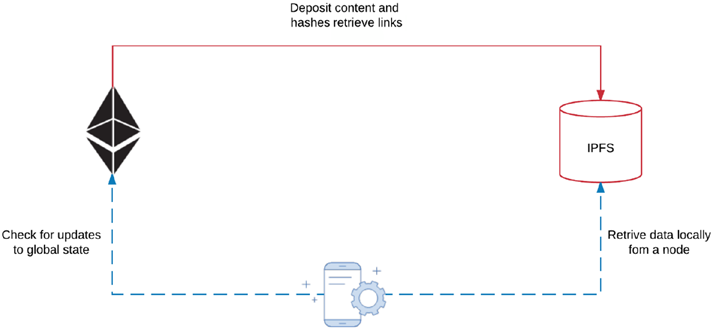
How does the back end of a DApp pull static content for the front end such as JavaScript from the Ethereum stack to static content and receive the updated global state from the blockchain? Let’s look at an example using IPFS as storage to understand these back-end calls, as depicted in Figure 4-7.
• The back-end code is essentially a contract that executes on the blockchain given the appropriate amount of resources.
• Some applications need to use a persistent database to host static content used in the app. We can rely on IPFS that stores static files, hosted throughout the network on several nodes.
• Hashes from IPFS are delivered to the DApp and the contract’s execution updates the global state, which is deliverd to the DApp from the Ethereum stack.
Figure 4-7. A simple schematic of back-end calls made by a DApp
The blockchain can deposit content to an IPFS-like system on one of the nodes and the hashes can be made available to the app for retrieval when necessary. The app can request updates from the blockchain on the global state as it affects the app running on a device. Finally, as needed, the app can retrieve and download full content from the decentralized storage to the user device. Splitting up roles in this manner allows for more innovative user interfaces, as a developer can switch it out, not having to change the back end at all.
43
Chapter 4 ■ UnpaCking ethereUm
Geth and Mist
There are two more tools we need to discuss briefly that play a role in DApp develpoment. Geth is the command-line interface (written in Go-lang) for running a full node on the Ethereum network. Using Geth, you can interact with the Ethereum network and perform tasks such as:
• Mine Ether on the network
• Transfer funds between addresses
• Create contracts and send transactions
• Use the DApps API
Geth comes with two interfaces that are used in development: The JavaScript console with web3.js library, and the JSON-RPC server. Let’s talk about both technologies briefly. Geth can be launched with an interactive console that provides the JavaScript runtime environment for you to interact with a node.
This runtime environment includes the web3 library, which can construct contracts and transactions to be propagated to the node. The JSON-RPC server is a remote procedure call (RPC) protocol that facilitates data exchange between the node and its clients (JSON is a data-exchange format that nodes use to communicate with clients). More precisely, RPC is a collection of methods and rules that define how data (commands and output) can be transferred between a node and a client. The JavaScript API uses the web3.js library to offer a convenient interface for using the RPC methods.
■ Tip For most ethereum applications today, geth is a prerequisite for installation as a command-line tool.
Often, during the installation, geth is provided as an add-on so that a user doesn't have to download and install it separately.
The second tool is called the Mist DApp browser. In early discussions, Mist was conceptualized to be a standalone app-store-type browser for DApps, but that vision has evolved. Mist is still in heavy development; however, the release plan is to bundle Mist together with the Ethereum wallet to make a powerful tool. In future releases, the wallet will just be a single DApp running on the Mist browser. Soon the browser will be able to open any DApp available and the wallet will just be one app among them.
Eventually, the most powerful entitites on the Ethereum network using Geth and Mist will be decentralized autonomous organizations (DAOs), which are essentially automated companies powered by smart contracts that run on the Ethereum network. We end our journey exploring Ethereum here and pick up our discussion of DAOs in the next chapter.
Summary
In this chapter, we introduced Ethereum, one of the biggest alternate currencies competing against Bitcoin. In recent years, it has gained a very serious focus from developers and investors. We began our discussion here with a broad overview of what Ethereum is in comparison to Bitcoin. We talked about accounts and function calls as being foundational to Ethereum. We then provided some more depth to the ideas of accounts as entities on the blockchain. After that, we discuss the use of gas on Ethereum for smart contract execution, how internal storage is adapted to work with Merkel-Patricia trees, and the concept of internal state for an account. After that, we talked about EVM and how smart contracts are executed on the 44
Chapter 4 ■ UnpaCking ethereUm
blockchain. Then, we discussed a model for writing smart contracts using Solidity and applying a plug-in for Visual Studio to rapidly prototype smart contracts. Finally, we talked about the world computer model as it applies to Ethereum components such as IPFS and Whisper. We ended the discussion with a short description of all the components in the world computer.
References
The main reference material used to prepare this chapter was Ethereum Homestead developer documentation and Solidity documentation. A detailed list of references is given at the end of the book.
45