Bitcoin can be thought of as the first prototypical decentralized autonomous organization (DAO). It created a network-based ecosystem of participants who contributed computational power toward a singular goal. In Bitcoin, the distributed protocol providing a financial service and rewarding miners became a rudimentary decentralized organization. In this chapter, we talk about more complex and full DAOs made in Aragon.
Aragon (https://aragon.one/) is a decentralized application (DApp) that lets anyone create and manage different kinds of organizations (nongovernmental organizations [NGOs], nonprofits, foundations) on the Ethereum blockchain. Creating a DAO requires numerous steps and originally it was more difficult to implement in Ethereum. However, Aragon implements all the basic features of an organization in a base template that is deployed whenever a user instantiates a company. Most of the traditional features such as a cap table, voting, fundraising, and accounting are offered in Aragon as a decentralized counterpart to run on the blockchain. In addition, an Aragon company can be customized to a very granular extent and extended using new modules that can be added to a company’s existing smart contracts. Aragon enables different organizations to be built on the blockchain, and one interesting use case integrates identity using a two-way verification scheme with Keybase. We talk about how the Keybase to Aragon peg functions to provide identity services in the context of a decentralized system. We also briefly go over the Aragon kernel, which is essentially a task manager with subroutines that ensure smooth communication within an organization, among its members, and in the underlying blockchain.
We begin our discussion with the Aragon kernel and it’s main functions. Then, we take two approaches in defining a DAO: A definition in terms of consensus between members, and a definition focusing on features given by Ralph Merkel. Aragon-core has adopted the latter definition, and extended it to “organs”, so we go through all the organs available to Aragon-core. The heart of this chapter is a set of visual tutorials split into three topics. The first topic introduces users to the basics of an Aragon company and how to set up a MetaMask wallet. This topic ends with users having set up a default company and a functional wallet.
The second topic dives into understanding the daily operations of your newly created company. This covers stocks and stock classes available in Aragon, user permissions, and tokens. A variety of operations are demonstrated here, such as adding new stock classes, issuing shares, assigning stocks to a new hire, assigning a role to a new employee, and transferring existing tokens within the company. The third topic focuses on more advanced topics in Aragon. Here, we discuss fundraising on the Ethereum blockchain using Aragon and the different types of rounds implemented in Aragon. Finally, we conclude the tutorial and this chapter with a discussion of bylaws and how to edit the default company template deployed by Aragon.
© Vikram Dhillon, David Metcalf, and Max Hooper 2017
47
V. Dhillon et al., Blockchain Enabled Applications, https://doi.org/10.1007/978-1-4842-3081-7_5
Chapter 5 ■ DeCentralizeD OrganizatiOns
Aragon Kernel
The kernel in Aragon serves as a switchboard directing requests and message passing to the various subroutines (also called organs). In production mode, the kernel will be concurrently interfacing with hundreds of Aragon organizations or users on the blockchain. Here, our focus is limited to the kernel interacting with just one company: a DAO. What is a DAO? A DAO is a blockhcain entity built on a consensus of decisions by its members. A DAO brings the concept of consensus inherent to the blockchain to include decisions and choices made by members of a DAO that have a stake in it (usually in the form of DAO tokens).
As such, a DAO is built with automation at its core and members at the periphery that rely on a majority-based consensus to make decisions for the organization. Although this definition of a DAO is a general descriptor, it is incomplete. Perhaps a better approach to defining a DAO would be through the functions it performs. The concept for a DAO was originally derived from Bitcoin, which might be viewed as the first prototype for a DAO.
■ Note the simplest functional unit on an aragon network is a DaO and therefore the majority of our discussion is focused around a minimal use case. aragon provides a base template that can be used to set up a DaO and you can modify this template to set up a custom set of rules. Other types of organizations (e.g., ngOs or nonprofits) are built on the base template with significant modifications that allow a new modus operandi.
additionally, throughout the remainder of this chapter, the terms DaO, company, and organization are used interchangeably to represent the same concept.
Ralph Merkle talks about a DAO as an entity that owns internal property that has value, can update its internal state, is responsive to the members, and runs smart contracts. These are some of the most basic functions that any DAO should be able to perform, but currently there are no compliance standards (like the ERC20 for tokens) for DAOs. The kernel uses a set of organs to carry out most of its daily activities. Let’s go through the organs provided by default in Aragon:
•
Meta organ: A self-aware (in terms of internal state) and self-actionable organ that is responsible for updating the DAO internally in response to actions by the members or externally. This organ also maintains a global registry of organs operating within the kernel.
• Dispatch organ: A validator organ that determines whether a requested action or a transaction can be carried out on behalf of the requestor. This can be done through
an oracle, or programmed logic that filters requests based on specific criteria. The outcome of the dispatch organ is a simple pass or fail. If an action fails, it will not be carried out. However, if an action or transaction passes, it will be dispatched
to a more appropriate organ for processing or execution. The dispatch organ also
maintains a list of priorities for each request to be triaged and directed appropriately.
• Vault organ: The vault organ serves as a collective wallet for the DAO. It stores the funds owned by the DAO as tokens and approves any spending requests.
• Token organ: The token organ specifically deals with governance tokens allocated to the members of DAO. This organ also contains the operational logic for adding new
types of tokens or replacing and removing older tokens.
• Applications organ: This is the smart contract collective that operates at the core of a DAO. The applications running in this organ are sandboxed from the remainder
of the organization, but most of the business logic resides in this organ. Aragon
provides a basic set of Ethereum contracts responsible for default actions, but this organ is extensible. New applications or modules can be added to the organization to increase functionality to satisfy specific use cases.
48
Chapter 5 ■ DeCentralizeD OrganizatiOns
Identity Management
The concept of identity is a conundrum for cryptotechnologies because it requires a certain level of trust to be inherent in the network architecture. Most generalized approaches toward integrating identity in a consensus-based system involve some variation of cryptographic proofs and signatures. In Aragon, an external service called Keybase along with a registry contract are used to establish a “trustless” two-way verification scheme.
The logic behind this scheme is very straightforward: Establish that a particular address belongs to you, and then verify that your username owns the address. How do these two statements reconcile in a functional setting? Let’s introduce the two components that make a two-way bridge possible. In simple terms, Keybase is a public–private key pair management service with OAuth integrations that allow a user to authenticate and verify accounts. Keybase can serve as a centralized hub for a user to link and verify external accounts. For instance, after creating an account on Keybase, the public profile of a user can display all the linked social media accounts establishing their legitimacy and connection. The second component is a registry contract that provides an account-to-address association mechanism from within the Aragon network. The two-way bridge forms from using the address (linked to an account on the network) to cryptographically sign a file that can then be hosted on Keybase (linked to user identity through various social media integrations).
■ Note it is crucial to keep in mind that in aragon, identity is an opt-in feature. the use cases developed for aragon range from providing complete anonymity, as in the case of a DaO, to full usernames integrating Keybase for a next-generation blockchain company.
So how would users make their identity available to the two-way verification scheme? The workflow in Keybase Registry 2.0 has been simplified to one simple step: Upload the signed proof to the Keybase Filesytem (KBFS). This introduces a few new components.
• Keybase Filesystem: KBFS is a cryptographically secure local and cloud storage directory. KBFS only allows the owner of the directory to add new files, and these
files are made available publicly. In KBFS, every file added to the directory is
automatically signed by the owner’s private key and the signature can be verified by anyone through Keybase.
• Signed proof: Aragon uses a standard proof of identity signed by the user uploaded to the KBFS public directory. There are four components of this proof: the username on
Keybase, the Ethereum account address owned by the user, a string or comment by
the user, and finally the public key of the signature. Anyone who wishes to verify an identity can obtain this proof file and use a function such as getUsername(args) to
perform a username reverse lookup given the account address in the proof.
• Oraclize: The reverse lookup is an on-chain verification process performed through the registry contract within the Aragon network. For Keybase lookup, a data carrier
service called oraclize is used. Oraclize requests the signature for a given Keybase username and creates a mapping of the username to an Ethereum account address.
The signature on this proof file should validate with the user’s public key on the
network. Oraclize performs an on-chain check to verify the proof signature and
ensure that the mapping is legitimate. The party initiating this verification on behalf of another user also has to pay for the steps, including oraclize reference calls.
• Keybase Resolver: The Ethereum Name Service (ENS) allows us to resolve human-readable links into Ethereum addresses. Recently, Aragon has begun testing a
Keybase resolver that will map callbacks to usernames into addresses such that
john.keybase.eth -> 0x99...cx88. This simplifies the reverse lookups and
username references throughout the network.
49
Chapter 5 ■ DeCentralizeD OrganizatiOns
DAO/Company Walkthrough
In this section, we go through the process of creating a DAO and becoming familiar with the major DAO
operations in Aragon. For the sake of simplicity, we will only have two entities participating in this DAO, an executive and an employee. This walkthrough is split into three topics:
• Setting up a DAO: We introduce the participants of this DAO, show how to create a wallet, and get familiar with the interface.
• Creating stocks and assigning shares: After our DAO has been set up, we create new stock classes, issue new stock, and assign shares to the other entity.
• Fundraising and editing bylaws: After shares have been assigned, we look at how fundraising works in Aragon. A DAO can raise funds from a specific investor in
return for stocks, or publicly offer stock to raise a round of funding. We review the fundraising process, and more important, the bylaws that govern the DAO.
Setting Up a DAO
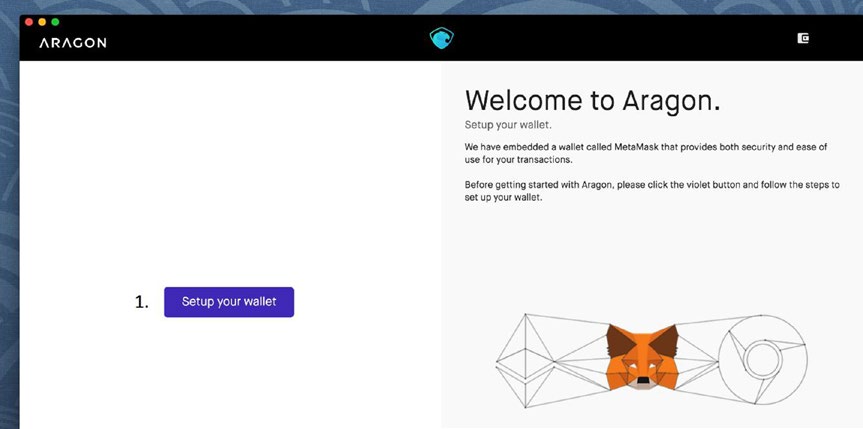
Download the Aragon client from https://aragon.one/. This client has two main components: Aragon Core and MetaMask. In each client, Aragon Core functions as an administrative dashboard for the DAO. The main purpose of this component is directing access control of all entities participating in a DAO. Depending on your role and if you hold any stock, you might have access to the advanced features. We see later how this access to features can change by editing the bylaws. The second component is MetaMask, a digital wallet designed as a plug-in for Google Chrome to make Ethereum accessible to pragmatic daily users. MetaMask was chosen for Aragon to drive adoption by bringing an already familiar interface to the user. The opening screen, shown in Figure 5-1, provides a brief introduction to Aragon, along with the wallet setup.
Figure 5-1. The Aragon setup screen. A brief introduction to Aragon is provided here, along with a button to create a MetaMask wallet. On the top right of the screen there is an icon to access the wallet.
50
Chapter 5 ■ DeCentralizeD OrganizatiOns
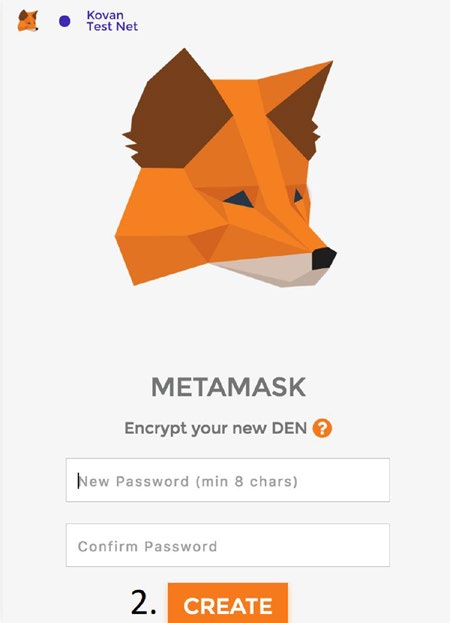
MetaMask first asks you to create a password for your wallet, as shown in Figure 5-2. This will be your access key. After entering the password, you will be provided with a passphrase to recover your wallet in case you lose your password.
Figure 5-2. Creating a password for your MetaMask wallet. Every major step in Aragon is followed by a series of confirmations that broadcast new changes to the network in the form of transactions.
■ Note aragon is still connected to a testnet to illustrate the concept. as a result, for some steps, you might need to verify and confirm transactions multiple times to ensure the initial company creation steps. some of the bugs are known and under active development in the beta code.
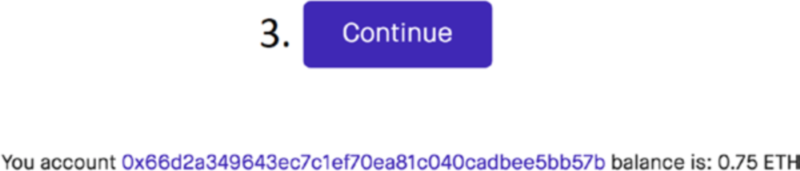
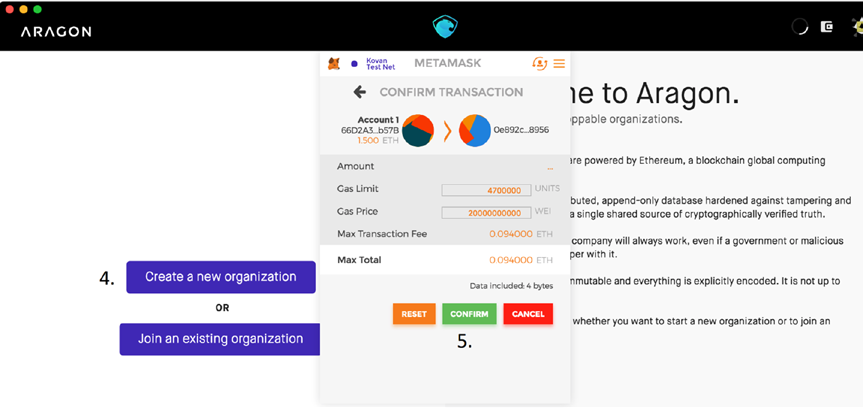
After creating a wallet password and confirming the transactions, you should see a confirmation screen and the state of your current wallet (see Figure 5-3). Here is a quick note about Aragon’s alpha releases: Currently the Aragon client does not operate on the Aragon network. It is connected to an Ethereum testnet (Kovan Test Net in this case, as shown in Figure 5-3), which serves as a testing ground for Aragon. On a testnet, currency holds no value, so users can test the product and report any serious bugs, assisting in product development. A user can request test ETH to be sent to their wallet and experiment with Aragon without any consequences. That’s why when the wallet is created, it already comes loaded with a balance.
51
Chapter 5 ■ DeCentralizeD OrganizatiOns
Figure 5-3. Wallet created using MetaMask. Notice the wallet address shown below along with the balance it has on the testnet.
The screen after wallet creation brings you to Aragon Core, and there are two options available: Create a New Organization and Join an Existing Organization, shown in Figure 5-4. From here on, the walkthrough focuses on the first option, and Aragon is presented from the point of view of an executive. However, we briefly touch on how users can join a DAO and the level of access available to a regular employee.
Figure 5-4. Aragon Core Welcome screen
The two options provided to a user are not limited to just DAOs; rather, any type of organization can be built on Aragon, including NGOs and nonprofits. Traditional companies would take a new decentralized outlook on the Aragon blockchain, but ultimately it is up to the companies to decide which components can be decentralized. We will select Create a New Organization here. Creating a new company costs Ether, paid with the wallet we created in the previous step. Then, the transactions are broadcast to the blockchain by confirming them. Aragon uses a general template to deploy a company on the blockchain, but the founders can edit this template by changing bylaws. A circular progress indicator in the top right corner shows the transactions being verified for company deployment.
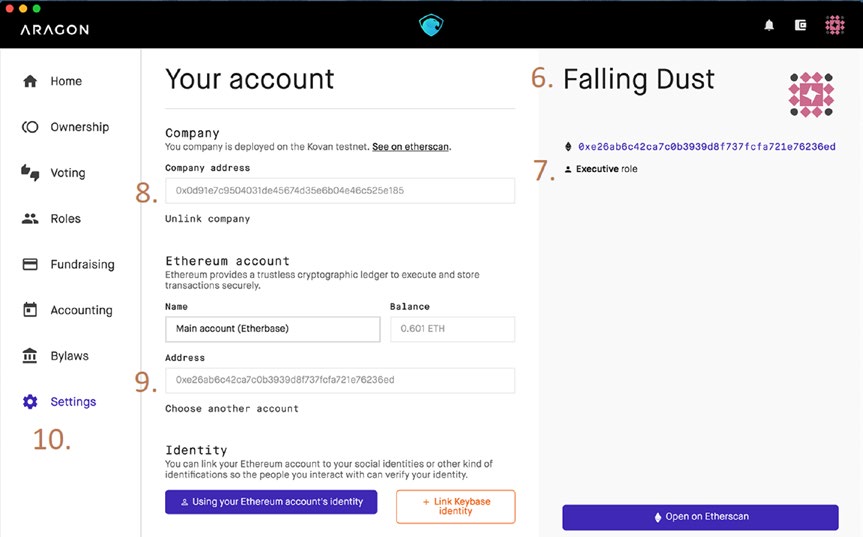
After the company has been deployed, the next screen is the Aragon Core dashboard. This is where a user (executive or employee) handles the daily operations of a DAO, with functionss to participate in voting, assign shares, and more. The dashboard displays the welcome screen by default to the user. To navigate this dashboard, let’s begin by looking at your profile under Settings (Figure 5-5).
52
Chapter 5 ■ DeCentralizeD OrganizatiOns
Figure 5-5. Settings in Aragon Core dashboard
Each account is assigned an address and a username on the network. This address is also associated with the funds available to the account through the wallet. Under the address is the role of this user. Next, the Settings screen shows some information about the company we created in earlier steps. The address for the company is given shown, and a founder would share this address with an employee so that he or she can join the organization. Recall the two choices from Figure 5-4. To join an organization, a user would enter the address given in the Company Address field. Below that, under Ethereum Account, is information on the user connected to this Aragon client. This address matches the one shown at the top right of that page, but here, we also see the remaining balance in that account. You can also rename this account or log out of this company. The more interesting tidbit is shown below the Ethereum Account information, an option to link your account and verify your identity. As we mentioned earlier, not all companies built on Aragon will take the form of a DAO and some might require verification of the participants. Aragon provides access to an Ethereum-Keybase resolver for identity management in specific use cases. Finally, the rest of the features in Aragon Core are accessible through the side menu.
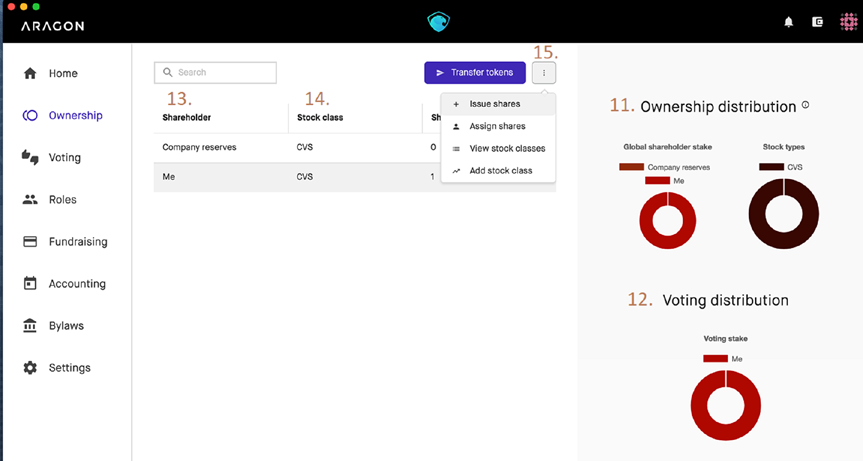
The Settings in Aragon only provide an overview of the user connected to the client, but what’s the default state of the company we just created? To get an overview of our DAO, we need to navigate to the Ownership tab shown in Figure 5-6.
53
Chapter 5 ■ DeCentralizeD OrganizatiOns
Figure 5-6. Overview of our DAO
Essentially, each participant of the DAO will have a stake in decision making, and this page provides the amount of stock each party owns. By default, the creator of a DAO initially owns all the stock. We can see the ownership distribution on the right side of the page, where Me is the current user, and on the pie chart, Me owns 100 percent of the stock. Currently, there is only one type of stock in the template, Class of Voting Stock (CVS), which allows the holder to participate in voting. Generally speaking, the more stock you own, the more influence you can exert on the voting process, but these effects diminish in a DAO with a large number of users. More precisely, the Voting Distribution section shows how the voting power is distributed among the entities in our DAO. We only have one user for now, but this chart will update as new users are added. Next, in this DAO the Shareholder list enumerates the shareholders and currently there are two, the company itself and the creator (executive, “Me”). The only stock class available is the voting stock, to which we will add more soon. Finally, the Ownership tab also allows us to perform advanced functions (e.g., issuing stock) that can be reached through the menu icon in the top right, which is the focus of the second topic in our walkthrough.
Issuing Shares
Now that we have our generic company operational, it’s time to start editing the template and customizing the DAO. We explore here how to issue stock, add new types of shares, and assign them to an employee.
In Aragon, every action that deals with changing the company's operation relies on members reaching a consensus through majority voting. The default settings give every shareholder voting power, but this can be refined by editing the bylaws. Let’s begin by issuing shares to the DAO.
54
Chapter 5 ■ DeCentralizeD OrganizatiOns
■ Note One interesting use case for a company (or a DaO) in aragon is to be used as a decentralized decision-making body for an open source project or an associated technology. the stocks become a mechanism for decision making for future directions of the project with greater community involvement through voting.
the use of tokens and the ability to raise funds also provides a mechanism for providing monetary support to sustain development. We revisit this scenario later in this chapter.
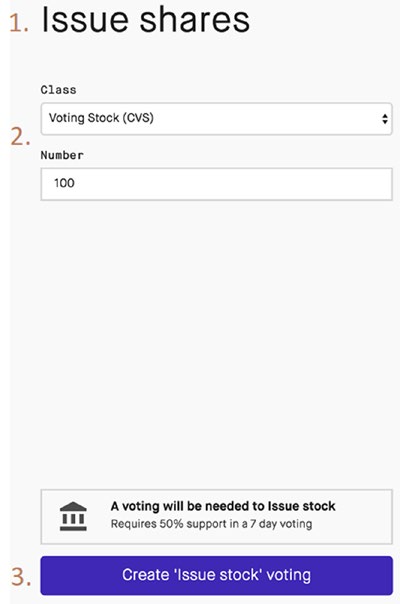
Referring to Figure 5-6, use the menu available in the top right to select Issue Shares to open a screen on the side. Issuing new shares will require us to pick a class of shares to offer and the number of shares to issue.
The process is shown in Figure 5-7.
Figure 5-7. Issuing more shares
First, we have to decide the class of shares to issue. Currently, there is only one class of shares available, so we will use the default. Next, we choose to issue 100 new shares of the CVS type. To finalize this action, we first have to go through a voting process. Recall that all major changes to the company need to be reviewed by other shareholders and approved before an action can be carried out. Here, additional shares will only be issued if the notion receives at least 50 percent approval from shareholders. Only after that, the company gains more shares that can be reassigned to other users.
55
Chapter 5 ■ DeCentralizeD OrganizatiOns
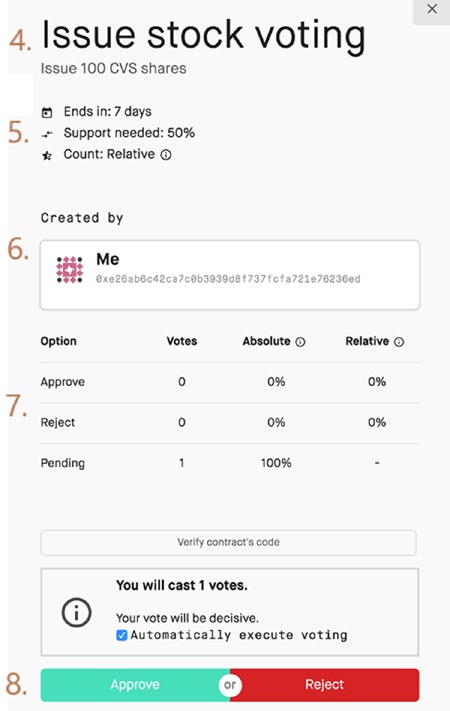
Currently there is only one voting user in the DAO, so this will be the deciding vote. The voting interface looks like the general schematic for the voting process shown in Figure 5-8.
Figure 5-8. The voting interface
It follows a very straightforward outline, beginning with the name of the notion bring brought to voters’
attention. This is followed by the action being taken in response and a tentative schedule of the voting. The default setting for Aragon is to pass a notion with more than 50 percent approval. The interface next displays who put forth this notion for voting; here Me refers to the user connected to this Aragon client, along with the user’s address. The details of voting are shown next. Here only one vote is needed to approve the notion.
Finally, the user is presented with two choices: Approve and Reject. After the vote has been cast, it will be gathered in a transaction. When the poll closes, all the votes will automatically be counted and the outcome displayed.
56
Chapter 5 ■ DeCentralizeD OrganizatiOns
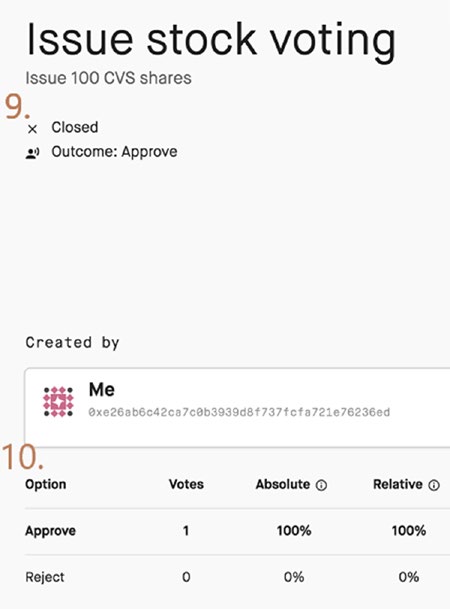
So what does the voting outcome look like? Here, we assume the choice was to approve the notion for our DAO. Figure 5-9 shows the outcome of the vote.
Figure 5-9. Outcome of voting. The proposition has been accepted and voting is closed. The overall statistics on voting are reported so any user can see how the vote was split
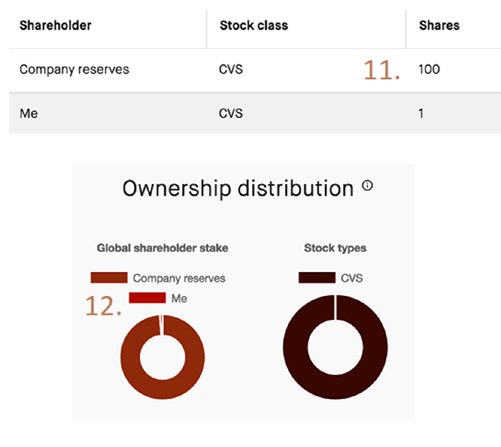
Issuing more shares just changed the ownership distribution in our DAO. By default, newly issued shares belong to the company and then executives can vote to transfer those shares to other users as they see fit. Figure 5-10 shows the new distribution after shares have been issued. Compare this to Figure 5-6 when
the company was just instantiated. Recall that until now, we have only had one stock class, so the global distribution of shares changes but there are no changes in the stock types. Let’s add new classes of stocks and explore the options associated with them.
57
Chapter 5 ■ DeCentralizeD OrganizatiOns
Figure 5-10. A composite of the changes in ownership distribution with new shares issued Notice that the new shares are issued directly to the company, not any particular user. Notice also the changes in the global distribution pie chart. Previously, the Me stake was the only visible portion of the chart. Now, with the new updates, the company holds a majority of the shares.
Before we add new stock types to our DAO, let’s briefly talk about the different types of stock typically issued by a public company. There are three major types that we consider here:
• Common stock (Class A): This is what people normally refer to when they mention stocks. Common stock is issued by a company and usually available through stock
exchanges such as the New York Stock Exchange (NYSE) or Nasdaq. The main
advantages of common stock are payment in dividends and trade in an exchange. A
dividend is typically a sum of money paid to the shareholders of a company at the
end of a quarter out of the profits generated in that quarter. Common stock can be
also be traded or sold at any time on an accredited exchange.
• Preferred stock (Class B): Preferred stock is a special kind of stock issued to investors who have a significant stake in the company. This stock has a few financial
advantages over common stock, making it a safer investment. In terms of dividends,
preferred stock is cashed before common stock and as a result receives a larger share of a company’s profits as compared to common stock. Moreover, common stock can
vary in terms of dividends paid out, whereas preferred stock provides fixed returns to the shareholders.
• Founder stock (Class F): Class F shares are an exclusive kind of preferred stock issued to founders of a company. These shares come with greater voting rights; for instance, one share of founder stock might counts for ten votes. In comparison, one share of
common stock would only account for one vote. Founder stock grants super voting
rights and is normally used to retain control of a company’s decision-making process when a large number of entities are involved.
58
Chapter 5 ■ DeCentralizeD OrganizatiOns
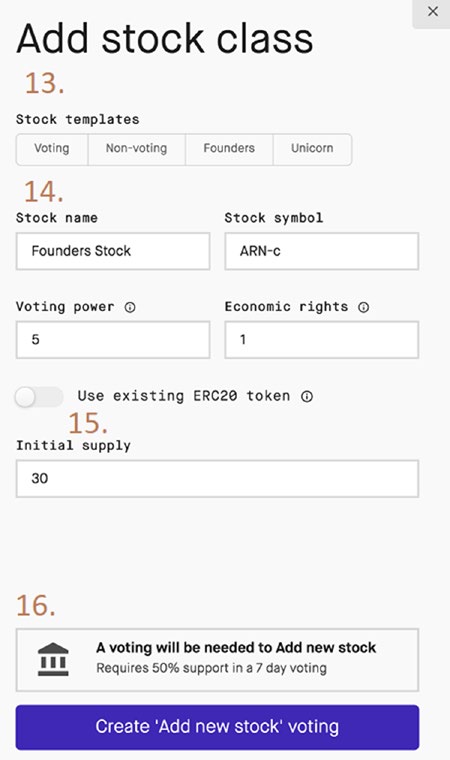
Let’s look at the stock classes offered in Aragon. This can be done through the Ownership tab we saw in Figure 5-6. Click Add Stock Class to open the dialog box shown in Figure 5-11.
Figure 5-11. Interface for adding new stock
There are four stock classes available in Aragon, listed under Stock Templates. Voting stock is the default, nonvoting stock may be issued to attract employees to a company where holding stock becomes an economic multiplier, founders stock offers super voting rights and often remains concentrated among the founders, and finally unicorn stock is given to special investors who have a significant stake in the company because it offers a high multiplier and voting power. Next we assign the parameters of our new stock class.
We will add a class of founder stock that will be indicated in the ownership with the symbol ARN-c. By default, founder stock has higher voting power than common stock, but that can be updated as necessary.
The Economic Rights setting is a multiplier for the stockholder; essentially, the dividends paid back to this stockholder are multiplied by their economic right. Next is the number of shares issued. In this case, we want to add a founder class, and issue 30 new founder shares to the company. As usual, adding a new stock class would require a vote to be cast (16) and then the new shares would be made available.
59
Chapter 5 ■ DeCentralizeD OrganizatiOns
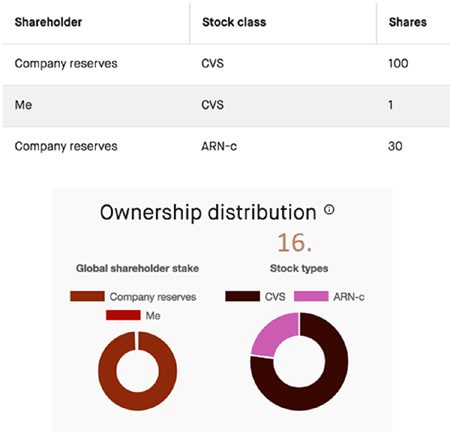
What does the new stock distribution look like? Figure 5-12 shows the addition of a new stock, and the changes are visible in the Stock Types pie chart.
Figure 5-12. Founder stock added. ARN-c is used as the symbol, and all current shares are owned by the company. To assign shares to members, a vote would have to be taken
Next, we add another user to our DAO. The second user will be added as an employee and then assigned some shares. We can also show how an existing shareholder can reward another user with exclusive shares for their excellent work or a promotion. To add a new member to your organization, you would have to provide a user with the company address shown in Figure 5-5. They need to download Aragon and join your organization in the first steps after creating a wallet. After a new member joins, he or she can see the current state of the company through the Ownership settings. Figure 5-13 shows the process of assigning a role to a new user after that user has joined your organization.
■ Note the terms organization, company, and DaO are being used interchangeably throughout this walkthrough.
60
Chapter 5 ■ DeCentralizeD OrganizatiOns
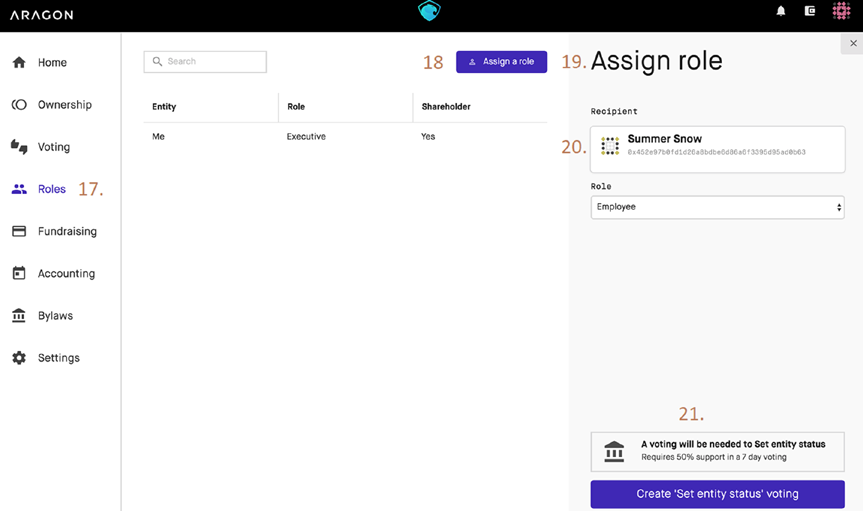
Figure 5-13. Assigning role to a new employee in the organization
The Roles tab shown in Figure 5-13 provides an overview of all the entities in the company. Currently, only one user is present: Me is the user connected to this Aragon client. To assign a new role, click Assign a Role to open the Assign Role dialog box. The recipient can be added by their username or an account address in the Recipient field. Depending on your company’s policies, if you require some level of identification to be associated with your members, you can add those users by referring to their username.
If you don’t use the Keybase identity registry, you would have to add new users by referring to an address. After inputting the address, you can decide on the role for a user. Here, we are adding a new employee; however, there are other options available, such as adding a new executive, another employee, or a superuser. The superuser role is normally reserved for nonhuman entities that are a part of your organization, such as oracles or a factory entity that can deploy other components of your company.
As always, assigning a new role to a user would require a vote to be cast before the role can be confirmed.
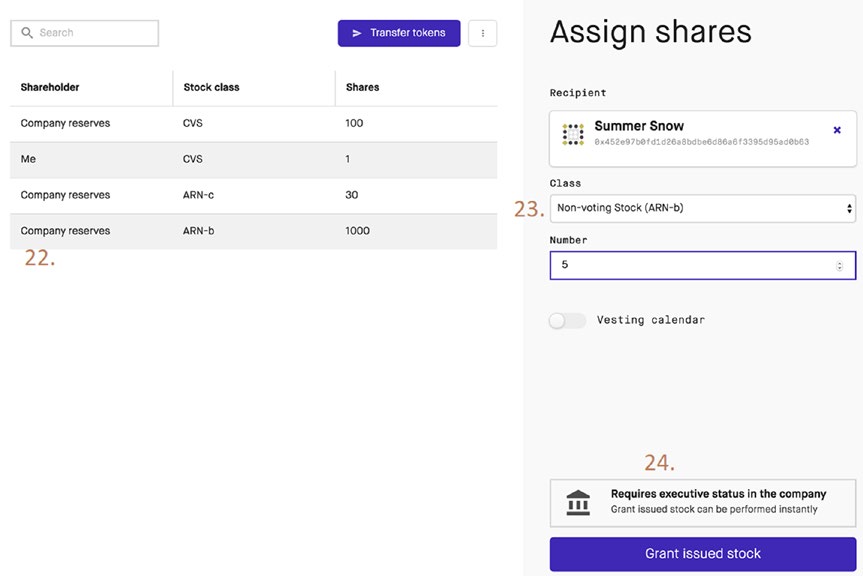
So far, we have discussed how to issue new shares, assign stock, add new stock classes, and assign roles to new members of your company. Here is an exercise for you: Building on the current state of our DAO, add a nonvoting stock class with an economic multiplier of 5, and issue 1,000 shares to the company. Then, assign five of those shares to the new employee, Summer Snow. The result should look like Figure 5-14.
61
Chapter 5 ■ DeCentralizeD OrganizatiOns
Figure 5-14. Assigning shares to a new user
The reader exercise should result in a new stock class called, ARN-b which is a nonvoting stock. There should be 1,000 shares issued and by default, all the shares belong to the company. Next, we want to assign shares, which can be done on the Ownership tab. We have to refer to Summer Snow by an address, then pick the stock class and the number of shares to be assigned. To approve this change, we normally need a vote. In this case, however, the nonvoting stock has an exception: An executive can grant nonvoting stock instantly to another employee without any need for approval. This is limited only to assigning nonvoting stock within a company, but this exception can be removed by editing the bylaws.
Here are two more tasks: Assign half of the founders stock to yourself, and transfer 1 founders share to Summer Snow. Both tasks can be performed on the Ownership tab and the final ownership distribution should look like Figure 5-15. The transfer process can also be completely instantly without any voting, but this action is irreversible.
62
Chapter 5 ■ DeCentralizeD OrganizatiOns
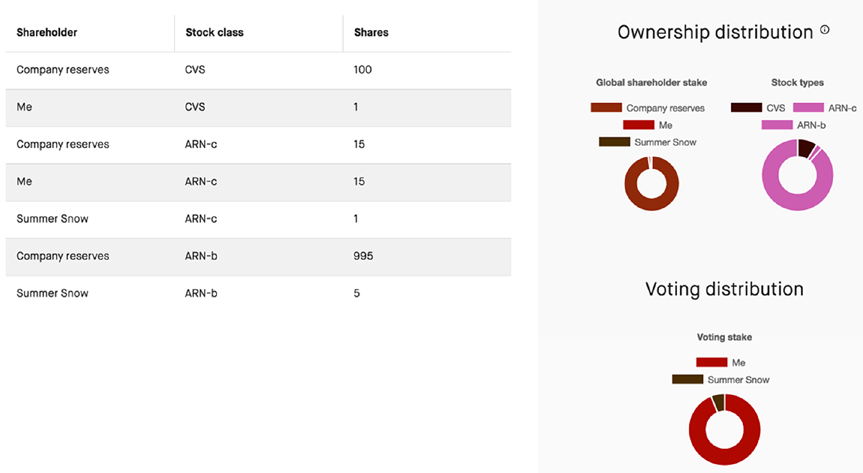
Figure 5-15. Final ownership distribution at the end of all the steps performed The Ownership tab organizes the shareholders by the stock classes they own. To review, we have three classes of stock available now: a nonvoting stock (ARN-c), a CVS, and founders stock (ARN-b). The majority of shares with voting power are still owned by the executive, but transferring stock to the employee makes them eligible to participate in voting. On the right side are the newly updated pie charts for voting and global distribution of stock within the company. These common operations allow your company to serve as a governing body and collaboratively determine the future direction of an attached project.
Fundraising and Bylaws
In the last topic of our walkthrough, we handle the more advanced features present in Aragon, namely fundraising on the blockchain and bylaws, which offer another level of fine-tuning for governance of your company. Raising a round of funding on the Aragon blockchain is very different from traditional fundraising.
The core idea is simple: Once your DAO is operational, you can issue shares and then you can offer a class of those shares to an investor in return for Ether. These shares can either be offered to an individual investor, or more broadly to the any participant in the network. A round has a specific closing window and starts when it has been approved by the company after voting. The second feature we discuss here is the bylaws, which are the computational equivalent of a configuration file that allows variables to be reassigned and updated as necessary. Bylaws provide a very granular level of access to the governing architecture of your company, and if changes are approved, the new rules are implemented immediately. All the default settings that we have referenced in previous topics arise from a template of bylaws adopted by Aragon to set up a company.
Although new bylaws cannot be added to Aragon yet, the existing rules can be changed to create different levels of user permissions for members of the company. Let’s look at fundraising in Aragon in Figure 5-16.
63
Chapter 5 ■ DeCentralizeD OrganizatiOns
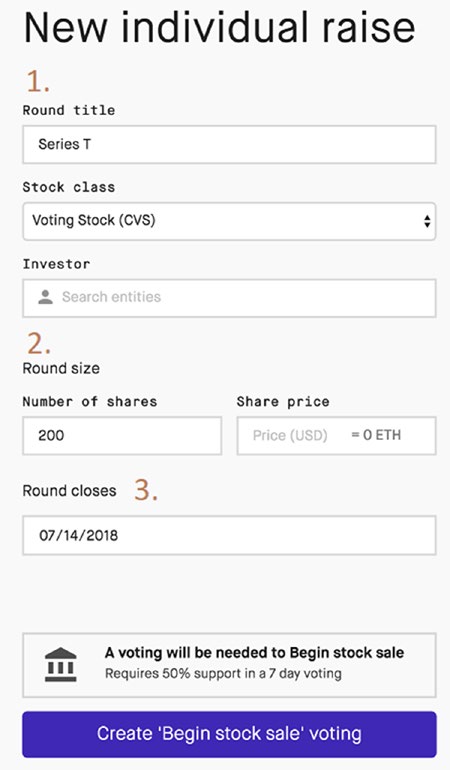
Figure 5-16. Fundraising from a specific investor in Aragon
In the Aragon Core, there’s a Fundraising tab, where you can click New Raise to open the corresponding dialog box. Currently there are two types of options for fundraising implemented in Aragon. The first one involves raising a round from a specific investor in return for a stake in your company. The second option is a crowdsale, where any participant of the network can buy stock in your company. In this case, we choose the first option and start an individual raise. The series needs a title and the class of shares being offered in return for the funds raised. Normally, an investor would want voting rights, so we picked CVS. After that, you have to enter the investor’s address manually and then specify how many shares you want to offer. Once the Aragon network has a true market, the shares can be priced in Ether and have tangible value on the blockchain. The outcome of a project associated with the Aragon-powered DAO will determine the value of the shares in market. The fundraiser has a time-window, at the end of which the round will close. This has the potential to evolve into the all-or-nothing model that Kickstarter uses. Finally, the fundraiser needs to be approved by a majority before it can become active and come online to the network.
64
Chapter 5 ■ DeCentralizeD OrganizatiOns
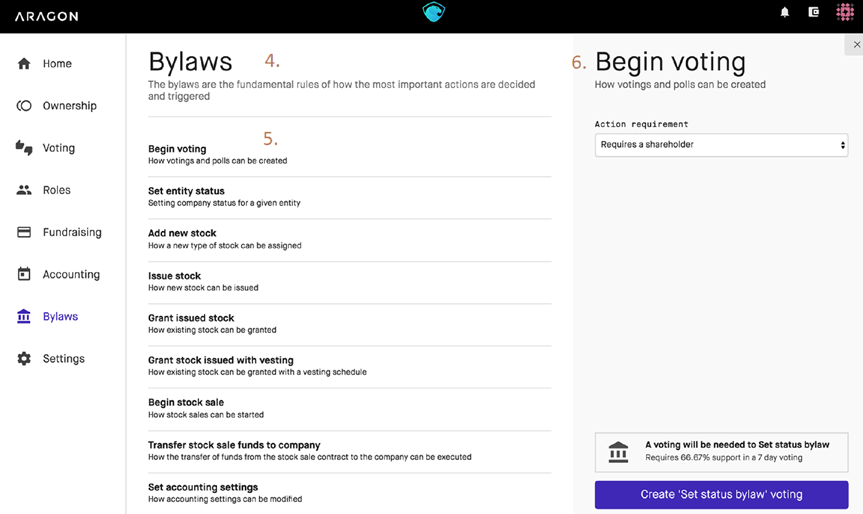
Let’s look at the bylaws next. Figure 5-17 shows a list of currently implemented bylaws that every entity participating in your company has agreed to honor. Eventually, executive-implemented rules will be allowed in Aragon to offer even more customization over governance.
Figure 5-17. Bylaws for the company
The Bylaws tab lists all the available laws implemented for the company. We take a look here at the first law, which dictates how voting can be initiated. In Aragon, every major action requires a vote from the participants, so changing who can initiate a vote also implies that more actions can be performed that require a vote. The action requirements in the Begin Voting dialog box provide a few options, such as being a shareholder, having a role assigned in the company, or limiting voting to specific addresses (users). By default, voting requires a shareholder, but that can be changed here as needed. As with every other major action, a change in bylaws requires majority approval to be implemented company-wide.
Let’s look at another example, this time granting the power to assign roles to new users and how identities can be integrated automatically using an oracle. Figure 5-18 provides a depiction of this example.
65
Chapter 5 ■ DeCentralizeD OrganizatiOns
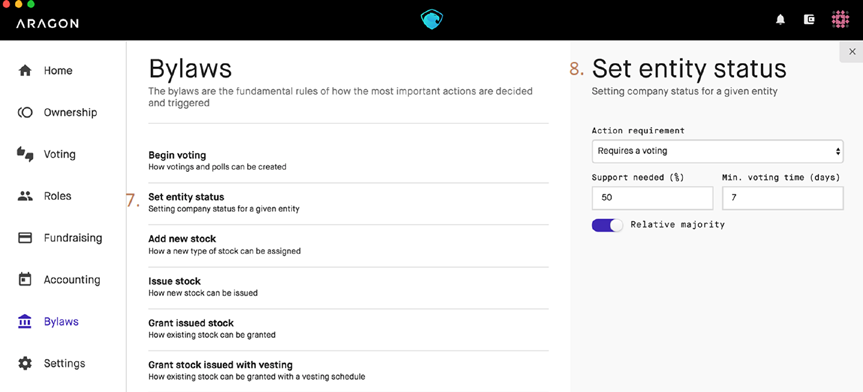
Figure 5-18. Changing the status of a member in your company
This process is similar to the previous step, but instead, we will edit the second bylaw, Set entity status, here. In the Set Entity Status dialog box, select the last option: An oracle will be called for confirmation. This changes the parameters, as now you just need to provide the address of the oracle on the network. How does identity management function using an oracle? If your company requires some level of identification, Aragon can be integrated with Keybase and an oracle can confirm the status of identification from Keybase.
In this way, new roles can be assigned without the need for a vote and only promotions or entity status updates would require network-wide voting.
Summary
In this chapter, we discussed the concept of decentralized organizations. We started with a presentation of Aragon in the context of decentralized organizations built on the blockchain. We talked about the definition of a DAO and the organs that Aragon implements. We had an in-depth discussion on the identity management features enabled by Aragon and Keybase. Finally, the heart of this chapter was the walkthrough of how to set up, manage, and operate a DAO, including all its basic functions. This chapter has provided the foundation for creating your own DAO.
References
The main reference used to compile this chapter was the Aragon whitepaper and the aragon-core GitHub docs.
66