Chapter 11 ■ reCent Developments in BloCkChain
Note the architectural design of Quorum in the top-right corner of Figure 11-24, just as we described all the major components earlier.
The most important take-home point from these slides is the detailed workflow of a private transaction as it propagates through the Quorum network. We did not have an opportunity to illustrate this workflow, so including the slide should enhance your understanding of how private transactions and encrypted payloads work in Quorum.
Ethereum Enterprise Roadmap
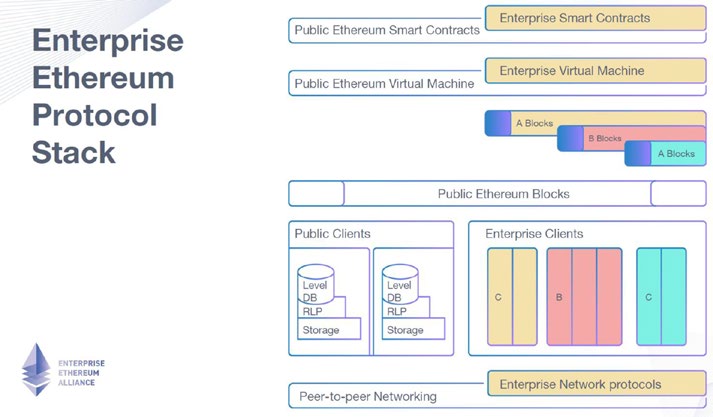
Figures 11-26 and 11-27 are taken from an update to the EEA provided by Bob Summerwill.
Figure 11-26. A new protocol stack for Ethereum modified to handle enterprise-grade transactions In this example, privacy is important, and most miners (nodes) are known and trusted. Notice the enterprise protocols sit on top of a shared public–private blockchain with necessary modifications to preserve privacy. The public clients share the same storage, and virtual machines, whereas private or enterprise clients would be given isolated storage and virtual machines that execute encrypted payloads of instructions. More broadly speaking, Ethereum Enterprise is a bigger movement than simply Quorum being developed by the EEA. Let’s take a step back and talk about why an enterprise version was needed. Jeremy Miller from ConsenSys provided three main reasons:
• Ethereum was developed initially for public chain deployment, where trustless
transaction requirements outweigh absolute performance. The current public chain
consensus algorithms (notably PoW) are overkill for networks with trusted actors
and high throughput requirements.
• Public chains by definition have limited (at least initially) privacy and permissioning requirements. Although Ethereum does enable permissioning to be implemented
within the smart contract and network layers, it is not readily compatible out of the box with traditional enterprise security and identity architectures or data privacy
requirements.
180
Chapter 11 ■ reCent Developments in BloCkChain
• Naturally, the current Ethereum improvement process (dominated by Ethereum
improvement proposals) is largely dominated by public chain matters, and it has
been previously challenging for enterprise IT requirements to be clarified and
prioritized within it.
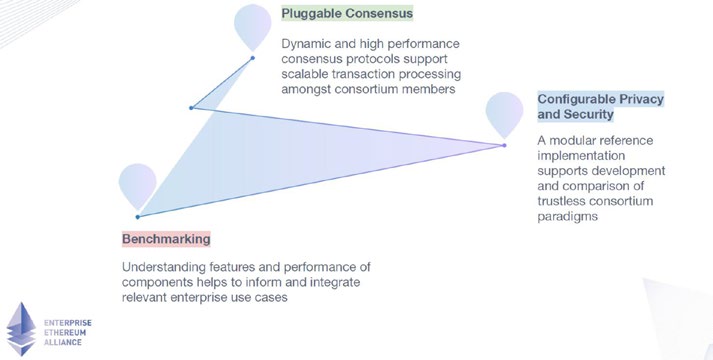
What are the main technical objectives for EEA in 2017? Figure 11-27 provides three main focal points.
Figure 11-27. Three areas of focus for Quorum in 2017
The largest focus and shift is toward providing a high level of privacy (identified by JPMorgan as a current major roadblock) that can be configured for transactions and smart contracts executed by users.
A hybrid public–private chain can become the perfect model for consortium-type settings. The next focus is on creating a pluggable consensus model where transactions and complex situations can choose the best consensus mechanism applicable to the use case. Finally, high-volume performance is crucial for Quorum to succeed, therefore developing better benchmarking tools to measure and improve will become the key to wide adoption.
Summary
The rapid growth of research and development in the blockchain world can be explained by gaining a deeper understanding of where the value is created and captured for a traditional Internet companies and a blockchain company. Joel Monegro and Naval Ravikant talked about the idea of fat protocols, where most of the innovation in the blockchain space will happen at the core technology level. Then a token layer can monetize the use of underlying architecture and provide access to the application layer.
References
The main references used to prepare this chapter were the EOS developer guide and documentation, the Chain developer guide and API docs, Quorum docs and Quorum presentation to Hyperledger, and finally the Ethereum Enterprise Alliance roadmap presented by Bob Summerwill.
181
Technological Revolutions and