2
The Father of OKRs
There are so many people working so hard and achieving so little.
—Andy Grove
This all began with an ex-girlfriend I was trying to win back. Ann had dumped me and was working in Silicon Valley, but I didn’t know where. It was the summer of 1975, between terms at Harvard Business School. I drove through Yosemite and arrived in the Valley with no job and no place to live. Though my future was unsettled, I could program computers.* While earning my master’s in electrical engineering at Rice University, I’d cofounded a company to write graphics software for Burroughs, one of the “Seven Dwarfs” battling IBM for market share. I loved every minute of it.
I’d hoped to land an internship at one of the Valley’s venture capital firms, but they all turned me down. One suggested I try a chip company they’d funded in Santa Clara, a place called Intel. I cold-called the highest-ranking Intel person I could get on the phone, Bill Davidow, who headed the microcomputer division. When Bill heard I could write benchmarks, he invited me to come down and meet him.
The Santa Clara headquarters was an open expanse of low-walled cubicles, not yet a design cliché. After a brief chat, Bill referred me to his marketing manager, Jim Lally, who referred me on down the line. By five o’clock I’d scored a summer internship at the rising paragon of tech firms. As luck would have it, I found my ex-girlfriend there, too, working just down the corridor. She was not amused when I showed up. (But by Labor Day, Ann and I would be back together.)
Midway through orientation, Bill took me aside and said, “John, let’s be clear about something. There’s one guy running operations here, and that’s Andy Grove.” Grove’s title was executive vice president; he would wait twelve more years to succeed Gordon Moore as CEO. But Andy was Intel’s communicator, its operator par excellence, its taskmaster-in-chief. Everybody knew he was in charge.
By pedigree, Grove was the least likely member of the Intel Trinity that ran the company for three decades. Gordon Moore was the shy and revered deep thinker, author of the eponymous law that underpins the exponential scaling of technology: Computer processing power doubles every two years. Robert Noyce, co-inventor of the integrated circuit (aka the microchip), was the charismatic Mr. Outside, the industry’s ambassador, equally at home at a congressional hearing or buying a round of drinks at the Wagon Wheel. (The semiconductor crowd was a hard-partying crowd.)
And then there was András István Gróf, a Hungarian refugee who’d narrowly escaped the Nazis and reached the U.S. at age twenty with no money, little English, and severe hearing loss. He was a coiled and compact man with curly hair and a maniacal drive. By dint of sheer will and brainpower, he rose to the top of the most admired organization in Silicon Valley and led it to phenomenal success. During Grove’s eleven-year tenure as CEO, Intel would return more than 40 percent per annum to its shareholders, on a par with the arc of Moore’s law.
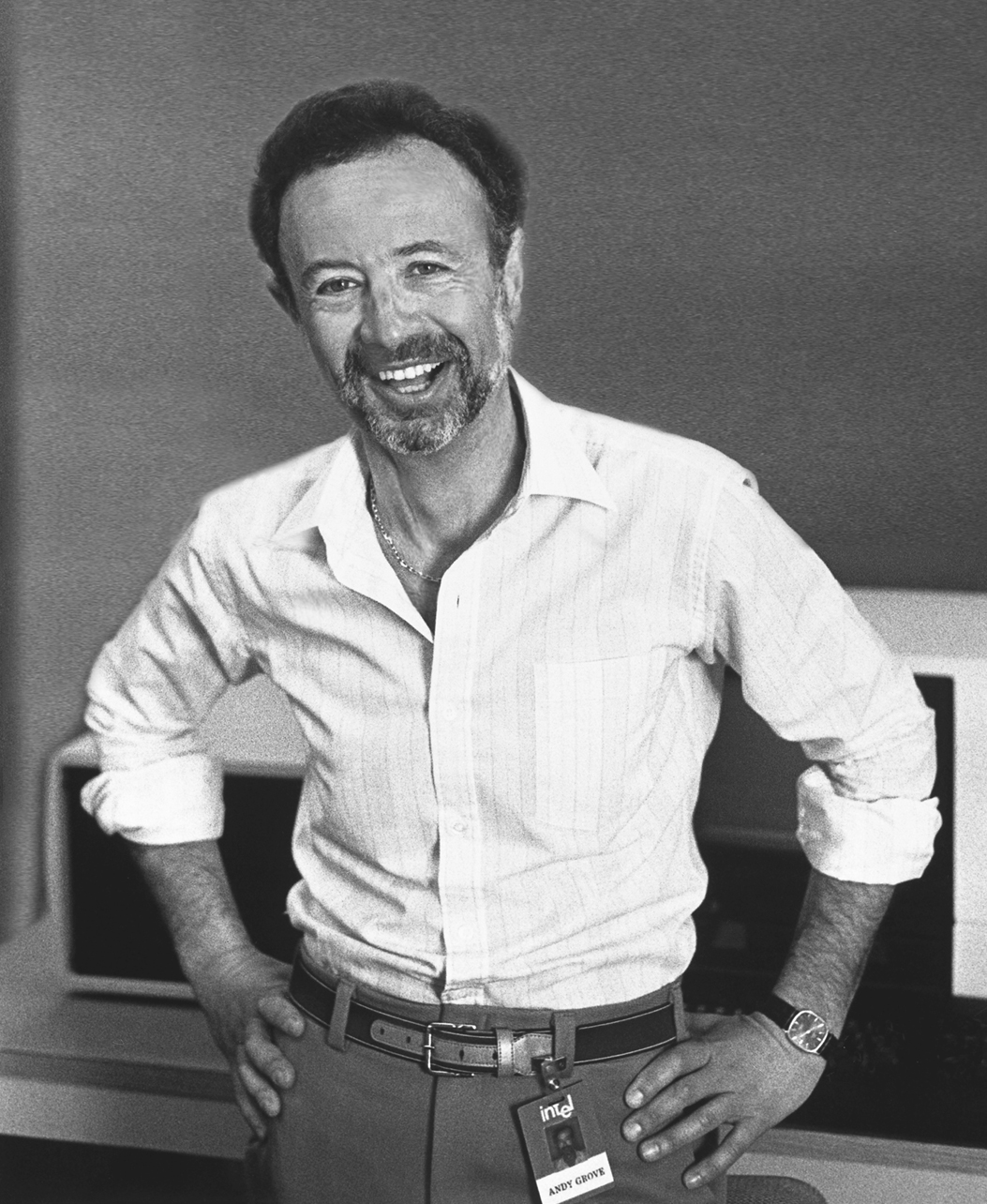
Andy Grove, 1983.
Intel was Grove’s laboratory for management innovation. He loved to teach, and the company reaped the benefits.* A few days after getting hired, I received a coveted invitation to Intel’s Organization, Philosophy, and Economics course, known as iOPEC, a seminar on Intel strategy and operations. Resident professor: Dr. Andy Grove.
In the space of an hour, Grove traced the company’s history, year by year. He summarized Intel’s core pursuits: a profit margin twice the industry norm, market leadership in any product line it entered, the creation of “challenging jobs” and “growth opportunities” for employees.* Fair enough, I thought, though I’d heard similar things at business school.
Then he said something that left a lasting impression on me. He referenced his previous company, Fairchild, where he’d first met Noyce and Moore and went on to blaze a trail in silicon wafer research. Fairchild was the industry’s gold standard, but it had one great flaw: a lack of “achievement orientation.”
“Expertise was very much valued there,” Andy explained. “That is why people got hired. That’s why people got promoted. Their effectiveness at translating that knowledge into actual results was kind of shrugged off.” At Intel, he went on, “we tend to be exactly the opposite. It almost doesn’t matter what you know. It’s what you can do with whatever you know or can acquire and actually accomplish [that] tends to be valued here.” Hence the company’s slogan: “Intel delivers.”
It almost doesn’t matter what you know. . . . To claim that knowledge was secondary and execution all-important—well, I wouldn’t learn that at Harvard. I found the proposition thrilling, a real-world affirmation of accomplishment over credentials. But Grove wasn’t finished, and he had saved the best for last. Over a few closing minutes, he outlined a system he’d begun to install in 1971, when Intel was three years old. It was my first exposure to the art of formal goal setting. I was mesmerized.
A few unvarnished excerpts, straight from the father of OKRs:*
Now, the two key phrases . . . are objectives and the key result. And they match the two purposes. The objective is the direction: “We want to dominate the mid-range microcomputer component business.” That’s an objective. That’s where we’re going to go. Key results for this quarter: “Win ten new designs for the 8085” is one key result. It’s a milestone. The two are not the same. . . .
The key result has to be measurable. But at the end you can look, and without any arguments: Did I do that or did I not do it? Yes? No? Simple. No judgments in it.
Now, did we dominate the mid-range microcomputer business? That’s for us to argue in the years to come, but over the next quarter we’ll know whether we’ve won ten new designs or not.
It was a “very, very simple system,” Grove said, knowing simplicity was catnip to an audience of engineers. On its face, the conception seemed logical, commonsensical—and inspiring. Against the stale management orthodoxy of the period, Grove had created something fresh and original. Strictly speaking, however, his “objectives and key results” did not spring from the void. The process had a precursor. In finding his way, Grove had followed the trail of a legendary, Vienna-born gadfly, the first great “modern” business management thinker: Peter Drucker.
Our MBO Ancestors
The early-twentieth-century forefathers of management theory, notably Frederick Winslow Taylor and Henry Ford, were the first to measure output systematically and analyze how to get more of it. They held that the most efficient and profitable organization was authoritarian.* Scientific management, Taylor wrote, consists of “knowing exactly what you want men to do and then see that they do it in the best and cheapest way.” The results, as Grove noted, were “crisp and hierarchical: there were those who gave orders and those who took orders and executed them without question.”
Half a century later, Peter Drucker—professor, journalist, historian—took a wrecking ball to the Taylor-Ford model. He conceived a new management ideal, results-driven yet humanistic. A corporation, he wrote, should be a community “built on trust and respect for the workers—not just a profit machine.” Further, he urged that subordinates be consulted on company goals. Instead of traditional crisis management, he proposed a balance of long- and short-range planning, informed by data and enriched by regular conversations among colleagues.
Drucker aimed to map out “a principle of management that will give full scope to individual strength and responsibility and at the same time give common direction of vision and effort, establish team work and harmonize the goals of the individual with the common weal.” He discerned a basic truth of human nature: When people help choose a course of action, they are more likely to see it through. In 1954, in his landmark book The Practice of Management, Drucker codified this principle as “management by objectives and self-control.” It became Andy Grove’s foundation and the genesis of what we now call the OKR.
By the 1960s, management by objectives—or MBOs, as the process was known—had been adopted by a number of forward-thinking companies. The most prominent was Hewlett-Packard, where it was a part of the celebrated “H-P Way.” As these businesses trained their attention on a handful of top priorities, the results were impressive. In a meta-analysis of seventy studies, high commitment to MBOs led to productivity gains of 56 percent, versus 6 percent where commitment was low.
Eventually, though, the limitations of MBOs caught up with them. At many companies, goals were centrally planned and sluggishly trickled down the hierarchy. At others, they became stagnant for lack of frequent updating; or trapped and obscured in silos; or reduced to key performance indicators (KPIs), numbers without soul or context. Most deadly of all, MBOs were commonly tied to salaries and bonuses. If risk taking might be penalized, why chance it? By the 1990s, the system was falling from vogue. Even Drucker soured on it. MBOs, he said, were “just another tool” and “not the great cure for management inefficiency.”
Measuring Output
Andy Grove’s quantum leap was to apply manufacturing production principles to the “soft professions,” the administrative, professional, and managerial ranks. He sought to “create an environment that values and emphasizes output” and to avoid what Drucker termed the “activity trap”: “[S]tressing output is the key to increasing productivity, while looking to increase activity can result in just the opposite.” On an assembly line, it’s easy enough to distinguish output from activity. It gets trickier when employees are paid to think. Grove wrestled with two riddles: How can we define and measure output by knowledge workers? And what can be done to increase it?
Grove was a scientific manager. He read everything in the budding fields of behavioral science and cognitive psychology. While the latest theories offered “a nicer way to get people to work” than in Henry Ford’s heyday, controlled university experiments “simply would not show that one style of leadership was better than another. It was hard to escape the conclusion that no optimal management style existed.” At Intel, Andy recruited “aggressive introverts” in his own image, people who solved problems quickly, objectively, systematically, and permanently. Following his lead, they were skilled at confronting a problem without attacking the person. They set politics aside to make faster, sounder, more collective decisions.
Intel relied on systems in every facet of its operations. Marking his debt to Drucker, Grove named his goal-setting system “iMBOs,” for Intel Management by Objectives. In practice, however, it was very different from the classical MBO. Grove rarely mentioned objectives without tying them to “key results,” a term he seems to have coined himself. To avoid confusion, I’ll refer to his approach as “OKRs,” the acronym I assembled from the master’s lexicon. In nearly every respect, the new method negated the old:
MBOs vs. OKRs
|
MBOs |
Intel OKRs |
|
“What” |
“What” and “How” |
|
Annual |
Quarterly or Monthly |
|
Private and Siloed |
Public and Transparent |
|
Top-down |
Bottom-up or Sideways (~50%) |
|
Tied to Compensation |
Mostly Divorced from Compensation |
|
Risk Averse |
Aggressive and Aspirational |
By 1975, when I arrived at Intel, Grove’s OKR system was in full swing. Every knowledge worker in the company formulated monthly individual objectives and key results. Within days of the iOPEC seminar, my supervisor directed me to do the same. I’d been put to work writing benchmarks for the 8080, Intel’s latest entry in the 8-bit microprocessor marketplace, where it reigned supreme. My goal was to show how our chip was faster and generally beat the competition.
My Intel OKRs are mostly lost to the pre-cloud sands of time, but I’ll never forget the gist of my first one:
OBJECTIVE
Demonstrate the 8080’s superior performance as compared to the Motorola 6800.
KEY RESULTS
(AS MEASURED BY . . .)
-
Deliver five benchmarks.
-
Develop a demo.
-
Develop sales training materials for the field force.
-
Call on three customers to prove the material works.
Intel’s Lifeblood
I remember typing out that OKR on an IBM Selectric. (The first commercial laser printer was a year away.) Then I posted a hard copy on my carrel for people to scan as they walked by. I’d never worked at a place where you wrote down your goals, much less where you could see everybody else’s, on up to the CEO. I found it illuminating, a beacon of focus. And it was liberating, too. When people came to me mid-quarter with requests to draft new data sheets, I felt I could say no without fear of repercussion. My OKRs backed me. They spelled out my priorities for all to see.
Through the Andy Grove era, OKRs were Intel’s lifeblood. They stood front and center at weekly one-on-ones, biweekly staff meetings, monthly and quarterly divisional reviews. That was how Intel managed tens of thousands of people to etch a million lines of silicon or copper to within a millionth of a meter in accuracy. Fabricating semiconductors is a tough business. Without rigor, nothing works; yields plummet, chips fail. OKRs were constant reminders of what our teams needed to be doing. They told us precisely what we were achieving—or not.
Along with writing my benchmarks, I trained Intel’s domestic sales team. Weeks passed. Grove got wind that the most knowledgeable person on the 8080 was a twenty-four-year-old intern. One day he grabbed me and said, “Doerr, come to Europe with me.” For a summer kid, it was a heady invitation. I joined Grove and his wife, Eva, on a trip to Paris, London, and Munich. We trained the European sales force, called on three big prospects, and won two accounts. I contributed what I could. We dined at Michelin-starred restaurants, where Grove knew his way around a wine list. He took a liking to me; I felt awed in his presence. He was a man who lived life large.
Back in California, Andy had Bill Davidow write a letter to confirm I’d have a job waiting the following year. That summer was an eye-opening, mind-blowing education, to the point where I almost dropped out of Harvard. I figured I could learn more about business by remaining at Intel. I compromised by returning to Massachusetts and working part time on the company’s account with Digital Equipment Corporation, helping to drag them kicking and screaming into the microprocessor era. I finished my last semester, raced back to Santa Clara, and stayed at Intel for the next four years.
Andy Grove, OKR Incarnate
The mid-1970s marked the birth of the personal computer industry, a yeasty time for fresh ideas and upstart entrepreneurs. I was low on the totem pole, a first-year product manager, but Grove and I had a relationship. One spring day I grabbed him and drove up to the first West Coast Computer Faire at the San Francisco Civic Auditorium. We found a former Intel executive demonstrating the Apple II, the state of the art for graphical display. I said, “Andy, we’ve already got the operating system. We make the microchip. We’ve got the compilers; we’ve licensed BASIC. Intel should make a personal computer.” But as we hiked down the aisles, past vendors hawking plastic bags of chips and parts, Grove took a long look and said, “Eh, these are hobbyists. We’re not going into that business.” My big dream was dashed. Intel never did enter the PC market.
Though he wasn’t demonstrative, Grove could be a compassionate leader. When he saw a manager failing, he would try to find another role—perhaps at a lower level—where the person might succeed and regain some standing and respect. Andy was a problem solver at heart. As one Intel historian observed, he “seemed to know exactly what he wanted and how he was going to achieve it.”* He was sort of a walking OKR.
Intel was born in the era of the Free Speech Movement at Berkeley and the flower children of Haight-Ashbury. Punctuality was out of fashion among the young, even young engineers, and the company found it challenging to get new hires into work on time. Grove’s solution was to post a sign-in sheet at the front desk, to log anyone dragging in after 8:05—we called it Andy’s Late List. Grove collected the sheet each morning at 9:00 sharp. (On those mornings when I was tardy, I’d try to beat the system by sitting in the parking lot until five minutes after nine.) Nobody knew of anyone who’d been docked. Even so, the list signified the importance of self-discipline in a business with no margin for error.
Grove was hard on everybody, most of all himself. A proudly self-made man, he could be arrogant. He did not suffer fools, or meandering meetings, or ill-formed proposals. (He kept a set of rubber stamps on his desk, including one engraved BULLSHIT.) The best way to solve a management problem, he believed, was through “creative confrontation”—by facing people “bluntly, directly, and unapologetically.”*
Despite Andy’s hot temper, he was down-to-earth and approachable, open to any good idea. As he once told The New York Times, Intel managers “leave our stripes outside when we go into a meeting.” Every big decision, he believed, should begin with a “free discussion stage . . . an inherently egalitarian process.” The way to get his respect was to disagree and stand your ground and, ideally, be shown to be right in the end.
After I’d logged eighteen months as a product manager, Jim Lally—by then the head of systems marketing, and a great mentor and hero of mine—said to me, “Doerr, if you want to be a really good general manager someday, you need to get out in the field, sell, get rejected, and learn to meet a quota. You can have all the technical expertise in the world, but you’ll succeed or fail in this business based on whether your team makes their numbers.”
I chose Chicago. In 1978, after Ann and I got married, I became a technical sales rep in the Midwest region. It was the best job I’ve ever had. I loved helping our customers make a better dialysis machine or traffic-light controller. I loved selling Intel microprocessors, the brains of the computer, and I was pretty good at it. (I came by this talent honestly; my father, Lou Doerr, was a mechanical engineer who loved people and loved selling to them.) Since I’d written all the benchmarks, I knew the programming cold. My sales quota that first year was an intimidating $1 million, but I beat it.
After Chicago, I returned to Santa Clara as a marketing manager. Suddenly I had to hire a small team, guide my people’s work, and measure it against expectations. My skill set was stretched, and that’s when I came to more fully appreciate Grove’s goal-setting system. With an Intel manager coaching me through the process, I developed more discipline, more constancy. I relied on OKRs to communicate more clearly and help my team get our most important work done. None of this came naturally. It was a second, deeper level of learning objectives and key results.
In 1980, an opportunity surfaced at Kleiner Perkins to leverage my technical background in working with new companies. Andy could not fathom why I would want to leave Intel. (He himself put the company ahead of everything, with the possible exception of his grandchildren.) He had an amazing ability to reach into your chest and grab your heart, pull it out, and hold it in his hands in front of you. By then he was the company’s president, and he said, “Come on, Doerr, don’t you want to be a general manager and own a real P&L? I’ll let you run Intel’s software division.” It was a nonexistent business, but could have been built into one. Then he added a zinger: “John, venture capital, that’s not a real job. It’s like being a real estate agent.”
Andy Grove’s Legacy
When Grove died at seventy-nine after years of stoic suffering with Parkinson’s disease, The New York Times called him “one of the most acclaimed and influential personalities of the computer and Internet era.” He wasn’t an immortal theorist like Gordon Moore or an iconic public figure like Bob Noyce. Nor did he publish enough to rest beside Peter Drucker in the pantheon of management philosophy. Yet Grove changed the way we live. In 1997, three decades after his experiments at Fairchild, he was named Time magazine’s Man of the Year, “the person most responsible for the amazing growth in the power and the innovative potential of microchips.” Andy Grove was a rare hybrid, a supreme technologist and the greatest chief executive of his day. We sorely miss him.
Dr. Grove’s Basic OKR Hygiene
The essence of a healthy OKR culture—ruthless intellectual honesty, a disregard for self-interest, deep allegiance to the team—flowed from the fiber of Andy Grove’s being. But it was Grove’s nuts-and-bolts approach, his engineer’s mentality, that made the system work. OKRs are his legacy, his most valuable and lasting management practice. Here are some lessons I learned at Intel from the master and from Jim Lally, Andy’s OKR disciple and my mentor:
Less is more. “A few extremely well-chosen objectives,” Grove wrote, “impart a clear message about what we say ‘yes’ to and what we say ‘no’ to.” A limit of three to five OKRs per cycle leads companies, teams, and individuals to choose what matters most. In general, each objective should be tied to five or fewer key results. (See chapter 4, “Superpower #1: Focus and Commit to Priorities.”)
Set goals from the bottom up. To promote engagement, teams and individuals should be encouraged to create roughly half of their own OKRs, in consultation with managers. When all goals are set top-down, motivation is corroded. (See chapter 7, “Superpower #2: Align and Connect for Teamwork.”)
No dictating. OKRs are a cooperative social contract to establish priorities and define how progress will be measured. Even after company objectives are closed to debate, their key results continue to be negotiated. Collective agreement is essential to maximum goal achievement. (See chapter 7, “Superpower #2: Align and Connect for Teamwork.”)
Stay flexible. If the climate has changed and an objective no longer seems practical or relevant as written, key results can be modified or even discarded mid-cycle. (See chapter 10, “Superpower #3: Track for Accountability.”)
Dare to fail. “Output will tend to be greater,” Grove wrote, “when everybody strives for a level of achievement beyond [their] immediate grasp. . . . Such goal-setting is extremely important if what you want is peak performance from yourself and your subordinates.” While certain operational objectives must be met in full, aspirational OKRs should be uncomfortable and possibly unattainable. “Stretched goals,” as Grove called them, push organizations to new heights. (See chapter 12, “Superpower #4: Stretch for Amazing.”)
A tool, not a weapon. The OKR system, Grove wrote, “is meant to pace a person—to put a stopwatch in his own hand so he can gauge his own performance. It is not a legal document upon which to base a performance review.” To encourage risk taking and prevent sandbagging, OKRs and bonuses are best kept separate. (See chapter 15, “Continuous Performance Management: OKRs and CFRs.”)
Be patient; be resolute. Every process requires trial and error. As Grove told his iOPEC students, Intel “stumbled a lot of times” after adopting OKRs: “We didn’t fully understand the principal purpose of it. And we are kind of doing better with it as time goes on.” An organization may need up to four or five quarterly cycles to fully embrace the system, and even more than that to build mature goal muscle.