3
Operation Crush: An Intel Story
Bill Davidow
Former Vice President, Microcomputer Systems Division
Operation Crush—the fight for survival by a young Intel Corporation—is the subject of our first extended story on OKRs. Crush illustrates all four OKR superpowers: focus, alignment, tracking, and stretching. Most of all, it shows how this goal-setting system can move multiple departments and thousands of individuals toward a common objective.
Near the end of my time at Intel, the company faced an existential threat. Led by Andy Grove, top management rebooted the company’s priorities in four weeks. OKRs allowed Intel to execute its battle plan with clarity, precision, and lightning speed. The entire workforce shifted gears to focus together on one prodigious goal.
Back in 1971, the Intel engineer Ted Hoff invented the original microprocessor, the multipurpose “computer-on-a-chip.” In 1975, Bill Gates and Paul Allen programmed the third-generation Intel 8080 and launched the personal computer revolution. By 1978, Intel had developed the first high-performance, 16-bit microprocessor, the 8086, which found a ready market. But soon it was getting beaten to a pulp by two chips that were faster and easier to program, Motorola’s 68000 and upstart Zilog’s Z8000.
In late November 1979, a district sales manager named Don Buckout shot off a desperate eight-page telex. Buckout’s boss, Casey Powell, sent it on to Andy Grove, then Intel’s president and chief operating officer. The communiqué set off a five-alarm fire—and a corporate crusade. Within a week, the executive staff had met to confront the bad news. One week after that, a blue-ribbon task force convened to map out Intel’s counteroffensive. Zilog, all agreed, wasn’t a serious threat. But Motorola, an industry Goliath and international brand, posed a clear and present danger. Jim Lally set the tone for the war to come:
There’s only one company competing with us, and that’s Motorola. The 68000 is the competition. We have to kill Motorola, that’s the name of the game. We have to crush the f—king bastards. We’re gonna roll over Motorola and make sure they don’t come back again.
That became the rallying cry for Operation Crush,* the campaign to restore Intel to its rightful place as market leader. By January 1980, armed with Andy Grove videos to exhort the troops, Crush teams were dispatched to field offices around the globe. By the second quarter, Intel’s salespeople had fully deployed the new strategy. By the third quarter, they were on their way toward meeting one of the most daring objectives in the history of tech: two thousand “design wins,” the crucial agreements for clients to put the 8086 in their appliances and devices. By the end of that calendar year, they’d routed the enemy and won a resounding victory.
Not one Intel product was modified for Crush. But Grove and his executive team altered the terms of engagement. They revamped their marketing to play to the company’s strengths. They steered their customers to see the value of long-term systems and services versus short-term ease of use. They stopped selling to programmers and started selling to CEOs.
Grove “volunteered” Bill Davidow, head of Intel’s microcomputer systems division, to lead the operation. Over his long career as an engineer, industry executive, marketing maven, venture investor, thinker, and author, Bill has made many lasting contributions. But one is especially dear to my heart. Bill grafted the critical connective tissue—the phrase “as measured by,” or a.m.b.—into Intel’s company OKRs. For example, “We will achieve a certain OBJECTIVE as measured by the following KEY RESULTS. . . .” Bill’s a.m.b made the implicit explicit to all.
At a 2013 panel discussion hosted by the Computer History Museum, Crush veterans recalled the importance of structured goal setting at Intel—and how objectives and key results were used “down into the trenches.” The OKRs for Operation Crush, which are sampled here, were classics of the genre: time bound and unambiguous, with every what and how in place. Best of all, they worked.
As Jim Lally told me: “I was a skeptic on objectives and key results until Grove sat down with me and explained why they mattered. If you tell everybody to go to the center of Europe, and some start marching off to France, and some to Germany, and some to Italy, that’s no good—not if you want them all going to Switzerland. If the vectors point in different directions, they add up to zero. But if you get everybody pointing in the same direction, you maximize the results. That was the pitch Grove gave me—and then he told me I had to teach it.”
As Bill Davidow recounts here, OKRs were Grove’s secret weapon in Operation Crush. They turbocharged a large and multifaceted organization, then propelled it with surprising agility. Up against a unified, goal-driven Intel, Motorola never stood a chance.
Bill Davidow: The key result system was Andy Grove’s way to mold behavior. Andy had a single-minded commitment to making Intel great. He discouraged people from serving on outside boards; Intel was supposed to be your life. Your objectives and key results consolidated that commitment.
When you’re really high up in management, you’re teaching—that’s what Andy did. Objectives and key results were embedded in the management system at Intel, but they were also a philosophy, a seminal teaching system. We were all taught that if you measured it, things got better.
We wrote our top-level goals with Andy in our executive staff meetings. We sat around the table and decided: “This is it.” As a division manager, I adopted any relevant company key results as my objectives. I brought them to my executive team, and we’d spend the next week talking about what we would do that quarter.
What made the system so strong is that Andy would say, “This is what the corporation is going to do,” and everybody would go all out to support the effort. We were part of a winning team, and we wanted to keep winning.
At lower levels, people’s objectives and key results might encompass close to a hundred percent of their work output. But managers had additional day-to-day responsibilities. If my objective is to grow a beautiful rose bush, I know without asking that you also want me to keep the lawn green. I doubt I ever had a key result that said, “Walk around to stay on top of employees’ morale.” We wrote down the things that needed special emphasis.
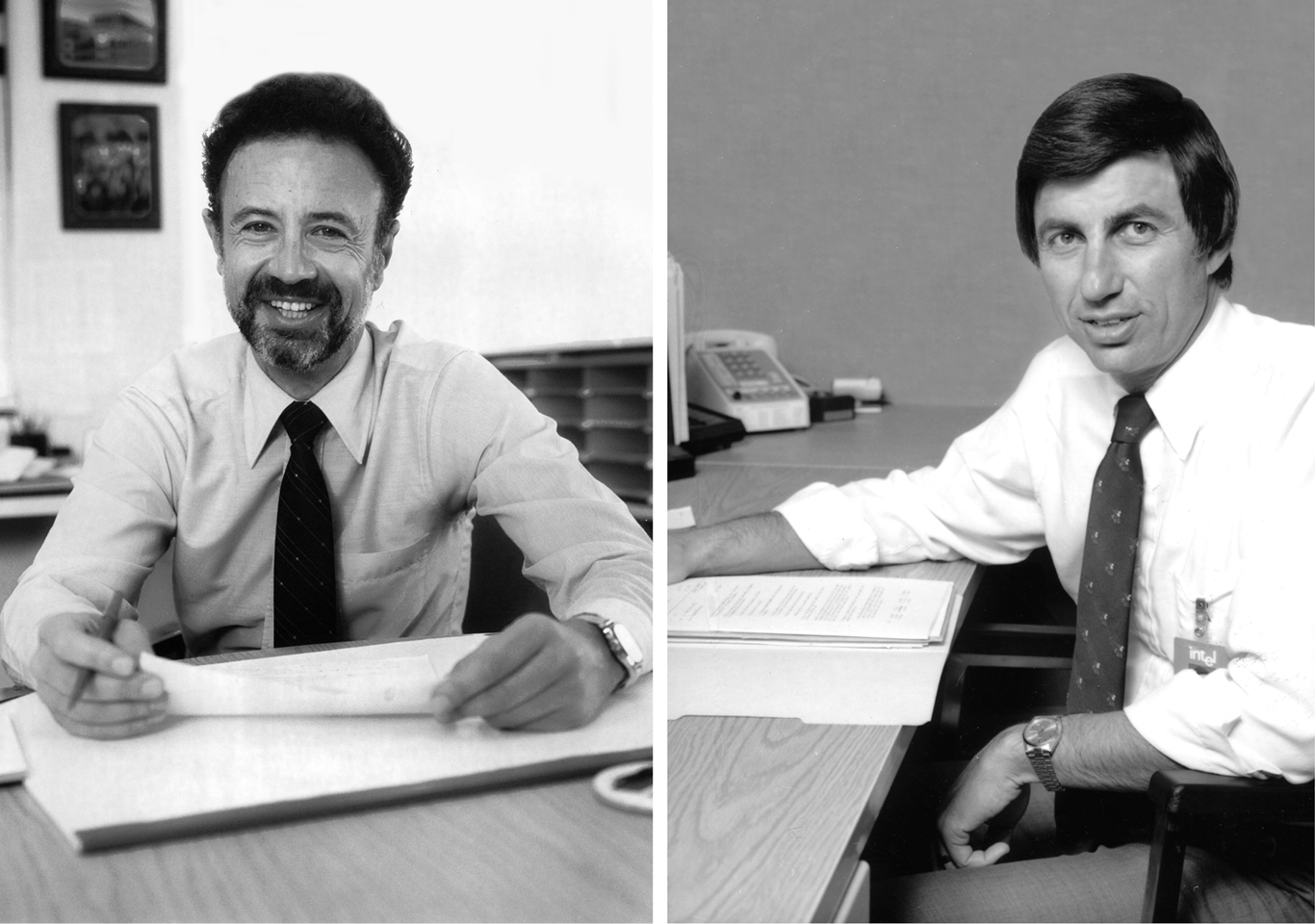
Andy Grove and Bill Davidow, Intel headquarters, 1980.
Intel’s Urgency
In December 1979, I went into Andy Grove’s executive staff meeting full of complaints. I thought the microprocessor people could do a better job of racking up design wins for the 8086. I wanted to goad them into fighting back and believing in themselves again. And then Andy tagged me and told me to “solve the problem.” Operation Crush became my job.
The 8086 didn’t bring in so much revenue in and of itself, but it had a broad ripple effect. My division sold design aids—software development systems—for systems using Intel microprocessors. Though we were growing like crazy, we were still dependent on customers’ choosing Intel’s microchip for their products. Once Intel got its foot in the door with the 8086, we’d get EPROM [the programmable, read-only-memory chip invented at Intel in 1971] and peripheral and controller chip contracts as well. In total, they might be worth ten times the original sale. But if the 8086 went away, my systems business went away, too.
So the stakes were high. After making its reputation as a supplier of memory chips, Intel was under siege. Recently we’d lost the lead on DRAM [the most widely used and economical type of computer memory] to a start-up, and couldn’t seem to regain our momentum. Japanese companies were spoiling to invade our beachhead in the lucrative market for EPROM. Microprocessors were Intel’s best hope for the future, and we had to get back on top. I can still remember the first slide of one early presentation:
Crush, the purpose: To establish a sense of urgency and set in motion critical, corporate-wide decisions and action plans to address a life-threatening competitive challenge.
Our task force convened on Tuesday, December 4. We met for three days running, many hours a day. It was an intellectual challenge, like solving an enormous puzzle. There was no time to rebuild the 8086, so we spent most of our time figuring out just what we had to sell and how to regain a competitive advantage over Motorola.
I thought we could win by creating a new narrative. We needed to convince our customers that the microprocessor they chose today would be their most important decision for the next decade. Sure, Motorola could come in and say, “We’ve got a cleaner instruction set.” But they couldn’t match our broad product family or system-level performance. They couldn’t compete with our superb technical support or low cost of ownership. With Intel peripherals, we’d remind people, your products get to market faster and cheaper. With Intel design aids, your engineers work more efficiently.
Motorola was a big, diverse company that made everything from two-way radios to pocket televisions. Intel was a technology leader that stuck to memory chips and microprocessors and systems that supported them. Who would you rather call when something went wrong? Who would you count on to stay in the vanguard?
We had a lot of good ideas that needed to be woven together. Jim Lally wrote them on the whiteboard: “Publish a future products catalog”; “Develop a sales pitch for fifty seminars—and attendees get a catalog.” By Friday, we had a plan to mobilize the company. By the following Tuesday, we had approval for a nine-part program—including a multimillion-dollar ad spend, something Intel had never done before. Within a week after that, the strategy went out to the sales force, which was eager to sign on. They’d alerted us to the crisis in the first place, after all.
All that happened before Christmas.
Motorola was extremely well run, but it had a different sense of urgency. When Casey Powell smacked us between the eyes, we responded within two weeks. When we smacked Motorola between the eyes, they couldn’t move nearly so fast. A manager there told me, “I couldn’t get a plane ticket from Chicago to Arizona approved in the time you took to launch your campaign.”
Intel excelled at declaring great generalizations and translating them into actionable, coordinated programs. Each of our nine projects became a company key result. Here’s an Intel Crush corporate OKR and a related engineering OKR from the second quarter of 1980:
INTEL CORPORATE OBJECTIVE
Establish the 8086 as the highest performance 16-bit microprocessor family, as measured by:
KEY RESULTS (Q2 1980)
-
Develop and publish five benchmarks showing superior 8086 family performance (Applications).
-
Repackage the entire 8086 family of products (Marketing).
-
Get the 8MHz part into production (Engineering, Manufacturing).
-
Sample the arithmetic coprocessor no later than June 15 (Engineering).
ENGINEERING DEPARTMENT OBJECTIVE (Q2 1980)
Deliver 500 8MHz 8086 parts to CGW by May 30.
KEY RESULTS
-
Develop final art to photo plot by April 5.
-
Deliver Rev 2.3 masks to fab on April 9.
-
Test tapes completed by May 15.
-
Fab red tag start no later than May 1.
Turning on a Dime
Early on, just after the first of the year, Bob Noyce and Andy Grove staged a Crush kickoff at the San Jose Hyatt House. Their directive to Intel’s management corps was simple and clear: “We’re going to win in 16-bit microprocessors. We’re committed to this.” Andy told us what we had to do and why we had to do it, and that we should consider it a priority until it was done.
There were close to one hundred people at the meeting. The message penetrated two levels of management off the bat, and to a third level within twenty-four hours. Word spread awfully fast. Intel was close to a billion-dollar company at the time, and it turned on a dime. To this day, I have never seen anything like it.
And it couldn’t have happened without the key result system. If Andy had run the San Jose meeting without it, how could he have simultaneously kicked off all those Crush activities? I can’t tell you how many times I’ve seen people walk out of meetings saying, “I’m going to conquer the world” . . . and three months later, nothing has happened. You get people whipped up with enthusiasm, but they don’t know what to do with it. In a crisis, you need a system that can drive transformation—quickly. That’s what the key result system did for Intel. It gave management a tool for rapid implementation. And when people reported on what they’d gotten done, we had black-and-white criteria for assessment.
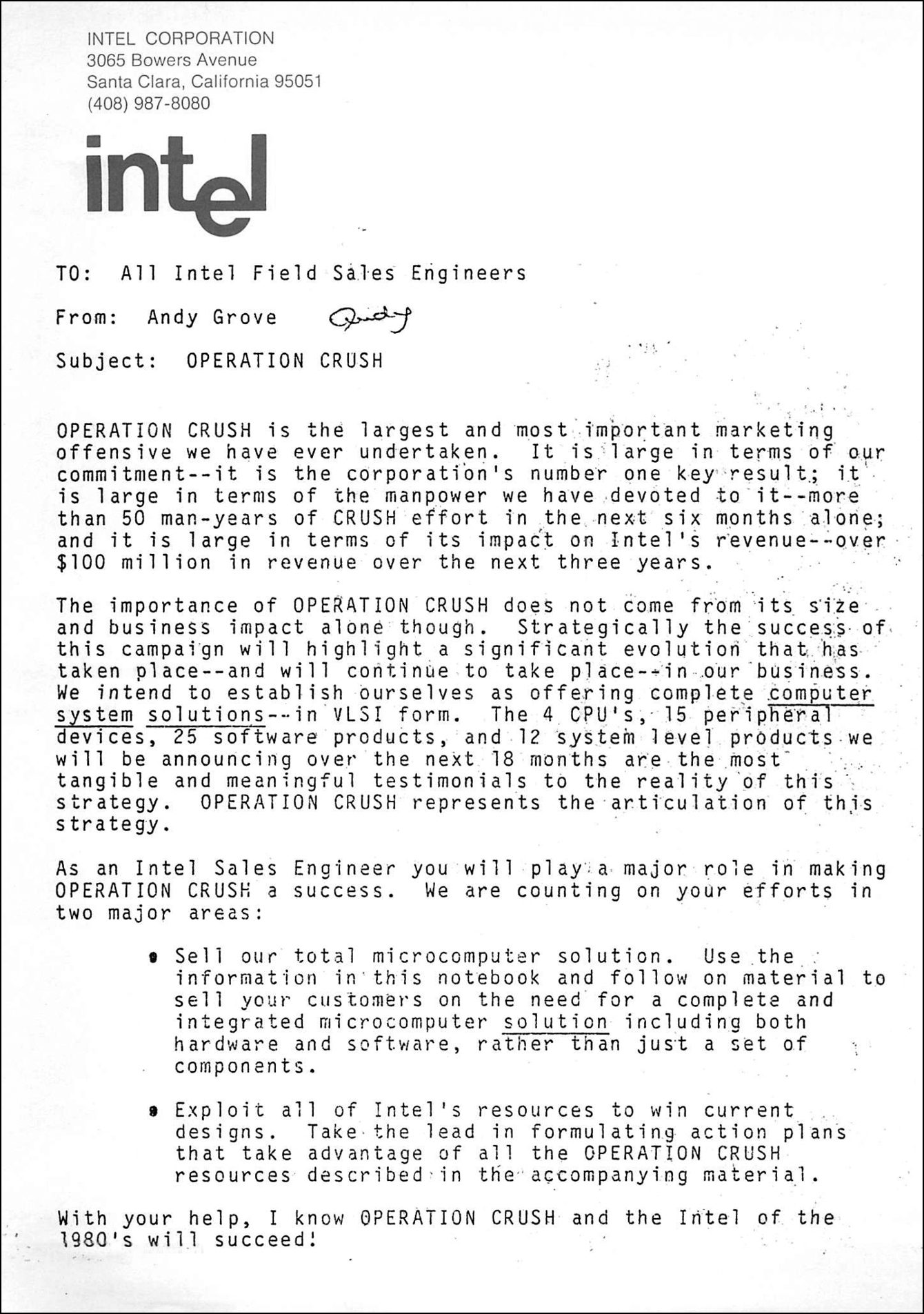
Andy Grove marshals the troops for Operation Crush, January 1980.
Crush was a thoroughly cascaded set of OKRs, heavily driven from the top, but with input from below. At Andy Grove’s level, or even my level, you couldn’t know all the mechanics of how the battle should be won. A lot of this stuff has to flow uphill. You can tell people to clean up a mess, but should you be telling them which broom to use? When top management was saying “We’ve got to crush Motorola!” somebody at the bottom might have said “Our benchmarks are lousy; I think I’ll write some better benchmarks.” That was how we worked.
The Greater Good
Intel stayed on a war footing for six months. I was in a staff position, with no line authority, but I got whatever I needed because the whole company knew how much it mattered to Andy. When the key results came back from Intel’s divisions, there was virtually no dissent. Everybody was on board. We redirected resources on the fly; I don’t think I even had a budget.
Operation Crush ultimately included top management, the entire sales force, four different marketing departments, and three geographic locations—all pulling together as one.* What made Intel different was that it was so apolitical. Managers sacrificed their little fiefdoms for the greater good. Say the microprocessors division was putting out the futures catalog. Somebody might notice, “Oh my God, we’ve got a peripheral missing”—and that would ripple out to the peripherals division and the allocation of engineering resources. The sales force organized the seminars, but they leaned on application engineers and marketing, and on my division, too. Corporate communications wrangled articles for the trade press from all over the company. It was a total organizational effort.
When I think about Crush, I still can’t believe we pulled it off. I guess the lesson is that culture counts. Andy always wanted people to bring problems to management’s attention. A field engineer tells his general manager, “You turkeys don’t understand what’s happening in the market,” and within two weeks, the whole company is realigned, top to bottom. Everyone’s agreed: “The whistleblower is right. We’ve got to act differently.” It was terribly important that Don Buckout and Casey Powell felt they could speak their minds without retribution. Without that, there’s no Operation Crush.
Andy Grove was accustomed to having the last word, so let’s give it to him here. “Bad companies,” Andy wrote, “are destroyed by crisis. Good companies survive them. Great companies are improved by them.” So it was for Operation Crush. By 1986, when Intel dumped its formative memory-chip business to go all-in on microprocessors, the 8086 had recaptured 85 percent of the 16-bit market. A bargain-priced variant, the 8088, found fame and fortune inside the first IBM PC, which would standardize the personal computer platform. Today, tens of billions of microcontrollers—in computers and cars, smart thermostats and blood-bank centrifuges—all run on Intel architecture.
And as we’ve seen, none of this would have happened without OKRs.