5
Focus: The Remind Story
Brett Kopf
Cofounder
It’s no news that the U.S. education system needs help. A Brown University study pointed to one possible solution: better communication between teachers and families. When summer school teachers made daily phone calls and sent texts or written messages home, their sixth-graders completed 42 percent more homework. Class participation rose by nearly half.
For decades, companies have tried to boost student achievement by injecting technology into schools. It hasn’t worked. But suddenly, while nobody was looking, tens of millions of American kids walked into the classroom with a transformational piece of tech in their pockets. Thanks to the pervasive smartphone, text messaging became the leading mode of teenage communication. Remind found a market opportunity: to make texting a secure and practical communication system for principals, teachers, students, and parents.
Focus is essential for choosing the right goals—for winnowing OKR wheat from chaff. Brett Kopf discovered the urgency of focus while building Remind, enabling teachers, students, and parents to text in a safe and secure environment. By using OKRs to zero in on its top priorities, the company is serving millions of people who matter for the future of this country.
When Brett and I first met, I was struck by his passion for serving his customers. His start-up was exquisitely focused on teachers. I’ll never forget stepping into the bathroom of his tiny loft office and seeing a list of company objectives taped to the mirror, over the commode. Now there was a sign of serious goal orientation.
I found Brett highly skilled at identifying priorities and enlisting others to buy in. In 2012, he and his brother David made the Forbes honor roll of “30 Under 30 Education.” But with accelerating scale, their company needed more focus. OKRs guaranteed a process that they’d already begun.
Brett Kopf: Growing up in Skokie, Illinois, I struggled to focus at school. I was fine if I could move around, but sitting at a desk for me was torture. A forty-minute math lesson felt like eternity. I was the kid who was always messing with my neighbor or blowing spitballs. I just wasn’t engaged.
I was tested in fifth grade, and then came the diagnosis: attention deficit hyperactivity disorder and dyslexia. Organizing words and letters was tough for me. Numbers were tougher still.
Both my parents were entrepreneurs, and I’d see them up and working at five in the morning. I was working my butt off, too, but my grades kept sinking and my confidence with them. It only got worse in high school, on the North Side of Chicago. When other kids called me stupid, I believed them.
Then, junior year, a teacher named Denise Whitefield began working with me one-on-one—and changed my life. Each day she’d begin by asking, “What do you have to do today?” I’d run down my list: a history worksheet, an English essay, an upcoming math test. Then she’d say something really smart: “Okay, let’s just pick one and talk about it.” We focused on one thing at a time, and I’d get it done. “Just keep trying,” she encouraged me. “You’ll get it. I have all day.” The panicked beating in my chest subsided. School would never be easy for me, but I began to believe I could handle it.
My mother spoke to Mrs. Whitefield every week, came into school at least once a month. They were a force in lockstep, Team Brett, and they would not let me fail. I’m sure I didn’t fully get the importance of their connection, but it planted a seed.
Even after my grades improved, the college-prep ACT exam—answer six hundred questions and don’t move for four hours—was a horror movie for a person with ADHD. But somehow I made it into Michigan State, my first big win.
When people try to crack the country’s massive problems in education, they usually start with curriculum or “accountability,” which is code for test scores. What gets lost are the human connections. That’s what Remind is all about.
Twitter for Education
Like many ventures, Remind began with one person’s problem. As a college freshman, I was hopeless with academic deadlines and schedules, which my professors seemed to change on a whim. Cut off from my support system, I failed at three majors before settling on agricultural economics, the easiest one I could find. But I still had five syllabi per semester, and each syllabus might contain thirty-five assignments and quizzes and tests. Success in college is a matter of time management. When to start writing that ten-page poli-sci essay? How to prep for the chem final? It’s all about dynamic goal setting, and I kept dropping the ball.
Things came to a head junior year, after I slaved over an essay and got a mediocre grade. Adding insult, I had to hunt for that lousy grade on a clunky web-based system on my laptop. My friends and I texted on our BlackBerrys in real time—why couldn’t our school data be at our fingertips, too? Why couldn’t teachers connect with students on their smartphones anytime, anywhere? I felt driven to build something to help kids like me. I called my older brother, David, who was working in web services security for a big Chicago insurance firm. I said, “You have twenty-four hours to decide if you want to start that company with me.” Five minutes later he called back and said, “Okay, I’m in.”
For two years, David and I fumbled in the dark. We knew nothing about technology and less about product development or operations. (My total real-world experience was an internship at Kraft Foods, where I’d mostly stocked cookies.) Random students shared their syllabi, and I plugged them into David’s Excel macros to send alerts to their phones: “Brett Kopf, you have a quiz at eight a.m. tomorrow in History 101, don’t forget to study.” The system was archaic and absolutely unscalable. But for a few hundred active users, including me, it worked. I graduated from Michigan State.
In early 2011, I moved to Chicago to work on our app full time. With $30,000 from friends and family, David and I did the full-monty entrepreneur thing, pasta dinners every night. And we failed because I was arrogant. We spent lots of time meeting potential investors and working up intricate website schematics, and no time learning about teachers’ problems. We weren’t yet focused on what counted.
Down to a few hundred dollars, our company cheated death by getting into Imagine K12, the Silicon Valley start-up accelerator for the education market. Our mission statement went something like: “Remind101: A safe way for teachers to message students and parents. We’re building the most powerful communication platform in education and using SMS as the ‘hook.’ Think Twitter, for education.” There were millions of children with learning issues like mine, and countless teachers struggling to help them. I was bold or naive enough to think we could do something about it.
With our Demo Day opportunity ninety days out, David quit his job and we moved to the Valley. We learned the three watchwords for entrepreneurs:
-
Solve a problem
-
Build a simple product
-
Talk to your users
While David locked himself in a room to teach himself how to code, I focused on a single ten-week goal: to interview 200 teachers across the United States and Canada. (I guess you could say that was my first OKR.) After contacting 500 teachers on Twitter, I wound up with 250 one-on-ones, exceeding my objective. When you listen to enough educators in the trenches, you learn pretty quickly that off-site communication ranks high among their pain points. At final bell, teachers were plastering sticky notes—Homework’s due tomorrow—on students’ shoulders. Couldn’t we do better than that?
Traditional phone trees and permission slips were labor intensive and unreliable. On the other hand, texting between thirty-year-old teachers and twelve-year-old children was loaded with liability. Teachers needed a secure platform with no personal data attached, something accessible yet private. And they needed less work, not more.
By Day 15, we had a crude beta version of Remind. On a sheet of printer paper, over hand-drawn symbols for mobile phones and email, I scrawled, “Your students can receive your messages. . . .” Below were three options: “Invite,” “Print,” “Share.” After reaching a teacher on Skype, I’d hold the paper to the screen and say, “You can type any message you want to your students, hit the button, and they’ll never see your phone number or social networking profile.” I did this countless times, and the teachers just about fell out of their chairs—every time. “My God,” they’d say, “that would solve such a big problem for me!”
That’s when David and I knew we were on the right track.
Scaling on a Shoestring
By Day 70, our software was in place. Teachers could sign up on the web, form a virtual “class,” and provide a dedicated number to students and parents for text messaging. We scaled quickly, a good sign—130,000 messages within three weeks of launch. We had what every new company wanted, a hockey-stick growth chart. On Demo Day, I entered a big, buzzing room with eleven other start-ups and a hundred investors. I had two minutes to make my pitch, followed by two hours of frantic mingling. I handed out my card to at least forty people.
Growth costs money. By early 2012, my brother and I were $10,000 in debt. But then Miriam Rivera and Clint Korver’s Ulu Ventures seeded us with a save-the-day $30,000. Another infusion followed from Maneesh Arora, the Google product manager who later founded MightyText and became my mentor. Remind kept scaling like crazy on our seed-capital shoestring. Sometimes—most of the time—it felt like the sorcerer’s apprentice, moving really fast and out of control. At one point we were adding eighty thousand users a day when we had five people, and only two of us were engineers. We’d yet to spend a dime on marketing. I spoke to teachers for feedback, and they’d put out the word to fifty colleagues. Since our service was free, we didn’t need school district approval.
Our goals stayed strictly qualitative until the fall of 2013, when we hit six million users and raised Series A funding from Chamath Palihapitiya and the Social+Capital Partnership. Maneesh had already been nudging us to back our decisions with more data, and Chamath showed us how to paint a picture with one page of it. Plus he taught us to discern what was inessential, like our number of registered users. Nobody cared how many teachers registered on Remind if they never came back to use it.
By the time John Doerr saw our goals posted above our office toilet, they were more concrete. We listed three metrics: Weekly Active Teachers (WAT), Monthly Active Teachers (MAT), and retention.
Then I’d squeeze in a few quarterly initiatives: migrate the databases, build the app, hire four people. I wanted everyone in the company to see just what we were doing.
Working out of a one-bedroom loft, still plagued by a chronic shortage of engineers, we’d barely gotten our mobile app up and running. But John could tell we were homed in on what mattered. Our objectives were clear and quantified, and we were teacher-obsessed from the start.
In February 2014, just before we closed our Series B funding (led by Kleiner Perkins), John pitched us on OKRs. He told us about some companies using them: Intel, Google, LinkedIn, Twitter. Here was a method to keep us focused, to guide and track and support us at every step. And I thought: Why not try it?
Goals for Growth
That August, the heart of our busy back-to-school season, the Remind app exploded: more than 300,000 student and parent downloads per day. We were number three in the Apple App Store! By the end of the fall semester, we’d passed the billion-message mark. Our operation had to ramp up in a hurry, in each and every department. None of our goal setting was glamorous, but all of it was very necessary.
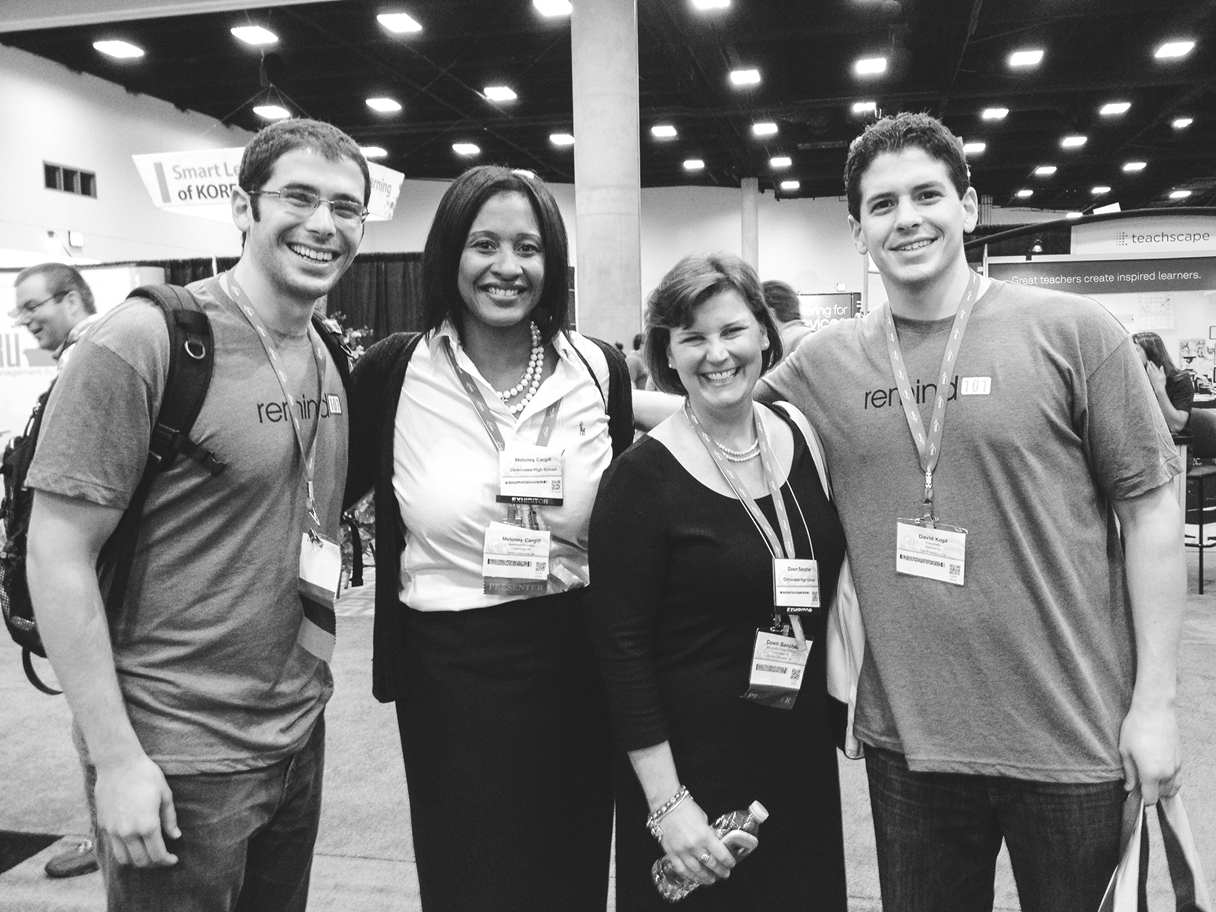
Remind cofounder Brett Kopf, Clintondale Community Schools coprincipals Meloney Cargill and Dawn Sanchez, Remind cofounder David Kopf, 2012.
We started OKRs when our company had fourteen people. Within two years, we’d grown to sixty. We couldn’t all meet around a table anymore to hash out the next quarter’s priorities. OKRs helped enormously by helping people to focus on what could move the company to the next level. To meet our objective for teacher engagement, with its time-bound key result, we had to defer many other things. In my view, you can only do one big thing at a time really well, and so you better know what that one thing is.
OBJECTIVE
Support company hiring.
KEY RESULTS
-
Hire 1 director of finance and operations (talk to at least 3 candidates).
-
Source 1 product marketing manager (meet with 5 candidates this quarter).
-
Source 1 product manager (meet with 5 candidates this quarter).
For example: To this day, one of our most requested features is a repeated message. Say a teacher wants to remind a fifth-grade class to bring the novel they’re reading to school—and keep reminding them every Monday morning without resending. That’s a classic “delight” feature, but was it worth the engineering time to make it a top-line priority? Would it move the needle for user engagement? When our answer was no, we decided to shelve it—a tough call for a teacher-centric organization. Without our new goal-setting discipline and focus, we might not have held our ground.
OKRs gave us a way to move forward that wasn’t all top-down. After voting on the quarter’s top objectives, the leadership team would go to our contributors and say, “Here’s what we think is important and why.” And the contributors would say, “Okay, how do we get there?” Since it was all written down, everybody knew what everyone else was doing. There was no confusion or Monday-morning quarterbacking. OKRs took politics out of play.
The system helped my personal focus, too. I tried to limit myself to three or four individual objectives, tops. I printed them out and kept them close on my notepad and next to my computer, everywhere I went. Each morning, I’d say to myself, “These are my three buckets, and what am I doing today to move the company forward?” That’s a great question for any leader, with or without a learning issue.
I was wide open about my progress or lack of it. I’d tell my people, “Here are the three things I’m working on, and I’m failing at this one miserably.” As companies scale, people need to see the CEO’s priorities and how they can align for maximum impact. And they need to see it’s okay to make a mistake, to correct it and move on. You can’t fear screwing up. That squelches innovation.
At a fast-growing start-up, effective leaders keep firing themselves from jobs they did at the beginning. Like many founders, I handled accounting and payroll, which drained a lot of time. One of my first OKRs was to offload the financial tasks and focus on product and strategy, our big-picture objectives. Meanwhile, I had to adjust to working through a layer of executives. My OKRs smoothed the transition and made it stick. They kept me from backsliding or micromanaging.
An OKR Legacy
OKRs are basically simple, but you don’t master the process off the bat. Early on, we’d be off by miles in our company-level objectives, mostly on the way-too-ambitious side. We might set seven or eight of them when we had the capacity for two, at best.
When John entered our lives, I was new to strategic planning. We probably should have eased into OKRs more slowly and not installed the whole system at once. But whatever our mistakes, I’d do it again in a heartbeat. OKRs helped Remind become a better-managed company, a company that executes. Three quarters after our first implementation, we secured $40 million in Series C funding. Our future was assured.
The sky’s the limit for Remind. Through all its growth and changes, it has never lost sight of its core constituency, those hardworking teachers. Brett and David Kopf are unwavering in their vision “to give every student an opportunity to succeed.” As Brett says: We live in a time when you can click a button and get a cab within five minutes. But when a child lags in school, it can take weeks or months for a parent to find out about it. Remind is on its way to solving that problem—by focusing on what matters.