7
Superpower #2: Align and Connect for Teamwork
We don’t hire smart people to tell them what to do.
We hire smart people so they can tell us what to do.
—Steve Jobs
With the eruption of social media, transparency is the default setting for our daily lives. It’s the express lane to operating excellence. Yet at most companies today, goals remain secrets. Too many CEOs share the frustration of Aaron Levie, founder and CEO of Box, the enterprise cloud company. “At any given time,” Aaron said, “some significant percentage of people are working on the wrong things. The challenge is knowing which ones.”
Research shows that public goals are more likely to be attained than goals held in private. Simply flipping the switch to “open” lifts achievement across the board. In a recent survey of one thousand working U.S. adults, 92 percent said they’d be more motivated to reach their goals if colleagues could see their progress.
In an OKR system, the most junior staff can look at everyone’s goals, on up to the CEO. Critiques and corrections are out in public view. Contributors have carte blanche to weigh in, even on flaws in the goal-setting process itself. Meritocracy flourishes in sunlight. When people write down “This is what I’m working on,” it’s easier to see where the best ideas are coming from. Soon it’s apparent that the individuals moving up are the ones doing what the company most values. Organizational poisons—suspicion, sandbagging, politicking—lose their toxic power. If sales hates the latest marketing plan, they won’t be simmering inside their silo; their differences will be aired out in the open. OKRs make objectives objective, in black and white.
Transparency seeds collaboration. Say Employee A is struggling to reach a quarterly objective. Because she has publicly tracked her progress, colleagues can see she needs help. They jump in, posting comments and offering support. The work improves. Equally important, work relationships are deepened, even transformed.
In larger organizations, it’s common to find several people unwittingly working on the same thing. By clearing a line of sight to everyone’s objectives, OKRs expose redundant efforts and save time and money.
The Same Page
Once top-line objectives are set, the real work begins. As they shift from planning to execution, managers and contributors alike tie their day-to-day activities to the organization’s vision. The term for this linkage is alignment, and its value cannot be overstated. According to the Harvard Business Review, companies with highly aligned employees are more than twice as likely to be top performers.
Unfortunately, alignment is rare. Studies suggest that only 7 percent of employees “fully understand their company’s business strategies and what’s expected of them in order to help achieve the common goals.” A lack of alignment, according to a poll of global CEOs, is the number-one obstacle between strategy and execution.
“We’ve got a lot of stuff going on,” says Amelia Merrill, an HR leader at RMS, a California risk modeling agency. “We’ve got people in multiple offices in multiple time zones—some doing parallel work, some doing work together. And it’s really hard for employees to see what they should work on first. Everything seems important; everything seems urgent. But what really needs to get done?”
The answer lies in focused, transparent OKRs. They knit each individual’s work to team efforts, departmental projects, and the overall mission. As a species, we crave connection. In the workplace, we’re naturally curious about what our leaders are doing and how our work weaves into theirs. OKRs are the vehicle of choice for vertical alignment.
The Grand Cascade
In the bygone business world, work was strictly driven from the top. Goals were handed down the org chart like tablets from Mount Sinai. Senior executives set top-line objectives for their department heads, who passed them to the next tier of management, and so on down the line.
While this approach to goal-setting is no longer universal, it remains prevalent at most larger organizations. The appeal is obvious. Cascaded goals corral lower-level employees and guarantee that they’re working on the company’s chief concerns. In the best case, cascading forges unity; it makes plain that we’re all in this together.
In my pitch to Google and many other organizations, I’ve used an imaginary football team to show how the OKR system works effectively—or not—when used in this fashion.
Follow along as we cascade a set of OKRs from top to bottom.
The Sand Hill Unicorns: Fantasy Football
Let’s say I’m the general manager of the Sand Hill Unicorns. I have one objective, the WHAT: Make money for the owner.
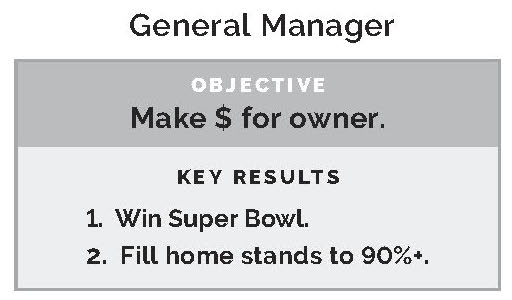
OKR Chart 1 — General Manager
My objective has two key results: win the Super Bowl and fill the stands to at least 90 percent capacity, which is HOW I will make money for the owner. If I fulfill both of those HOWs, there is no way we can fail to show a profit. So it’s a well-constructed OKR.
With our top-level OKRs set, we work our way down the organization.
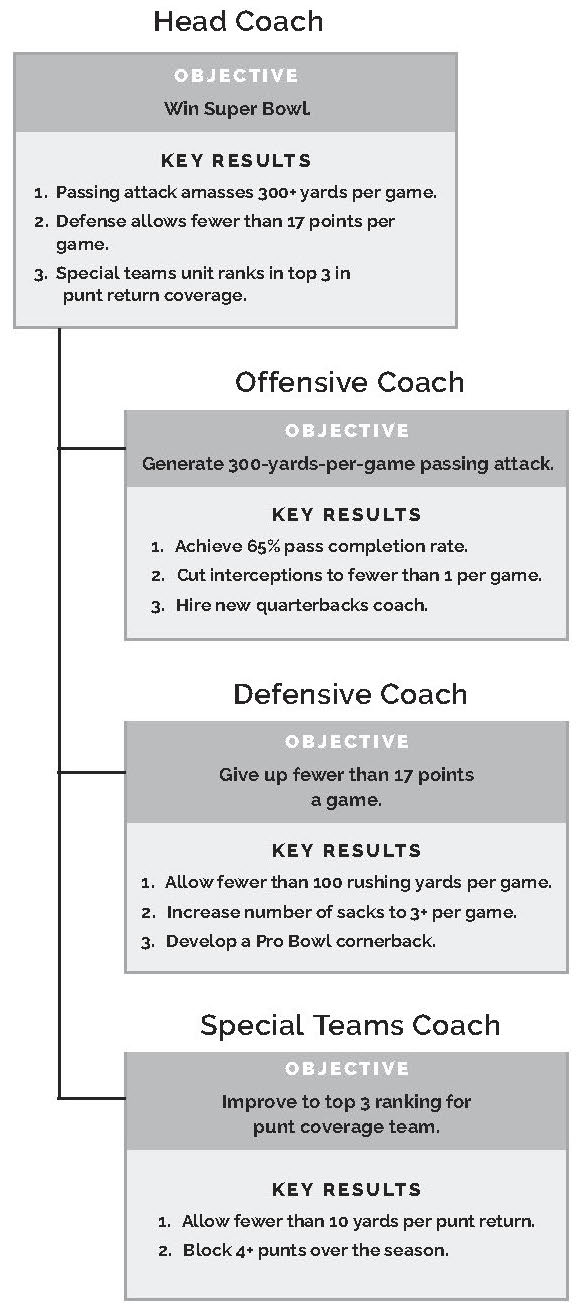
OKR Chart 2 — Coaches
As general manager, I cascade my goal down to the next level of management, the head coach and the senior vice president of marketing. My key results become their objectives. (See OKR Chart 2.) The head coach’s objective is to win the Super Bowl, with three key results to get him there: a passing attack of at least 300 yards per game, a defense surrendering fewer than seventeen points per game, and a top three ranking in punt return coverage. He cascades those KRs as objectives for his top three executives, the offensive and defensive coordinators and special teams coach. They in turn devise their own, lower-level key results. To achieve a 300-yards-per-game passing attack, for example, the offensive coordinator might aim for a 65 percent pass completion rate and less than one interception per game—after hiring a new quarterbacks coach.
These OKRs are aligned to the general manager’s aim to win the Super Bowl.
We are not done yet. We need to define how we’ll fill up our home stands.
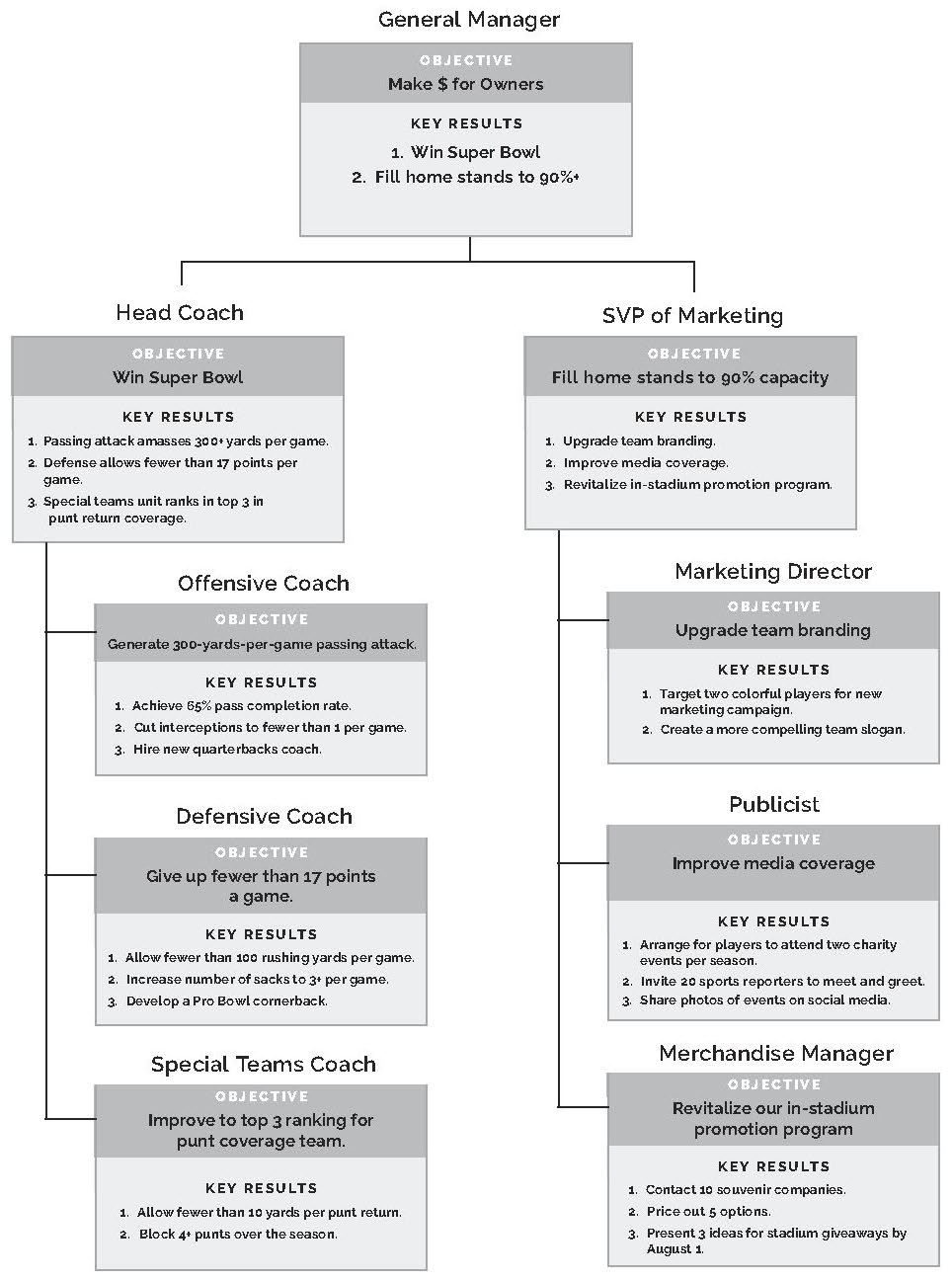
OKR Chart 3—OKRs for the Organization
Meanwhile, my SVP of marketing has derived her objective from my other key result, to fill the stands to 90 percent capacity. (See OKR Chart 3.) She’s crafted three key results: Upgrade the team’s branding, improve our media coverage, and revitalize the in-stadium promotion program. These KRs are cascaded as objectives for the marketing director, team publicist, and merchandise manager, respectively.
Now, what’s wrong with this picture? Here’s a clue: The SVP’s key results are a mess. Unlike the head coach’s KRs, they’re unmeasurable. They’re not specific or time bound. How do we define “improvement,” for example, in the team’s media coverage? (Five special features on ESPN? One cover spread in Sports Illustrated? Fifty percent more followers on social media?)
But even if the SVP came up with stronger key results, the organization’s goal-setting approach would remain deeply flawed. The top-line objective—to make a wealthy person wealthier—lacks intrinsic motivation for the general manager, much less for the team’s East Coast scout or the PR intern slaving away at the copy machine.
In moderation, cascading makes an operation more coherent. But when all objectives are cascaded, the process can degrade into a mechanical, color-by-numbers exercise, with four adverse effects:
-
A loss of agility. Even medium-size companies can have six or seven reporting levels. As everyone waits for the waterfall to trickle down from above, and meetings and reviews sprout like weeds, each goal cycle can take weeks or even months to administer. Tightly cascading organizations tend to resist fast and frequent goal setting. Implementation is so cumbersome that quarterly OKRs may prove impractical.
-
A lack of flexibility. Since it takes so much effort to formulate cascaded goals, people are reluctant to revise them mid-cycle. Even minor updates can burden those downstream, who are scrambling to keep their goals aligned. Over time, the system grows onerous to maintain.
-
Marginalized contributors. Rigidly cascaded systems tend to shut out input from frontline employees. In a top-down ecosystem, contributors will hesitate to share goal-related concerns or promising ideas.
-
One-dimensional linkages. While cascading locks in vertical alignment, it’s less effective in connecting peers horizontally, across departmental lines.
Bottoms Up!
Fortunately, we have an alternative. Precisely because OKRs are transparent, they can be shared without cascading them in lockstep. If it serves the larger purpose, multiple levels of hierarchy can be skipped over. Rather than laddering down from the CEO to a VP to a director to a manager (and then to the manager’s reports), an objective might jump from the CEO straight to a manager, or from a director to an individual contributor. Or the company’s leadership might present its OKRs to everyone at once and trust people to say, “Okay, now I see where we’re going, and I’ll adapt my goals to that.”
Considering that Google has tens of thousands of employees, its innovative culture would be hamstrung by OKRs cascaded by rote. As Laszlo Bock, a former head of the company’s People Operations, observes in Work Rules!:
Having goals improves performance. Spending hours cascading goals up and down the company, however, does not. . . . We have a market-based approach, where over time our goals all converge because the top OKRs are known and everyone else’s OKRs are visible. Teams that are grossly out of alignment stand out, and the few major initiatives that touch everyone are easy enough to manage directly.
The antithesis of cascading might be Google’s “20 percent time,” which frees engineers to work on side projects for the equivalent of one day per week. By liberating some of the sharpest minds in captivity, Google has changed the world as we know it. In 2001, the young Paul Buchheit initiated a 20 percent project with the code name Caribou. It’s now known as Gmail, the world’s leading web-based email service.
To avoid compulsive, soul-killing overalignment, healthy organizations encourage some goals to emerge from the bottom up. Say the Sand Hill Unicorns’ physical therapist attends a sports medicine conference and learns of a new regimen for injury prevention. Of her own volition, she coins an off-season OKR to implement the therapy. Her objective may not align with her direct manager’s OKRs, but it aligns with the general manager’s overarching objective. If the Unicorns’ top players stay healthy through the season, the team’s chances of winning the Super Bowl will soar.
Innovation tends to dwell less at the center of an organization than at its edges. The most powerful OKRs typically stem from insights outside the C-suite. As Andy Grove observed, “People in the trenches are usually in touch with impending changes early. Salespeople understand shifting customer demands before management does; financial analysts are the earliest to know when the fundamentals of a business change.”
Micromanagement is mismanagement. A healthy OKR environment strikes a balance between alignment and autonomy, common purpose and creative latitude. The “professional employee,” Peter Drucker wrote, “needs rigorous performance standards and high goals. . . . But how he does his work should always be his responsibility and his decision.” At Intel, Grove took a dim view of “managerial meddling”: “[T]he subordinate will begin to take a much more restricted view of what is expected of him, showing less initiative in solving his own problems and referring them instead to his [or her] supervisor. . . . [T]he output of the organization will consequently be reduced. . . .”
An optimal OKR system frees contributors to set at least some of their own objectives and most or all of their key results. People are led to stretch above and beyond, to set more ambitious targets and achieve more of those they set: “The higher the goals, the higher the performance.” People who choose their destination will own a deeper awareness of what it takes to get there.
When our how is defined by others, the goal won’t engage us to the same degree. If my doctor orders me to lower my blood pressure by training for the San Francisco Marathon, I might grudgingly take it under advisement. But if I decide of my own free will to run the race, I’m far more likely to reach the finish line—especially if I’m running with friends.
In business, I have found, there is rarely a single right answer. By loosening the reins and backing people to find their right answers, we help everybody win. High-functioning teams thrive on a creative tension between top-down and bottom-up goal setting, a mix of aligned and unaligned OKRs. In times of operational urgency, when simple doing takes precedence, organizations may choose to be more directive. But when the numbers are strong and a company has grown too cautious and buttoned-up, a lighter touch may be just right. When leaders are attuned to the fluctuating needs of both the business and their employees, the mix of top-down and bottom-up goals generally settles at around half-and-half. Which sounds about right to me.
Cross-functional Coordination
Even as modern goal setting successfully transcends the org chart, unacknowledged dependencies remain the number one cause of project slippage. The cure is lateral, cross-functional connectivity, peer-to-peer and team-to-team. For innovation and advanced problem solving, isolated individuals cannot match a connected group. Product relies on engineering, marketing on sales. As business becomes more intricate and initiatives more complex, interdependent divisions need a tool to help them reach the finish line together.
Connected companies are quicker companies. To grab a competitive advantage, both leaders and contributors need to link up horizontally, breaking through barriers. A transparent OKR system, as Laszlo Bock points out, promotes this sort of freewheeling collaboration: “People across the whole organization can see what’s going on. Suddenly you have people who are designing a handset reaching out to another team doing software, because they saw an interesting thing you could do with the user interface.”
When goals are public and visible to all, a “team of teams” can attack trouble spots wherever they surface. Adds Bock: “You can see immediately if somebody’s hitting the ball out of the park—you investigate. If somebody’s missing all the time, you investigate. Transparency creates very clear signals for everyone. You kick off virtuous cycles that reinforce your ability to actually get your work done. And the management tax is zero—it’s amazing.”