8
Align: The MyFitnessPal Story
Mike Lee
Cofounder and CEO
It all started with a beach wedding. Heading into their nuptials, Mike and Amy Lee wanted to lose some weight. A fitness trainer gave them a list of the nutritional values of three thousand foods—and a pad of paper for tracking calories. Mike, who’d programmed computers since the age of ten, knew there had to be a better way. So he conceived a solution, which became MyFitnessPal. For eight years, Mike and Albert self-funded the app from savings and credit cards.
Today, the brothers Lee are at the center of an epic movement for quantitative, self-digital health and personal well-being. Their mission is to create a healthy planet. In 2013, when Kleiner Perkins invested in MyFitnessPal, the app had 45 million registered users. Today it has more than 120 million, and they’ve lost a collective 300 million pounds. With a database of 14 million foods plus real-time links to Fitbit and dozens of other apps, MyFitnessPal makes it easier than ever to track what you eat and how effectively you exercise. By revealing what used to be hidden—the calories you burn on your morning run, for example—MyFitnessPal helps users set and achieve ambitious personal goals. Members make daily choices that change their lives. As a bonus, the app comes with a network of friends who cheer you on each day.
OKRs are not islands. To the contrary, they create networks—vertical, horizontal, diagonal—to connect an organization’s most vital work. When employees align with a company’s top-line goals, their impact is amplified. They stop duplicating efforts or working counterproductively against the grain. As brothers Mike and Albert Lee discovered while building MyFitnessPal, the world’s leading health and fitness app, strong alignment is critical to the day-to-day progress that kindles the next big leap.
If this story sounds like a perfect setting for OKRs, you’re not mistaken. Goal setting came organically for Mike and Albert—though not always easily, as you will see. In February 2015, their company was acquired by Under Armour for $475 million. The merger married MyFitnessPal’s strength in technology to one of the industry’s great brands. Suddenly the Lees had access to world-class professional athletes, the next frontier for digital fitness. As Mike says, “We want to skate to where the puck is going.”
The new business structure brought new challenges for goal setting, around alignment in particular. Mike and Albert would rely on OKRs to navigate a labyrinth of internal relationships. As MyFitnessPal dove into a much larger pond, objectives and key results would align its growing team and their goals.
Mike Lee: You have a device in your pocket that’s incredibly powerful. The data it collects—on yourself and the world around you—is exploding. For a nominal cost or none at all, you can have a coach or a nutritionist or even a medical consultant on hand at all times. Thanks to our smartphones, we can make healthier decisions and lead healthier lifestyles.
MyFitnessPal provides insights—we call them “moments of clarity”—that stick with our users all their lives. I know firsthand that it works. When I first began tracking what I ate, I learned that mayonnaise has ninety calories per tablespoon, and mustard only five. I haven’t touched a drop of mayo since. Make enough of those small changes, and you’ll find they add up.
I worked for a number of companies before cofounding MyFitnessPal. None of them used formal goal-setting systems. They had annual financial plans, revenue numbers to hit, and broad strategies around them, but nothing structured or continuous. Not coincidentally, those organizations shared something else in common: a glaring lack of alignment. I’d have no clue as to what other teams were doing, or how we might work together toward a common objective. We’d try to compensate with more meetings, which only wasted time. If you put two people in a boat and have one row east and the other row west, they’ll use up lots of energy going nowhere.
In our early days at MyFitnessPal, we’d joke that we had a thousand-item to-do list, and we’d cross off the top three items and say, “Okay, that was a good year.” We left a lot below the line, but that was okay. We worked within our limits: launch the Android app, or the BlackBerry app, or the iPhone or iPad version. We tackled one goal at a time and worked until it was done, and then we moved to the next item on the list. Rarely was there overlap.
Our process wasn’t sophisticated, but it was focused and highly measurable. When you’re defining a company’s strategy on your own, with just one other person working on products, alignment is simple. My brother and I would declare a keystone goal—launch on the iPad by such-and-such a date—and communicate each day on our progress. Small organizations can get by with less process. Though now I wish we’d had our OKRs in gear earlier on, even before we got funded. We’d have been better prepared to make sounder choices when opportunity came our way.
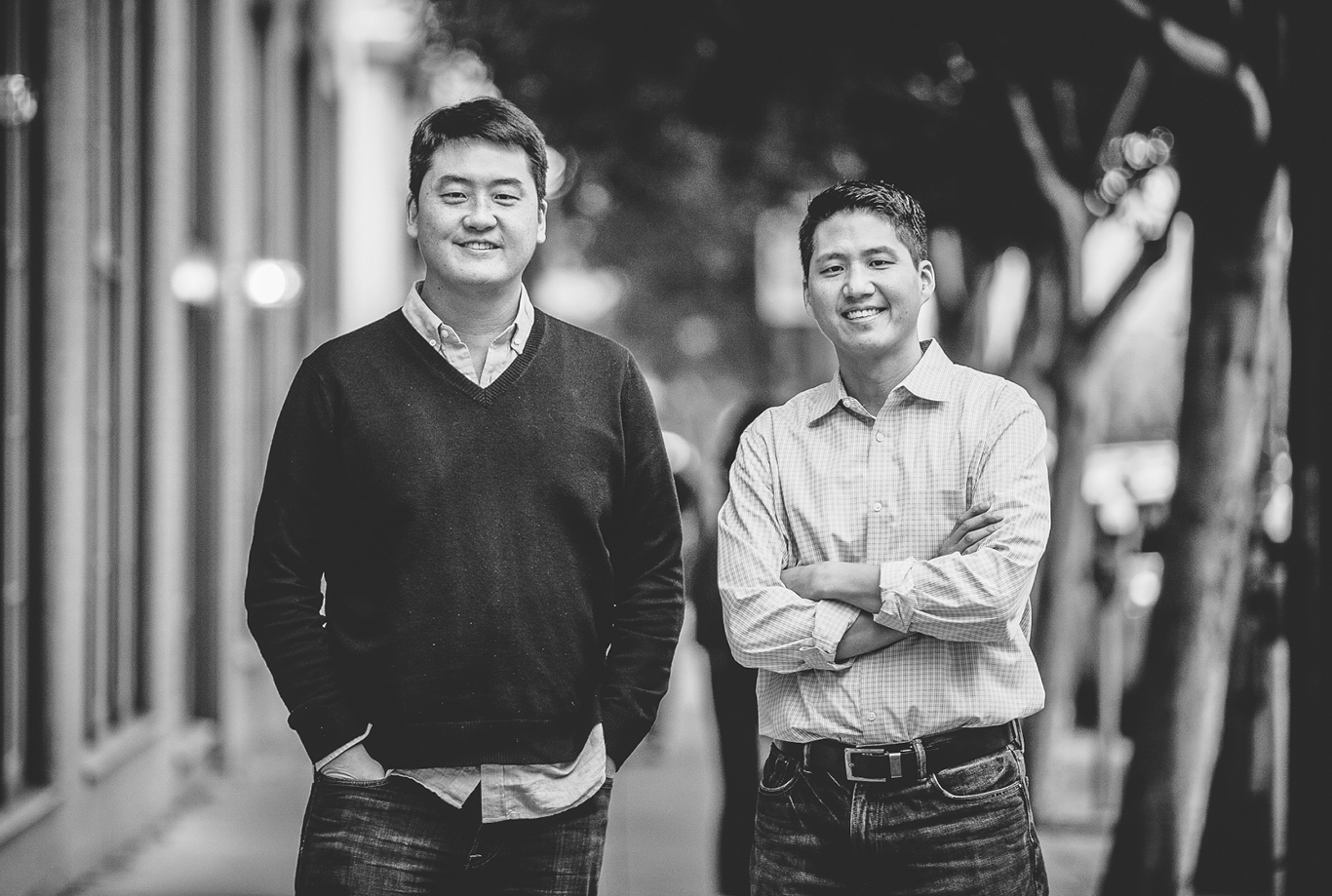
MyFitnessPal cofounders Mike and Albert Lee, 2012.
Once MyFitnessPal got up and running on the iPhone and Android, our growth shot off the charts. One day we woke up and had 35 million registered users. We were scaling too fast to do one thing at a time anymore. I found that entropy begins when you have two great people directly under you. You want to give each of them something big and purposeful to work on, and they both naturally want to move their piece of the project, and soon they’re pulling out of alignment and charging in different directions. Before you know it, they’re working on two different things. It doesn’t help to push them harder. If two nails are even slightly misaligned, a good hammer will splay them sideways.
Though Albert and I knew we needed more structure in our goal setting, we weren’t certain how to proceed. In 2013, not long after Kleiner Perkins first invested in our company, John Doerr came by to pitch us on OKRs. His football team analogy resonated with me; I just got it. I loved the simplicity of the main objective, and the way it was distilled and stretched and cascaded through the organization. And I thought to myself: That was how we’d get our company aligned.
Cross-team Integration
When we began to implement OKRs, it was harder than anticipated. We didn’t appreciate how much thought it took to create the right company objectives, and then to cascade them down to drive contributors’ behavior. We found it challenging to strike a balance between high-level, strategic thinking and more granular, directive communication. Once we had our Series A funding and scaled up our leadership team, our realm of the possible expanded. In a push for accountability, we set one big dedicated goal for each leader. We created company OKRs for people instead of matching people to our OKRs—we had it backward. Some objectives were too narrow, others too nebulous. If an HR manager got stuck trying to connect to the high-level goals for product or revenue, we’d add a top-line objective just for that person. Soon we had a cornucopia of company OKRs, but what really mattered at MyFitnessPal? We’d lost the forest for the trees.
In 2013, as we jumped from ten to thirty people, I assumed we’d become 200 percent more productive. I’d underestimated how much scaling slows you down. New engineers need extensive training before they can be as proficient as your holdovers. And with multiple engineers developing the same project, we had to build new processes to keep them from overriding one another. In the transition, productivity took a hit.
When you come down to it, alignment is about helping people understand what you want them to do. Most contributors will be motivated to ladder up to the top-line OKRs—assuming they know where to set the ladder. As our team got larger and more layered, we confronted new issues. One product manager was working on Premium, the enhanced subscription version of our app. Another focused on our API platform, to enable third parties like Fitbit to connect to MyFitnessPal and write data to it or applications on top of it. The third addressed our core login experience. All three had individual OKRs for what they hoped to accomplish—so far, so good.
The problem was our shared engineering team, which got caught in the middle. The engineers weren’t aligned with the product managers’ objectives. They had their own infrastructure OKRs, to keep the plumbing going and the lights on. We assumed they could do it all—a big mistake. They got confused about what they should be working on, which could change without notice. (Sometimes it boiled down to which product manager yelled loudest.) As the engineers switched between projects from week to week, their efficiency dragged. When returning to a product after an interruption, they’d have to ask themselves: How does this go again? The Premium work was especially urgent for revenue, yet it went in fits and starts.
I felt super-frustrated. We’d hired all these talented people and were spending tons of money, but we weren’t going any faster. Things came to a head over a top-priority marketing OKR for personalized emails with targeted content. The objective was well constructed: We wanted to drive a certain minimum number of monthly active users to our blog. One important key result was to increase our click-through rate from emails. The catch was that no one in marketing had thought to inform engineering, which had already set its own priorities that quarter. Without buy-in from the engineers, the OKR was doomed before it started. Even worse, Albert and I didn’t find out it was doomed until our quarterly postmortem. (The project got done a quarter late.)
That was our wake-up call, when we saw the need for more alignment between teams. Our OKRs were well crafted, but implementation fell short. When departments counted on one another for crucial support, we failed to make the dependency explicit. Coordination was hit-and-miss, with deadlines blown on a regular basis. We had no shortage of objectives, but our teams kept wandering away from one another.
The following year, we tried to fix the problem with periodic integration meetings for the executive team. Each quarter our department heads presented their goals and identified dependencies. No one left the room until we’d answered some basic questions: Are we meeting everyone’s needs for buy-in? Is a team overstretched? If so, how can we make their objectives more realistic?
Alignment doesn’t mean redundancy. At MyFitnessPal, every OKR has a single owner, with other teams linking up as needed. As I see it, co-ownership weakens accountability. If an OKR fails, I don’t want two people blaming each other. Even when two or more teams have parallel objectives, their key results should be distinct.
Each time we went through the OKR process, we did a little better. Our objectives got more precise, our key results more measurable, our achievement rate higher. It took us two or three quarters to really get the hang of it, particularly for product features keyed to a broad objective. It’s not easy to predict the market for the conceptually new; we’d wildly beat our metric or wildly miss. So we switched it up. We began pinning our key results to deadlines instead of revenue or projected users. (Example: “Launch MFP Premium by 5/1/15.”) After a feature launched and some real data came back, we’d be in a stronger position to assess its impact and potential. Then our next round of OKRs could be more realistically keyed (or stretched) to projected outputs.
At times we’d see our team choosing lower-risk key results, like sending emails here or push notifications there. The more ambitious the stretch in the objective, the more conservatively people made their KRs—a classic unintended consequence. So we learned to design our goals to fit the context. Where appropriate, we went for the incremental. But there were times when we told the team, “Don’t worry about monthly active user impact on this one. Just build the best feature you can. We want you to swing for the fences.”
Unacknowledged Dependencies, Writ Larger
Going with Under Armour meant adapting to a company with a whole different mode of goal setting. Suddenly I had a boss to align with and a newly formed division to run: UA Connected Fitness–North America. Our mandate was to leverage emerging digital technologies to improve fitness and performance. I had three additional apps to coordinate, each with a different culture and working style.
At scale, alignment grows exponentially more complex. How would we show four hundred people what we were trying to achieve, to help them align with us and with one another? How could we get everybody rowing in the same direction? In the beginning, I found it really hard to do; I can hardly imagine how Amazon or Apple manages. When we introduced OKRs throughout our division, it made a big difference.
A few weeks after our acquisition, my boss called an off-site leadership meeting for twenty people, including Connected Fitness stakeholders across the company. Since Under Armour followed an annual cadence, department heads were to present what they aimed to achieve that year. At MyFitnessPal, we were accustomed to investing the time to frame our objectives correctly. Our group was ready.
As the meeting unfolded, Albert and I were surprised to discover that the ecommerce team was counting on us to drive significant traffic from our apps. The data team assumed we’d deliver a mass of data. The media sales team had marked us down for a set dollar amount in new ad revenues. All three had preconceived notions of what they could expect from us, with no visibility into what other teams were asking. Nor could anyone see how their targets might align with our own growth objectives, much less the bigger company picture. There were unacknowledged dependencies wherever we looked. It was our old problem at MyFitnessPal, on steroids. There was simply no way we could get all these things done.
It took eighteen months to straighten out our division’s alignment, and we couldn’t have done it without OKRs. First, we had to define our capacity constraints for developing new software. Then we had to clarify our core priorities. By sharing our high-level OKRs for Connected Fitness, I could explain why certain projects required the allocated time, and where we should be doubling down on the company’s top goals. “This is the process we use,” I said, “and I’m showing you our objectives and key results. You need to let me know if you see anything missing, or if you think we’re working on the wrong things.”
It was one-way transparency, and I felt a little nervous going in, but it worked. People began to recognize our limits and adjust their expectations accordingly. For our part, we worked to align with them by finding projects that met cross-departmental objectives.
When Albert took hold of our MapMyFitness product team, first he examined the road map and said, “We need to cut half of this, right? We need to strip it down to the things that really matter.” Now we evaluate product features the MyFitnessPal way: “If we take this one off the road map this quarter, what happens? Would it really affect the user experience?” More often than not, the feature in question wouldn’t make a big difference. These calls are not subjective; we have metrics to measure impact. We’re making tougher, sharper choices about where to place our bets these days, and they all stem from the OKR process.
Focus and alignment are binary stars. In May 2015, three months after Under Armour acquired us, our Premium subscription version finally launched. It couldn’t happen until we openly admitted, “Look, we can’t get all of these things done. We have to choose.” We had to make it clear to the company that Premium was our number-one objective, above all else.
We’re still a work in progress. Shortly after the merger, two of our four apps simultaneously implemented maps inside their run-tracking functions. Because they’d failed to collaborate in development, they built their maps in different ways with different providers. Beyond the obvious inefficiency, our customers’ experience would be inconsistent. To their credit, the two teams devised a monthly check-in to avoid similar problems in the future. Shortly thereafter, we implemented OKRs throughout the division. Now we’re all on the same page. Everyone knows our group’s top priorities, which gives them freedom to say no to other things.
North Star Alignment
Though our start-up days are behind us, we’re still ambitious goal setters. We still stand by our OKR values of transparency and accountability. We publish our objectives on a wiki that anybody in the company can see. We discuss them at weekly all-hands meetings. At a recent off-site retreat, I demonstrated our OKR process to the larger leadership group—and they just ate it up. “Best off-site we’ve ever had,” one executive said. With OKRs entrenched as the operational foundation for Connected Fitness, my hope is to spread them by example throughout Under Armour. The larger the organization, the more value the system offers.
Beyond making objectives more consistent within a company, alignment contains a deeper meaning. It’s about keeping your goals true to your North Star values. Connected Fitness is deliberately aligned with Under Armour’s mission “to make all athletes better.” At the same time, we still live by the old MyFitnessPal mantra: When our customers succeed at reaching their health and fitness goals, we succeed as a company. As a team, we’re still posing the question that Albert and I asked each other at the beginning: Will this feature—or this partnership—help our customers succeed?
After all, it’s our users who do the hard work to change their lives. Like the woman who rose from her chair without using her hands, for the first time in twenty years—a poignant moment of clarity. To the extent we’ve succeeded as a company, it’s in helping to provide those moments. Whenever possible, we spell this out in our high-level objectives, as you can see in the following OKR from a few years back:
OBJECTIVE
Help more people around the world.
KEY RESULTS
-
Add 27M new users in 2014.
-
Reach 80M total registered users.
Every decision we make needs to square with our vision. When we face a trade-off between our customers and a business goal, we align with the customer. When an objective seems out of line with our mantra, it gets extra scrutiny. Before moving forward, we make sure it lines up with our North Star. That’s what keeps us walking the walk and connected with the people we serve. That’s what makes us who we are.