9
Connect: The Intuit Story
Atticus Tysen
Chief Information Officer
Intuit has made Fortune’s prestigious list of the “World’s Most Admired Companies” for fourteen years running. The firm made its first splash in the 1980s with Quicken, which brought personal finance to the desktop computer and became a household name. Then came tax preparation software (TurboTax) and a desktop accounting program (QuickBooks), which eventually moved online. Over its long history, by tech standards, Intuit has survived one competitive threat after the next by staying a step ahead. Most recently, it sold Quicken and reconstructed QuickBooks Online as an open platform. Subscriptions soared by 49 percent. “Whenever Intuit makes a wrong turn,” UBS analyst Brent Thill told The New York Times, “they quickly get off the gravel and back onto the blacktop. That’s why the company has done so well for such a long time.”
People can’t connect with what they cannot see; networks cannot blossom in silos. By definition, OKRs are open and visible to all parts of an organization, to each level of every department. As a result, companies that stick with them become more coherent.
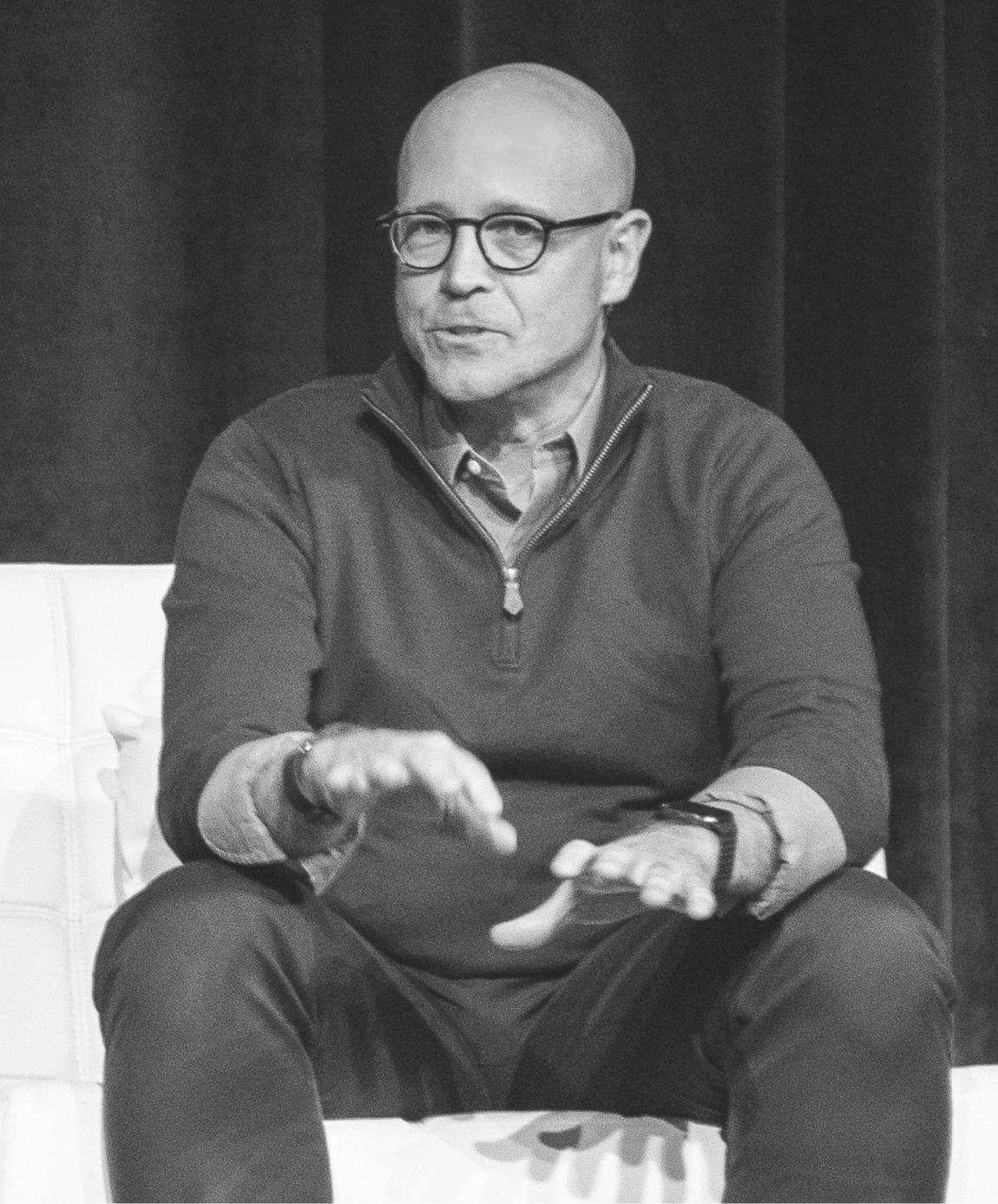
Intuit CIO Atticus Tysen at Goal Summit, 2017.
Adaptable organizations tend to be more openly connected ones. Intuit’s culture of transparency was ingrained by cofounder Scott Cook and strengthened by “Coach” Bill Campbell, who served as Intuit’s CEO and longtime chairman. “Bill was one of the most open guys I’ve ever met,” says Atticus Tysen, Intuit’s senior vice president and chief information officer. “He could read people and he invested in them. You always knew what he was thinking and that he was in your corner.”
The Coach’s legacy lives on. A few years ago, to help the IT department adapt as Intuit moved to the cloud, Atticus introduced OKRs to his direct reports. The following quarter, he rolled the system down to the director level; the quarter after that, to all six hundred IT employees. He was determined not to force the new process. “We didn’t want bureaucratic compliance,” Atticus says. “We wanted enthusiastic compliance. I wanted to see if the OKR system would succeed on its own—and it really did.”
Each quarter, Intuit’s IT group tackles about 2,500 active objectives. As they’ve built their goal-setting muscle with real-time, automated data and routine check-ins, users align roughly half of their OKRs with the goals of higher-ups or their department. Collectively, they view their managers’ OKRs more than four thousand times per quarter, or seven views per employee—a strong marker of frontline engagement. After the Lasik surgery of OKRs, contributors see clearer links between their own day-to-day work, their colleagues’ priorities, their team’s quarterly objectives, and the company’s “True North” mission.
Intuit’s story demonstrates the benefits of an OKR pilot project before (or even without) a full-company rollout. A few hundred users may suffice for an OKR laboratory, to iron out any kinks before deployment at scale. At Intuit, says CEO Brad Smith, who posts his own goals in his office for anyone to see, connected goal setting “is critical to enabling employees to do the best work of their lives.”
Atticus Tysen: I’d been working at Intuit for eleven years on the product side before moving to the IT department. Then, in 2013, I became CIO. I made the switch because I loved the company, and I knew IT needed to evolve to help Intuit on its new mission. It was a stressful, exciting time. The organization was pivoting in several directions at once: from desktop software to cloud-based software, from a closed platform to one that was open to thousands of third-party apps, from a North American company to a global company. As we leaned into our long-term strategy to become an integrated ecosystem, we gradually changed from a house of brands (TurboTax, Quicken, QuickBooks) to the branded house of Intuit.
In the storm of any disruption, IT will bear the brunt of in-house frustrations. Partly it’s because the operation tends to be opaque. Any thirty-plus-year-old company accumulates layers of complex technology—especially a technology company. In IT, we’re always juggling the needs of internal partners with the demands of our end users. We bridge technology and business outcomes. Maybe toughest of all, we must balance the task of making systems work perfectly today (as our people expect) with our mandate to invest in the future. For example: Intuit used to have nine different billing systems to serve our array of products, and each of them had special challenges. When you’re putting out fires every day, it’s hard to build a next-generation billing technology.
How could we signal to our workforce what mattered most while keeping them all up and running? And how could we assure all hands that we had their concerns covered? In a conventionally siloed organization, activity is opaque. People might try to look into what’s going on outside their own department, but they often don’t know where to start or have the time to follow up.
At Intuit, change started at the top. To jump-start our transformation, our chairman and CEO, Brad Smith, installed a company-wide goal-setting system. Brad is very conscious and intentional about this. Once each month, managers meet with their reports to discuss individual goals. The system has built-in, 360-degree feedback, with both parties comparing notes on a regular basis.
Our company has a long cultural history around learning and experimentation. We try a lot of things, keep the elements that work best, and adapt them to make them our own. I agreed to partner with HR to try OKRs in Enterprise Business Solutions, or EBS (our moniker for IT). Back in 2014, I first discovered objectives and key results while Googling “goal setting.” My research suggested that OKRs might help us change the way we operate, even how we perceive ourselves.
Modern IT goes way beyond checking off boxes to process help tickets or change requests. It’s about adding value to the business—shedding redundant clone systems, creating new functionality, finding future-oriented solutions. To become the team Intuit needed, our EBS would need to change root and branch. Our leaders had to give people air cover to back-burner some day-to-day tasks and focus on more valuable, longer-term initiatives.
Today, every employee in my department owns three to five business objectives per quarter, along with one or two personal ones. The system is powerful precisely because it is so simple—and so transparent. For our OKRs to be effective, I knew they’d have to be visible through all of Intuit, even if no one outside EBS used them. I wanted everyone in the company to know exactly what we were doing, and how, and why. When people understand your priorities and constraints, they’re more apt to trust you when something goes sideways.
Early on, I found it challenging to separate my individual goals from the department’s OKRs. As IT’s leader, I thought they should logically coincide. But it wasn’t a good optic. Most of our top-level objectives endured from quarter to quarter, typically for eighteen months. Down the line, teams and individuals would modify their own OKRs as the environment shifted and we kept making progress. And they were asking, quite reasonably, “What is the CIO doing if his goals never change?” I got the message. Now I have my own objectives, and I ladder up to our top-level OKRs like everyone else.
Beyond our base in the Bay Area, we made it a point to implement the system worldwide. EBS has formal teams in four U.S. regions and in Bangalore, the high-tech center of southern India, plus support teams in every Intuit location around the globe. When people work outside the center, they’re left to wonder what gets done at headquarters. (And headquarters may wonder about them, too.) OKRs ended the mystery. They made us more cohesive; they brought us together.
One of our top-level EBS objectives is to “rationalize, modernize, and secure all technology used to run Intuit.” (See here.) Lately, whenever I travel to see a team in Texas or Arizona, I hear our people saying, “This project is rationalizing our portfolio.” Or: “How can we modernize that system?” No matter where they happen to be stationed, they’re using the same three verbs. When a new project comes up for discussion, they’ll ask one another how it fits into our OKR template. If it doesn’t, they’ll rightly raise a red flag: “Why are we doing this?”
OBJECTIVE
Modernize, rationalize, and secure the technology used to run the business of Intuit.
KEY RESULTS
-
Complete migration of Oracle eBusiness Suite to R12 and retire 11.5.9 this quarter.
-
Deliver wholesale billing as a platform capability by end FY16.
-
Complete onboarding of agents in small business unit to Salesforce.
-
Create a retirement plan for all legacy technology.
-
Draft and get alignment on new Workforce Technology strategies, road maps, and principles.
Live Data from the Cloud
Intuit views itself as a thirty-four-year-old start-up. Beginning with the personal computer in the 1980s, our history reflects a series of tech disruptions, with each new platform upending its predecessor. Our first product was on DOS. Then we moved to Windows and Macintosh on the desktop, then to mobile devices, and most recently to the cloud.
OKRs can be deployed to even greater effect in the cloud era. Horizontal alignment comes naturally. With open, public goal setting, the data and analytics team could see from the start what our financial systems team had in mind. It was immediately obvious that they should be working together, in parallel. The teams linked up their objectives in real time, rather than after the fact—a sea change from our historical way of doing things.
At a desktop software company, leaders look at operations through a twentieth-century retail lens. They postmortem sales reports and channel flow. While they do their best to predict where the business might be headed, their line of sight is largely limited to the rearview mirror. By contrast, a cloud-based business wants to know what is happening now. How many subscriptions came in this week? How many trials are ongoing? What’s our conversion rate? A customer can Google an online product, skim the marketing page, take it for a spin, and make a purchase—all in ten minutes or less. For leaders to keep pace, they should be checking their funnel on a daily basis. At EBS, we need to be thinking about real-time reporting, data, and analytics, even as we build out features like wholesale billing. We’ve captured this necessity in a top-level objective:
OBJECTIVE
Enable every Intuit worker to make decisions based on “live” data.
KEY RESULTS
-
Deliver functional data marts for HR and Sales.
-
Complete migration to new Enterprise Data Warehouse built for real-time access.
-
Create single team operating all data visualization tools across Intuit to drive a unified strategy.
-
Create teaching module to help people in other teams use data visualization tools.
A Tool for Global Collaboration
As Intuit becomes more global, asynchronous collaboration is increasingly a way of life. When we’re working from headquarters with our team in Bangalore, live video has limited utility. Given the thirteen-hour time difference, our associates in India will be sleeping when we’re working, and vice versa. Three years ago, there were few practical options. Intuit invested in the latest workplace tools, but we lacked solutions for persistent chat, collaborative authoring, and videoconferencing. People were forced to improvise, with uneven results. Productivity slipped.
To attack the problem in a more connected way, we upgraded a key result for workforce technology to its own top-level OKR. In the space of six months, our new strategic emphasis led us to add several new tools, all integrated into a single authentication system: Slack for persistent chat, Google Docs for collaborative editing, Box for content management, BlueJeans for next-wave video technology. Our open OKR platform helped teams across EBS to make the transition and align with our new top-line objective. Now our people can focus on their work instead of wasting time to figure out which tool to use.
There’s an art to goal setting, and more than a few judgment calls. If you choose to temporarily elevate a key result, it helps to be candid about it. Leaders need to explain, “Yes, I want us to focus on that one right now as a top-level objective. When it no longer needs the extra attention, we’ll let it drift back down into a KR.” It’s a dynamic system. You’re always adjusting the altitude.
OBJECTIVE
Deliver awesome end-to-end workforce technology solutions and strategies.
KEY RESULTS
-
Implement Box pilot for first 100 users by mid-quarter.
-
Complete BlueJeans rollout to final users by end of the quarter.
-
Transfer first 50 individual account Google users to enterprise account by end of the quarter.
-
Finalize Slack contract by end of month 1 and complete rollout play by end of the quarter.
Studies have told us forever that frontline employees thrive when they can see how their work aligns to the company’s overall goals. I’ve found this especially true at our remote sites. I’ve heard it from people in Bangalore: “My objective is directly a key result of my manager’s OKR, which ties directly to the top-level EBS objective, which ties to the company’s shift to the cloud. Now I understand how what I’m doing in India connects to the company mission.” That’s a powerful realization. OKRs have consolidated our far-flung department. Thanks to structured, visible goal setting, our boundaries have melted away.
Horizontal Connections
Intuit was a flat organization from the start, with just a handful of tiers between the CEO and frontline employees. Our founder, Scott Cook, believed the best idea should win, not the biggest title, and that still holds true today. From the day I came in as a group manager, I was impressed by the collaborative culture. Even when we ran things in silos, we were vertically open. You could always speak freely to your manager, or your manager’s manager, and get a respectful hearing.
OKRs have opened our department horizontally, across teams. At first it was awkward. Everybody in IT instinctively wanted to align with their managers’ goals—or with mine. I went into the platform one day and found literally hundreds of key results linked to one of my top-level objectives. I told people, “Your manager is still your manager. You’ll continue to collaborate—none of that’s going to change. But you need to disconnect from us and connect to each other.”
Our ecommerce and billing teams work under separate vice presidents who roll up to me. If ecommerce is building a shopping cart, billing needs to bring related features to market. In the old way, the two engineering teams ran independently and reported to their respective program managers, who tried (with variable success) to connect from above. The people doing the actual work had no direct contact.
Now, with horizontally transparent OKRs, our engineers intentionally connect as they link to each other’s objectives. Quarter by quarter, they iterate against the department’s objectives while devising how best to coordinate with their peers. We’re trending away from senior committee mandates and toward real autonomy. Our EBS leaders still set the context, ask the big questions, and furnish relevant data. But it’s our interconnected groups whose insights are propelling us forward—together.