11
Track: The Gates Foundation Story
Bill Gates
Cochairman
Patty Stonesifer
Former CEO
In 2000, the newly hatched Bill & Melinda Gates Foundation became something the world had never seen: a $20 billion start-up. Though Bill Gates had recently stepped down as CEO of Microsoft, he was still the company’s chairman and chief product strategist. He had to find a way to channel the foundation’s vast ambition, adapt to fluid conditions in the field, and allow himself—the extremely busy, famously fast-moving founder—to make the best possible choices. The higher the stakes, the more important it is to track progress—to flag looming problems, double back from dead ends, and modify goals on the run.
The newborn institution had signed on for the most audacious mission imaginable: “Everyone deserves a healthy and productive life.” So its leaders enlisted scores of brilliant people who’d devoted their lives to global health and told them, “Quit thinking about incremental progress. What would you do if you had unlimited resources?”
By 2002, the foundation had scaled to the point where it urgently required a more structured form of goal setting. After CEO Patty Stonesifer heard my OKR pitch at an Amazon board meeting, she asked me to present it to the foundation. The rest is OKR history.
Patty Stonesifer: We had the beautiful gift of a blank sheet of paper: “How do you want to change the world?” But the gift also had a huge weight to it. Because when you have that big of a goal, how can you know you’re making progress?
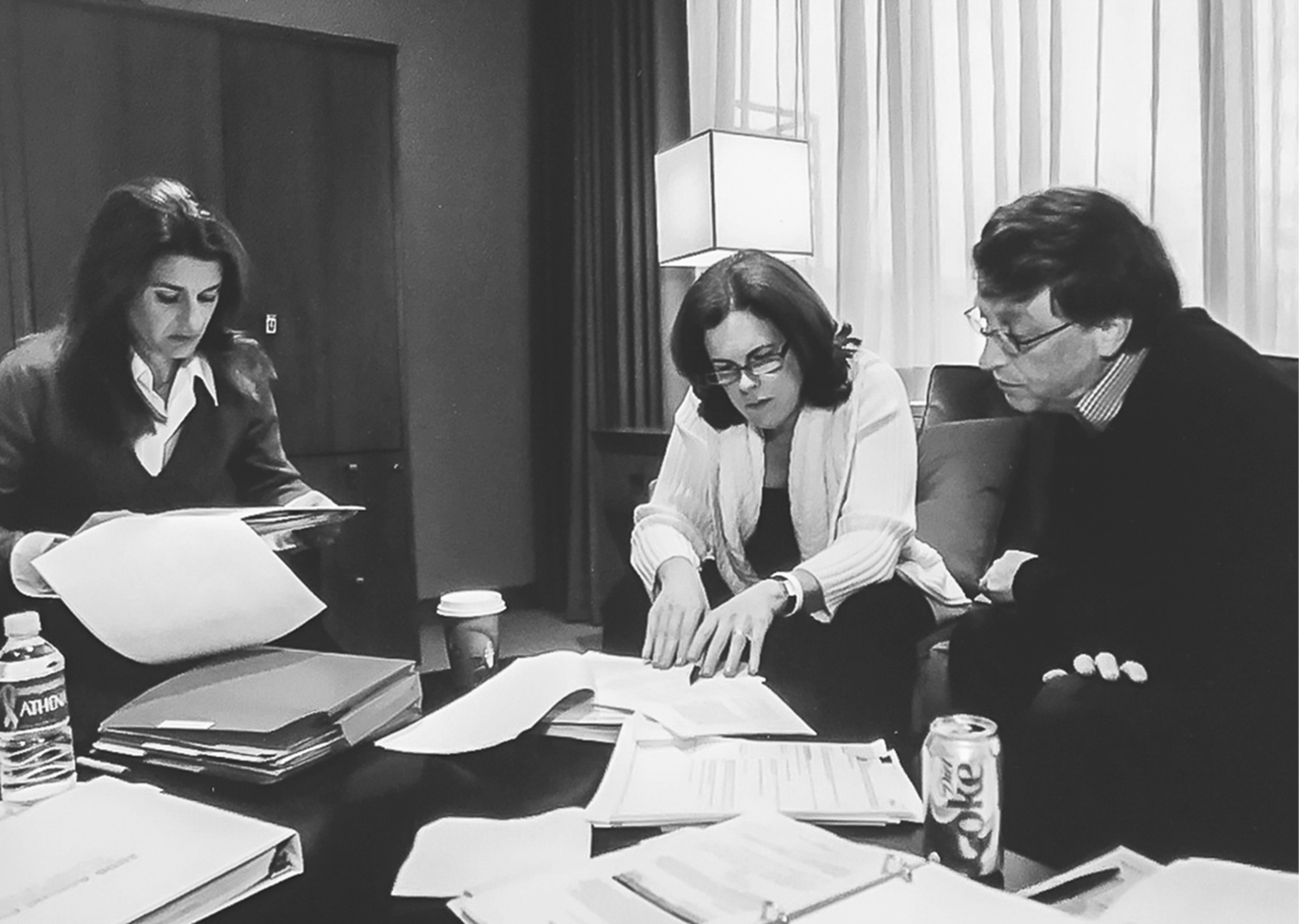
Melinda Gates, Patty Stonesifer, and Bill Gates reviewing OKRs, 2005.
We felt driven to be responsible with the capital. Bill and Melinda wanted to know that a disciplined system was in place to direct our hard choices. We borrowed from Jim Collins: “What can you be the best at in the world?” Once we figured that out, we laid the OKR system on top of it. We believed that everyone should have a healthy and productive life, and Bill and Melinda were passionate about the role of technology in creating change. That was in our DNA.
For a time we used a global health metric called Disability-Adjusted Life Years, or DALY. It gave us a data-driven framework for key results—say, to measure the impact of an investment in micronutrients against one to fight river blindness. DALY led us to focus on vaccines, which make such an enormous difference in productive life years. Now we had a credible metric, reinforced by our key results. OKRs made it all so clear.
Bill Gates: Ambitious, directional goals were always super-important at Microsoft. It was natural, in a way, because from a very young age I thought software was magic. In those early days, the exponential increase in transistors actually mapped to the performance of the device. We understood what the chips people were going to give us and that there was no end in sight, and that the storage and communication people likewise were writing exponential code. The screen people weren’t quite as exponential, but the graphical user interface would be fast enough. There was only one missing element: the magic software to make the device do something interesting. I gave up on being a lawyer or a scientist, surefire things, because the idea of what would happen with all that intelligence—what I called “information at your fingertips”—was just so fascinating. It was mind-blowing to me.
Even before Paul Allen and I started the partnership, we were saying: A computer on every desk and in every home. IBM and other people—with resources and skill sets way beyond ours—weren’t aiming for that goal. They didn’t see it as a possibility, so they weren’t pushing as hard to make it a reality. But we could see that it would happen. Moore’s law would make things cheaper and get the software industry to critical mass. Those were big, big goals, and they started early for us.
That was our biggest advantage: We aimed higher.
Making Goals Concrete
In the year 2000, Melinda and I put $20 billion into the Gates Foundation. Suddenly it’s both a start-up and the biggest foundation in the world. And the way the payout rules work, it has to spend a minimum of a billion dollars a year.
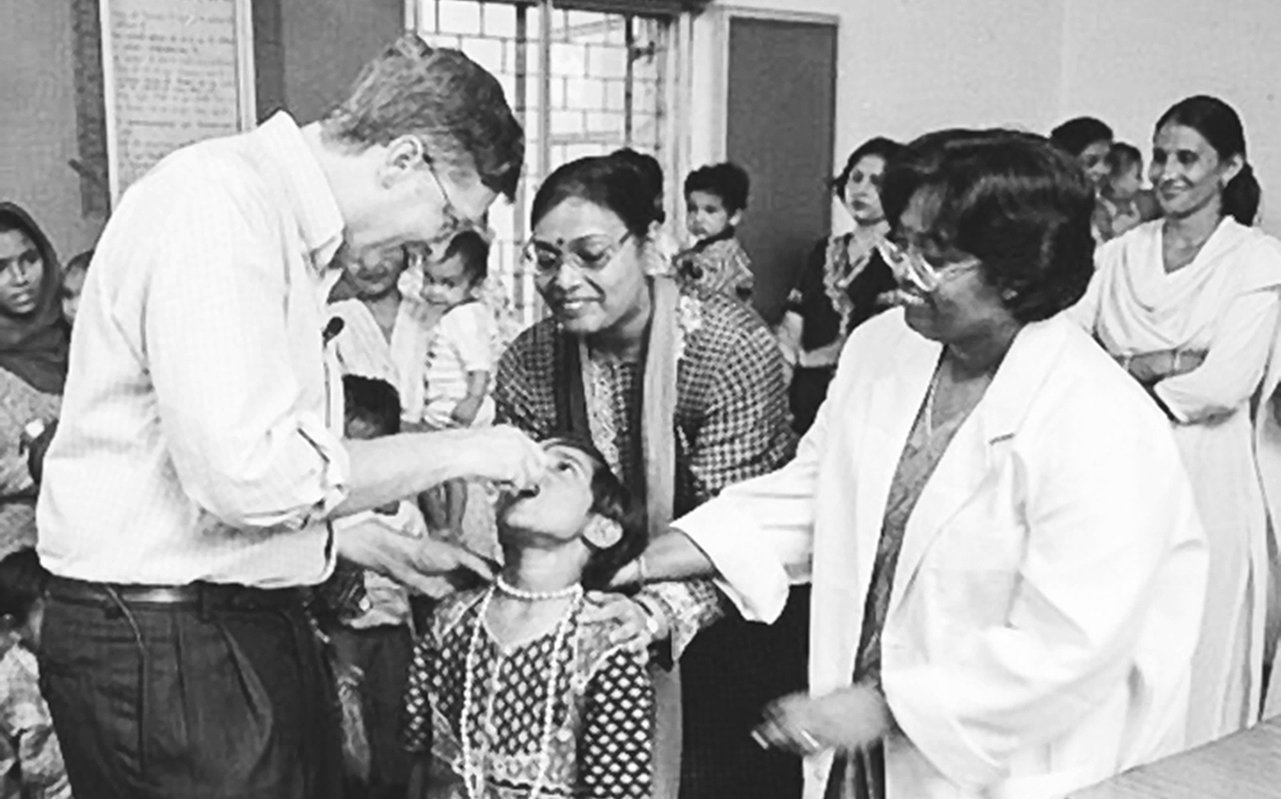
Bill Gates administering an oral polio vaccine to a child in Mumbai, India, 2000.
I’d watched Andy Grove manage people on subgoals [key results], and I watched the Japanese, and I learned how you deal with things when people fall short. I don’t think I invented anything there, but I did watch and learn. Then Patty Stonesifer brought in OKRs, the green-yellow-red approach, and it worked. When we used OKRs with our grant reviews, I felt good about what we were going after. I was still running Microsoft, and my time was limited, and Patty had to make things very efficient between us, to make sure we agreed. The goals process was a big part of that. There were two cases where I turned down a grant in the end because the goals weren’t clear enough. The OKR system made me confident I was making the right call.
I’m a huge fan of goals, but they need to be handled correctly. At one point, the malaria team thought we’d eradicate the disease by 2015, which wasn’t realistic. When a goal is too aspirational, it’s bad for credibility. In philanthropy, I see people confusing objectives with missions all the time. A mission is directional. An objective has a set of concrete steps that you’re intentionally engaged in and actually trying to go for. It’s fine to have an ambitious objective, but how do you scale it? How do you measure it?
I think it’s getting better, though. Philanthropy is bringing in more people from high-performance business environments, and they’re tilting the culture. Having a good mission is not enough. You need a concrete objective, and you need to know how you’re going to get there.
Patti Stonesifer: OKRs allowed us to be ambitious and disciplined at the same time. When measurable key results revealed a lack of progress or showed that an objective was unachievable, we reallocated the capital. If the goal was to eliminate Guinea worm disease, a very ambitious top-line goal, it was important to know whether the dollars and resources were making progress against it. With OKRs, we could set both quarterly and annual beats for substantial key results against such a huge objective.*
Until you set a really big goal, like vaccinating every child everywhere, you can’t find out which lever or mix of levers is most important. Our annual strategy reviews began with: “What is the objective here? Is it eradication or is it expanding the reach of vaccines?” Then we could get more practical with our key results—like the 80/90 rule at the Global Alliance for Vaccines and Immunization, where 80 percent of districts would have 90 percent or more coverage. You need those key results to align your everyday activities, and over time you keep moving them to be even more ambitious against that really big goal.
Sometimes, to be honest, we were probably measuring the wrong thing. But the effort was always there to hold ourselves accountable. At private foundations, where you lack a market effect to gauge impact, you have to pay close attention to whether your data is getting you to the ultimate goal. We were learning so fast that sometimes we had to change data sets midstream. Say you had a seed that would double production of yams, and you were focused on that number. But then it turned out that nobody would use the seed because the yams took four times longer to cook at night. . . .
Setting the big goals wasn’t as hard as breaking them down: What rocks need to be moved to achieve them? That’s one of the beauties of working with Bill and Melinda. They want to see progress, but bold goals don’t faze them.
Case in point: the ongoing fight against the most lethal animal on the planet, the mosquito.* In 2016, the Gates Foundation teamed with the British government in a five-year, $4.3 billion campaign to eradicate malaria, the deadliest of all tropical diseases. Driven by empirical data, they have broadened their focus from a transmission-blocking vaccine to a comprehensive eradication strategy.
OBJECTIVE
Global eradication of malaria by 2040.
KEY RESULTS
-
Prove to the world that a radical cure-based approach can lead to regional elimination.
-
Prepare for scale-up by creating the necessary tools—SERCAP (Single Exposure Radical Cure and Prophylaxis) Diagnostic.
-
Sustain current global progress to ensure the environment is conducive to eradication push.
The top-line objective is to eliminate the Plasmodium parasite from the human population, with a special emphasis on drug-resistant strains. As Bill Gates himself has acknowledged, this effort won’t be easy. But it has a real chance to succeed because his team is tracking what matters.