12
Superpower #4: Stretch for Amazing
The biggest risk of all is not taking one.
—Mellody Hobson
OKRs push us far beyond our comfort zones. They lead us to achievements on the border between abilities and dreams. They unearth fresh capacity, hatch more creative solutions, revolutionize business models. For companies seeking to live long and prosper, stretching to new heights is compulsory. As Bill Campbell liked to say: If companies “don’t continue to innovate, they’re going to die—and I didn’t say iterate, I said innovate.” Conservative goal setting stymies innovation. And innovation is like oxygen: You cannot win without it.
When stretch goals are chosen wisely, the payoff merits the risk and then some. “Big Hairy Audacious Goals”—Jim Collins’s memorable phrase in Good to Great—spark leaps to new levels:
A BHAG is a huge and daunting goal—like a big mountain to climb. It is clear, compelling, and people “get it” right away. A BHAG serves as a unifying focal point of effort, galvanizing people and creating team spirit as people strive toward a finish line. Like the 1960s NASA moon mission, a BHAG captures the imagination and grabs people in the gut.
Edwin Locke, the patriarch of structured goal setting, mined a dozen studies for a quantitative correlation between goal difficulty and achievement. The arenas ranged widely, but the results were “unequivocal,” Locke wrote. “[T]he harder the goal the higher the level of performance. . . . Although subjects with very hard goals reached their goals far less often than subjects with very easy goals, the former consistently performed at a higher level than the latter.” The studies found that “stretched” workers were not only more productive, but more motivated and engaged: “Setting specific challenging goals is also a means of enhancing task interest and of helping people to discover the pleasurable aspects of an activity.”
In 2007, the National Academy of Engineering asked a panel of leading thinkers—including Larry Page, futurist Ray Kurzweil, and geneticist J. Craig Venter—to choose fourteen “Grand Engineering Challenges” for the twenty-first century. After a year of debate, the panel settled on an array of quintessential stretch goals: Generate energy from fusion. Reverse-engineer the brain. Prevent nuclear terror. Secure cyberspace. (You get the picture.)
Not all stretch goals are so rarefied. Sometimes they represent “ordinary” work at an extraordinary level. But regardless of scope or scale, they fit my favorite definition of entrepreneurs:
Those who do more than anyone thinks possible . . . with less than anyone thinks possible.*
At fledgling start-ups and market leaders alike, stretch goals can sharpen an entrepreneurial culture. By pushing people past old limits, they are forces for operating excellence. As Philip Potloff, chief digital officer at Edmunds.com, noted, “We’re trying to change the way automotive retailing is conducted, and that’s a massive challenge and a massive opportunity. The only way for us to boil down our crazy, big, ‘change-the-industry’ goals is through OKRs. It’s why OKRs continue to be at the center of what we do.”
Aspirational goals draw on every OKR superpower. Focus and commitment are a must for targeting goals that make a real difference. Only a transparent, collaborative, aligned, and connected organization can achieve so far beyond the norm. And without quantifiable tracking, how can you know when you’ve reached that amazing stretch objective?
Two OKR Baskets
Google divides its OKRs into two categories, committed goals and aspirational (or “stretch”) goals. It’s a distinction with a real difference.
Committed objectives are tied to Google’s metrics: product releases, bookings, hiring, customers. Management sets them at the company level, employees at the departmental level. In general, these committed objectives—such as sales and revenue goals—are to be achieved in full (100 percent) within a set time frame.
Aspirational objectives reflect bigger-picture, higher-risk, more future-tilting ideas. They originate from any tier and aim to mobilize the entire organization. By definition, they are challenging to achieve. Failures—at an average rate of 40 percent—are part of Google’s territory.
The relative weighting of these two baskets is a cultural question. It will vary from one organization to the next, and from quarter to quarter. Leaders must ask themselves: What type of company do we need to be in the coming year? Agile and daring, to crack a new market—or more conservative and operational, to firm up our existing position? Are we in survival mode, or is there cash on hand to bet big for a big reward? What does our business require, right now?
Our Need to Stretch
Andy Grove was a fan of Abraham Maslow, the mid-twentieth-century psychologist best known for his “hierarchy of needs.” According to Maslow, only after we satisfy more basic concerns—starting with food and shelter, then safety, then “love” and “belongingness”—can we move to higher-level motivations. At the top of Maslow’s pyramid stands the need for “self-actualization”:
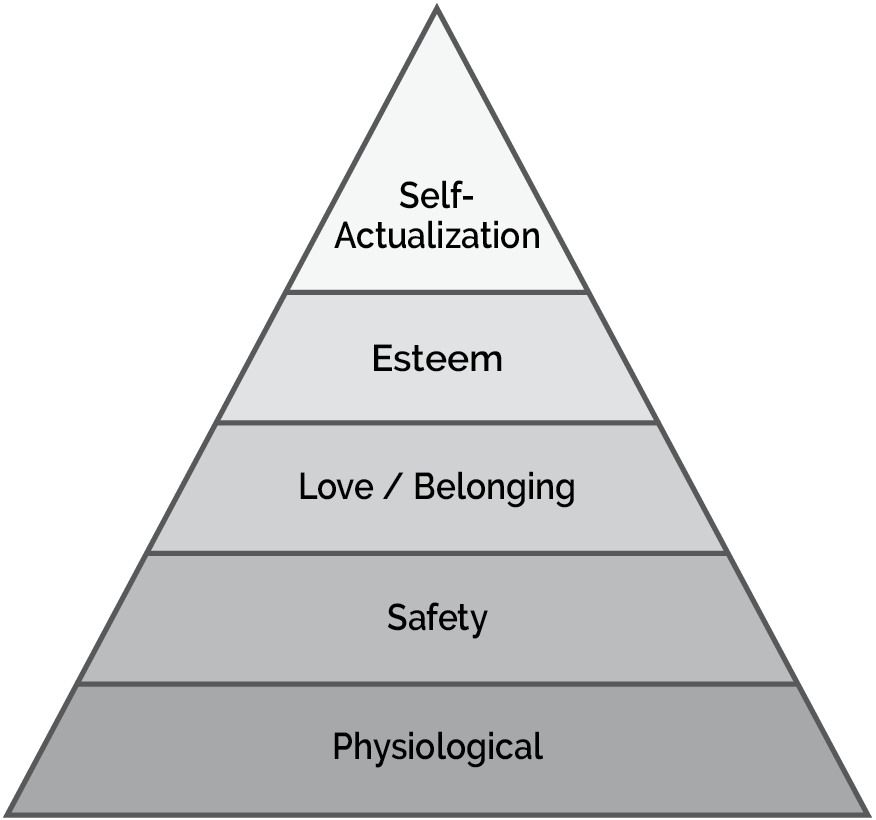
Maslow’s hierarchy of needs represented as a pyramid, with more basic needs at the base.
Grove was fascinated to find that some people, with no prompting, were consistently driven to “try to test the outer limits of their abilities” and achieve their “personal best.” These employees were a manager’s dream; they were never self-satisfied. But Grove also understood that not everyone was a natural-born achiever. For the rest, “stretched” goals could elicit maximum output: “Such goal-setting is extremely important if you want peak performance from yourself and your subordinates.”
Intel treasured calculated risk takers. It was the place I learned to stretch and to dare to fail. In Operation Crush, the do-or-die campaign to dominate the 16-bit chip microprocessor market, the company’s salespeople were measured by design wins, the number of products designed around our 8086 microprocessor. Led by Bill Davidow, the Crush task force set one of the bolder goals I’ve ever seen: one thousand design wins in a single calendar year, 50 percent more than sales had logged the year before. Here is what happened next, as recalled by Dave House, general manager for microprocessors:
This is Intel; you’ve got to measure it. And I think it was [Jim] Lally who said, we need 1,000 design wins. It was a number; it was either Bill or Jim. . . . And it seemed like an enormous number. And then as we were developing our plans, somehow that number got changed to 2,000. And that wound up being the number we would take to field sales.
Two thousand design wins equated to one win per salesperson per month. Management was asking our field reps to triple their numbers for a chip so unpopular that longtime customers were hanging up on them. The sales force was beaten down and defeated, and now it stared up at Mount Everest. When I recently asked Bill Davidow about setting such a steep objective, he replied, “I picked the two thousand because I thought we needed a rallying point. And that was a rallying point.”
The company incentivized the reps with a trip for two to Tahiti for all who reached the mark. Then Jim Lally added an ingenious stipulation: If a single individual failed to make the quota, the straggler’s entire district office would lose out on the trip. Early on, the numbers badly trailed the target, until the task force began to think about relaxing the design win criterion. But that summer, full-color Tahiti brochures mysteriously found their way into every salesperson’s home mailbox. By the third quarter, peer pressure on the laggards was enormous.
At year’s end, the design win tally exceeded 2,300. The 8086 reigned supreme in the marketplace; Intel’s future was assured. Virtually the entire sales force went to Tahiti. And a stretch goal had made all the difference.
The Gospel of 10x
If Andy Grove is the patron saint of aspirational OKRs, Larry Page is their latter-day high priest. In technology, Google stands for boundless innovation and relentless growth. In the world of objectives and key results, the company is synonymous with exponentially aggressive goals, or what author Steven Levy calls “the gospel of 10x.”
Consider Gmail. The main problem with earlier web-based email systems was meager storage, typically 2 to 4 megabytes. Users were forced to delete old emails to make room for new ones. Archives were a pipe dream. During Gmail’s development, Google’s leaders considered offering 100MB of storage—an enormous upgrade. But by 2004, when the product was released to the public, the 100MB goal was dead and forgotten. Instead, Gmail provided a full gigabyte of storage, up to five hundred times more than the competition. Users could keep emails in perpetuity. Digital communication changed forever.
That, my friends, is a Big Hairy Audacious Goal. Gmail didn’t merely improve on existing systems. It reinvented the category and forced competitors to raise their game by orders of magnitude. Such 10x thinking is rare in any sector, on any stage. Most people, Larry Page observes, “tend to assume that things are impossible, rather than starting from real-world physics and figuring out what’s actually possible.”
In Wired, Steven Levy elaborated:
The way Page sees it, a ten percent improvement means that you’re doing the same thing as everybody else. You probably won’t fail spectacularly, but you are guaranteed not to succeed wildly.
That’s why Page expects Googlers to create products and services that are ten times better than the competition. That means he isn’t satisfied with discovering a couple of hidden efficiencies or tweaking code to achieve modest gains. Thousand percent improvement requires rethinking problems, exploring what’s technically possible and having fun in the process.
At Google, in line with Andy Grove’s old standard, aspirational OKRs are set at 60 to 70 percent attainment. In other words, performance is expected to fall short at least 30 percent of the time. And that’s considered success!
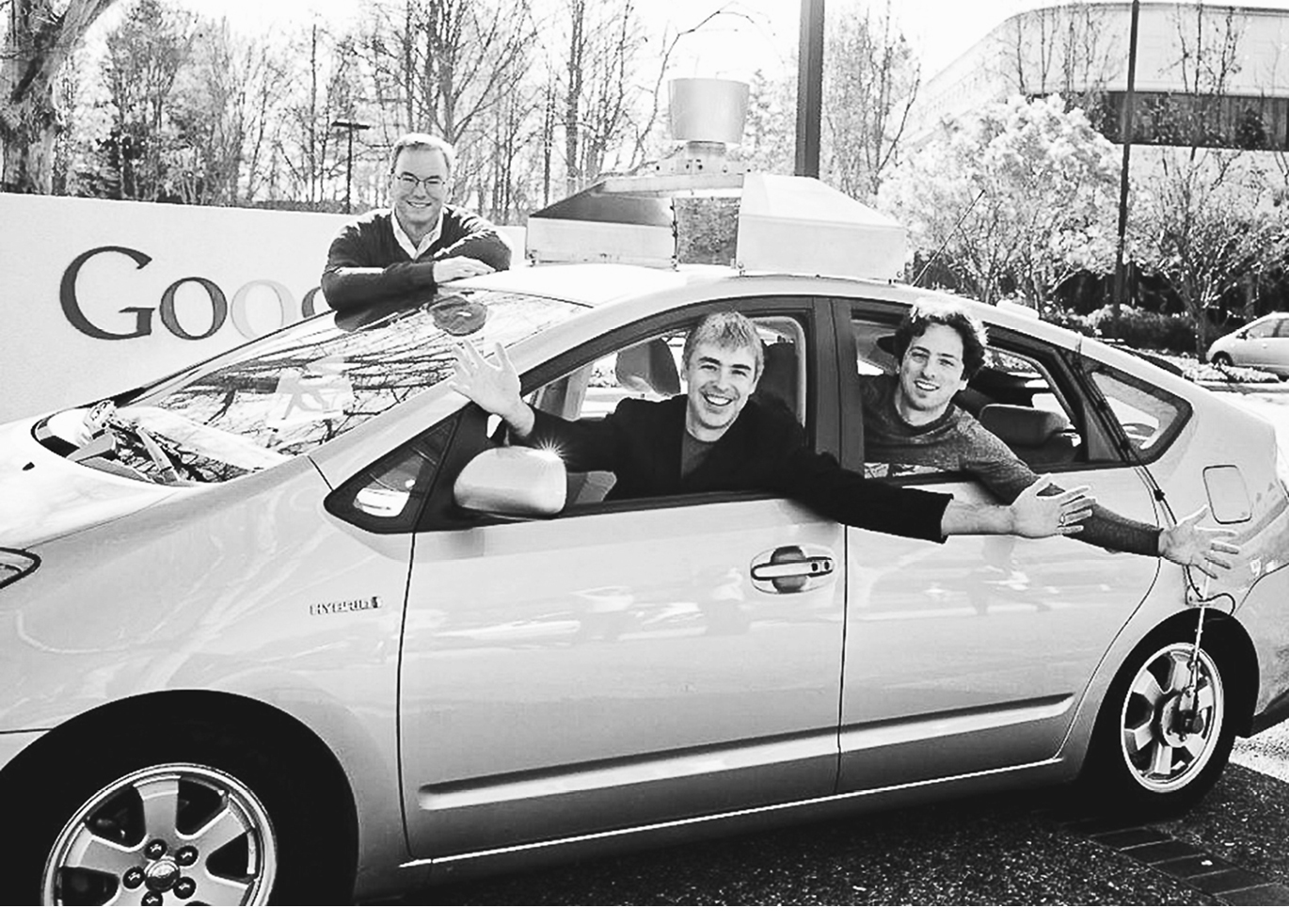
Eric Schmidt, Larry Page, and Sergey Brin with Google’s first self-driving car, 2011—10x thinking in action!
Google has had its share of colossal misfires, from Helpouts to Google Answers. Living in the 70 percent zone entails a liberal sprinkling of moonshots and a willingness to court failure. At the start of the period, not a single goal may look possible. And so the Googlers are pushed to ask harder questions: What radical, high-risk action needs to be considered? What do they need to stop doing? Where can they move resources or find new partners? By deadline, a healthy fraction of those impossible goals are somehow attained in full.
Stretch Variables
To succeed, a stretch goal cannot seem like a long march to nowhere. Nor can it be imposed from on high without regard to realities on the ground. Stretch your team too fast and too far, and it may snap. In pursuing high-effort, high-risk goals, employee commitment is essential. Leaders must convey two things: the importance of the outcome, and the belief that it’s attainable.
Few entities have Google’s resources to fall back upon when a moonshot crashes. Organizations have a range of risk tolerance, which may change over time. The greater the margin for error, the more a company can extend itself. For example, a 40 percent OKR failure rate might seem too risky—and too discouraging, no matter what leadership says. For high achievers, anything shy of perfection can sap morale. At Risk Management Solutions in California, there are “more degrees than employees,” says Amelia Merrill, a former HR leader. “People here are used to getting A’s. They don’t get B’s. Not getting 100 percent—that’s just really hard, culturally, to make that transition.”
At MyFitnessPal, Mike Lee considers all OKRs to be committed goals: difficult and demanding, yes, but attainable in full. “I am trying to set the bar right at where I think it should be,” he says. “If we get them all done, I’ll feel good about our progress.” That’s a reasonable approach, but not without pitfalls. Will Mike’s people shy away from objectives where they might top out at 90 percent? In my view, it’s better for leaders to set at least a modest stretch. Over time, as teams and individuals gain experience with OKRs, their key results will become more precise and more aggressive.
There is no one magic number for the “right” stretch. But consider this: How can your team create maximum value? What would amazing look like? If you seek to achieve greatness, stretching for amazing is a great place to start. But by no means, as Andy Grove made clear, is it the place to stop:
You know, in our business we have to set ourselves uncomfortably tough objectives, and then we have to meet them. And then after ten milliseconds of celebration we have to set ourselves another [set of] highly difficult-to-reach objectives and we have to meet them. And the reward of having met one of these challenging goals is that you get to play again.