13
Stretch: The Google Chrome Story
Sundar Pichai
CEO
Stretch goals were beautifully defined by the leader of the Google X team that developed Project Loon and self-driving cars. Says Astro Teller: “If you want your car to get fifty miles per gallon, fine. You can retool your car a little bit. But if I tell you it has to run on a gallon of gas for five hundred miles, you have to start over.”
In 2008, Sundar Pichai was Google’s vice president of product development. When Sundar and his team took their Chrome browser to market, they were most definitely starting over. Driven to succeed but unafraid of failure, they used OKRs to catapult their product—and their company—to amazing. Chrome is now the most popular web browser by far on both the mobile and desktop platforms. As you will see, there were bumps in the road. But as Larry Page says, “If you set a crazy, ambitious goal and miss it, you’ll still achieve something remarkable.” When you aim for the stars, you may come up short but still reach the moon.
The career of Sundar Pichai is a stretch goal personified. In October 2015, at age forty-three, Sundar became Google’s third CEO. Today he presides over an organization with more than sixty thousand employees and $80 billion in revenues.
Sundar Pichai: Growing up in South India in the 1980s, I had scant exposure to technology as we see it today. Yet what we had made a profound impact on my life. My father was an electrical engineer in Chennai, a great metropolis, but we lived modestly. The waiting list for a telephone—a rotary dial model—was three to four years. I was twelve years old when my family finally got one. It was a big event. Neighbors would come and use it.
I remember my life as pre-phone and post-phone; that one device changed so many things. Pre-phone, my mother would say, “Can you see if the blood test is ready in the hospital?” I would catch a bus and ride to the hospital, and wait in line, and often they would tell me, “No, it isn’t ready yet, come tomorrow.” By the time I rode the bus home, it was a three-hour trip. Post-phone, I could simply call the hospital and know the results. Now we take technology for granted, and it gets better every day. But for me there were these discrete moments, before and after, that I will never forget.
I read every book about computers and semiconductors that I could lay my hands on. I aspired to somehow make it to Silicon Valley, which meant getting into Stanford—that was my goal, to be a part of all the change happening there. In a way, I think I dreamt even more fervently because so little technology was available to us. I was driven by the power of imagining.
The New Applications Platform
For five years, I worked at Applied Materials in Santa Clara, in process engineering, R&D. Sometimes I would need to go to Intel, and I could feel the Andy Grove culture as soon as I stepped inside the door. The company was very disciplined, down to the smallest thing. (I vaguely remember having paid for each cup of coffee.) In semiconductor process engineering, you must be highly methodical in setting your goals and working your way through them. So my work at Applied Materials helped me think about goals in a more precise way.
As the internet continued to develop, I could see its tremendous potential. I read about everything Google was doing—I was passionate on the subject. I was especially excited when they launched a product called Deskbar, where you could search the web from Windows without opening the browser—it launched from a small window in the taskbar. It was there when you needed it, but only then. Deskbar was an early tool for growth, a way to bring Google to many more people.
I joined Google as a product manager in 2004, when the company still revolved around search. But that was also the year of Web 2.0 and the rise of user-generated content and AJAX.* The early web was a content platform, but it was fast becoming an applications platform. We were seeing the beginning of a paradigm shift on the internet, and I sensed that Google would be at the heart of it.
My first assignment was to expand the use and distribution of Google Toolbar, which could be added to any browser to get you to Google Search. It was the right project for the right time. In just a few years, we scaled up Toolbar users by more than 10x. That was when I first saw the power of an ambitious, stretch OKR.
Rethinking the Browser
By then we’d set up something new for Google, a team to build client software. We had people working on Firefox to help improve Mozilla’s browser. By 2006, we were beginning to rethink the browser as a computing platform, almost like an operating system, so that people could write applications on the web itself. That fundamental insight gave birth to Chrome. We knew we needed a multiprocess architecture to make each tab its own process and protect a user’s Gmail if another application crashed. And we knew we had to get JavaScript working a lot faster. But we were up for the task of building the best browser possible.
Eric Schmidt, our CEO, knew how hard it was to construct a browser from scratch: “If you’re doing it, you had better be serious about it.” If Chrome wasn’t going to be dramatically different and better and faster than the traditional browsers already on the market, there was no point in moving ahead.
In 2008, the year of Chrome’s rollout, our product management team formulated a top-level annual objective that would have an enduring influence on Google’s future: to “develop the next-generation client platform for web applications.” The main key result: “Chrome reaches 20 million seven-day active users.”
Upping the Goal
In Google’s OKR climate, it was understood that 70 percent achievement (on average) was considered a success. You weren’t supposed to strive for greens on every OKR you wrote—that wouldn’t stretch the team. But there was an intrinsic tension because you didn’t get hired at Google unless you were driven to succeed. As a leader, you didn’t want to find yourself at the end of the quarter, standing in front of the company with a big red on the screen, having to explain why and how you failed. The pressure and discomfort of that experience made a lot of us do a lot of heroic things to avoid it. But if you set your team’s objectives correctly, it was sometimes unavoidable.
Larry was always good about upping the goals for the company OKRs. He used certain phrases that stuck with me. He wanted people at Google to be “uncomfortably excited.” He wanted us to have “a healthy disregard for the impossible.” I tried to do the same for the products team. It took courage to write an OKR that might well fail, but there was no other way if we wanted to be great. We deliberately set the bar for 20 million weekly active users by year’s end, knowing it was a formidable stretch—we were starting from zero, after all.
As a leader, you must try to challenge the team without making them feel the goal is unachievable. I thought it unlikely we would reach our target in time. (Candidly, I thought there was no way we would get there.) But I also considered it important to keep pushing to the limit of our ability and beyond. By putting the 20 million out there, I knew good things would happen. Our stretch OKR gave the team direction and a barometer to measure our progress. It made complacency impossible. And it kept us all rethinking, every day, the framework for what we were doing. All of these things were more important than reaching a somewhat arbitrary target on a designated day.
Early on, as Chrome struggled to reach 3 percent market share, we received some unanticipated bad news. The Mac version of Chrome fell way behind schedule. Only Windows users would count toward the 20 million.
But there was good news, too—people who used Chrome loved it, which was starting to have a compounding effect on growth. Glitches notwithstanding, we were driving awareness of a new way to engage the web. We just needed to find more users, and sooner than later.
Digging Deeper
Google stands for speed. The company has waged a constant battle against latency, the delay in a data transfer that degrades the user experience. In 2008, Larry and Sergey wrote a beautiful OKR that truly captured people’s attention: “We should make the web as fast as flipping through a magazine.” It inspired the whole company to think harder about how we could make things better and faster.
For the Chrome project, we created a sub-OKR to turbocharge JavaScript. The goal was to make applications on the web work as smoothly as downloads on a desktop. We set a moonshot goal of 10x improvement and named the project “V8,” after the high-performance car engine. We were fortunate to find a Danish programmer named Lars Bak, who’d built virtual machines for Sun Microsystems and held more than a dozen patents. Lars is one of the great artists in his field. He came to us and said, without an ounce of bravado, “I can do something that is much, much faster.” Within four months, he had JavaScript running ten times as fast as it ran on Firefox. Within two years, it was more than twenty times faster—incredible progress. (Sometimes a stretch goal is not as wildly aspirational as it may seem. As Lars later told Steven Levy in In the Plex, “We sort of underestimated what we could do.”)
Stretch OKRs are an intense exercise in problem solving. Having gone through the Toolbar journey, I had a good sense of how to work my way through the inevitable troughs. Sure, there were sleepless nights. But no matter how much stress I was feeling, I stayed cautiously optimistic with my team. If we were losing users, I would tell them, let’s do an experiment to understand why and fix it. If compatibility was an issue, I’d assign a group to focus on that. I tried to be thoughtful and systematic and not too emotional, and I think that helped.
Google is propelled by our moonshot culture. The very ambitious is very hard to do. In a healthy way, our team realized that the success of Chrome would ultimately mean hundreds of millions of users. Whenever we invent something new at Google, we’re always thinking: How can we scale it to a billion? Early in the process, that number can seem very abstract. But when you set a measurable objective for the year and chunk the problem, quarter by quarter, moonshots become more doable. That’s one of the great benefits of OKRs. They give us clear, quantitative targets on the road to those qualitative leaps.
After we failed against the 20 million in 2008, it made us dig deeper. We never gave up on the objective, but we changed the way we framed it. Here’s what I tried to communicate: “No, we didn’t reach the goal, but we are laying the foundation to break through this barrier. Now, what are we going to do differently?” In a culture of smart people, you had better have good answers to that question; you can’t tap-dance your way through. In this case, we needed a solution to one very basic problem: Why was it so difficult to get people to try a new browser?
That’s how we became motivated to find new distribution deals for Chrome. Down the road, when we found that people were unclear about just what a browser did for them, we turned to television marketing to explain it. Our Chrome ads represented the largest offline campaign in the company’s history. People still remember “Dear Sophie,”* a spot created around a father’s digital scrapbook of his daughter as she grew. It showed the easy entrée from our browser to such a rich stock of web-based applications, from Gmail and YouTube to Google Maps. It led people to the internet as an applications platform.
Try-Fail, Try-Succeed
Success was not instantaneous. In 2009, we set another stretch OKR for Chrome—50 million seven-day active users—and failed again, ending the year at 38 million. For 2010, undeterred, I proposed a target of 100 million users. Larry believed we should be pushing even harder. My target, he pointed out, touched only 10 percent of the world’s one billion internet users at the time. I countered that 100 million was in fact very aggressive.
Larry and I eventually settled on an OKR of 111 million users, a classic stretch goal. To reach it, we knew we’d need to reinvent the business of Chrome and think about growth in new ways. Again, what could we do differently? In February, we broadened our distribution deals with the OEMs [original equipment manufacturers]. In March, we embarked on a “Chrome Fast” marketing campaign to heighten product awareness in the United States. In May, we expanded our demographic by launching Chrome for OS X and Linux. At last, our browser was no longer a Windows-only product.
Well into the third quarter, the outcome remained in doubt. Then we did a small thing that became a big thing: a passive alert for former Chrome users who’d been dormant. Weeks later, at the end of Q3, our user total had surged from 87 million to 107 million. And shortly after that, we reached 111 million seven-day actives. We had achieved our goal.
Today, on mobile alone, there are more than a billion active users of Chrome. We couldn’t have gotten there without objectives and key results. OKRs are the way we think about everything at Google, the way we’ve always done it.
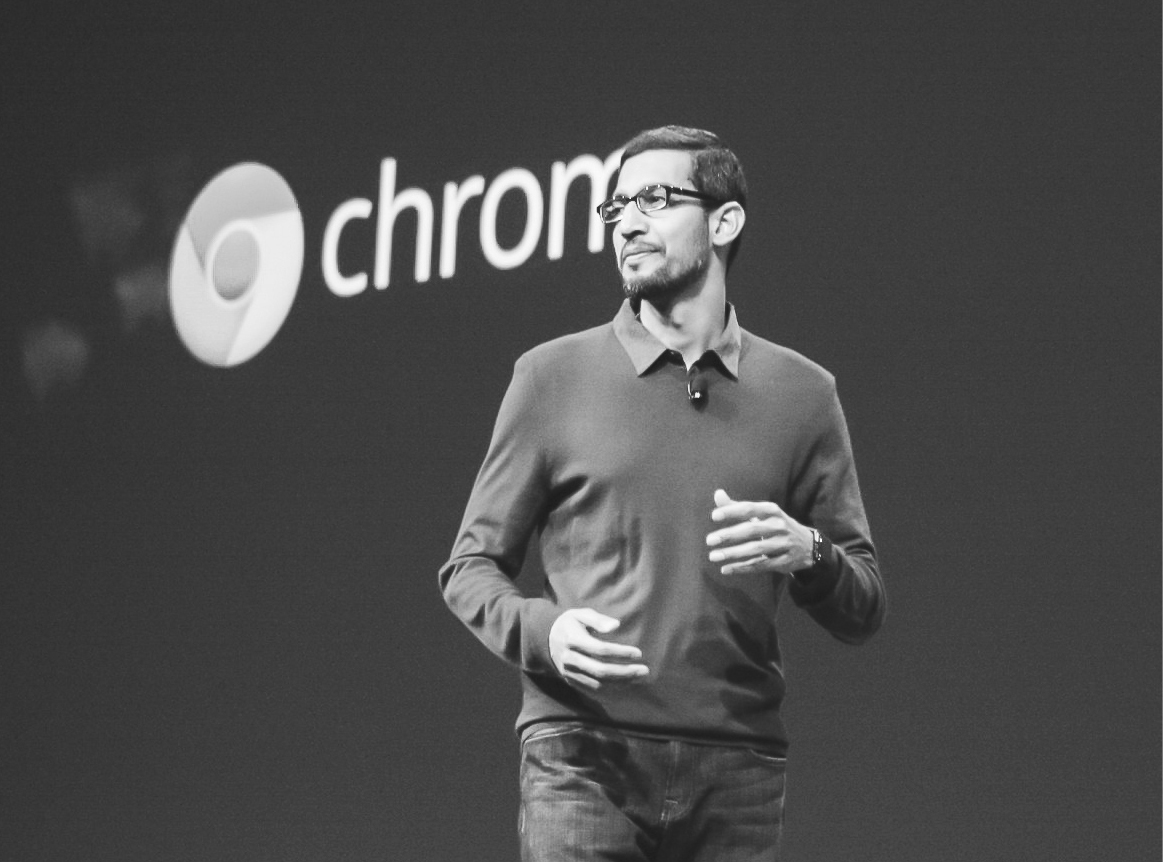
Sundar presents his Chrome keynote at Google’s I/O developer conference, 2013.
The Next Frontier
My father came of age in a time when computing meant huge teams and mainframes and system administrators—when computers were both inaccessible and very complicated. By the time I was working on Chrome, I realized that all he wanted was an easy, straightforward way to use the web. I’ve always been fascinated by simplicity. For all the complex things Google Search could do, the user experience was phenomenally uncomplicated. I wanted to emulate that quality in our browser—to the point where you could be a kid in India or a professor at Stanford, and it wouldn’t matter. If you had access to a computer and adequate connectivity, your experience with Chrome would be manifestly simple.*
In 2008, when my father was retired, I gave him a netbook and showed him how to use Chrome. And then an amazing thing happened for him: The technology just faded away. He could just do whatever he wanted on the thriving applications platform on the web. Once he got into our browser, he never opened another app. He never downloaded another piece of software. He lived in Chrome. He surrendered into a new and wonderfully simple world.
At Google, from very early on, I internalized the need to constantly imagine the next frontier—from Toolbar to Chrome, for example. You can never stop stretching. My father’s experience got us thinking: What if we could design an operating system with comparable simplicity and security, with the Chrome browser as its user interface? And what if we could invent a laptop around that operating system—a Chromebook—to tap directly into all of those applications living in the cloud?
But those would be stretch goals for another day.