14
Stretch: The YouTube Story
Susan Wojcicki
CEO
Cristos Goodrow
Vice President of Engineering
Google is so teeming with stretch goals that it would feel incomplete to chronicle only one of them. And so here is a second, the story of YouTube and how it grew—exponentially—with the “stretch” OKR superpower.
Susan Wojcicki, according to Time magazine, is “the most powerful woman on the internet.” She’s played a central role at Google from the start, even before becoming employee No. 16 and the company’s first marketing manager. In September 1998, days after Google was incorporated, Susan rented out her Menlo Park garage for the company’s first office. Eight years later, as analysts doubted that YouTube would survive, she was a leading voice in persuading Google’s board to acquire it. Susan had the vision to see that online video was about to disrupt network television—forever.
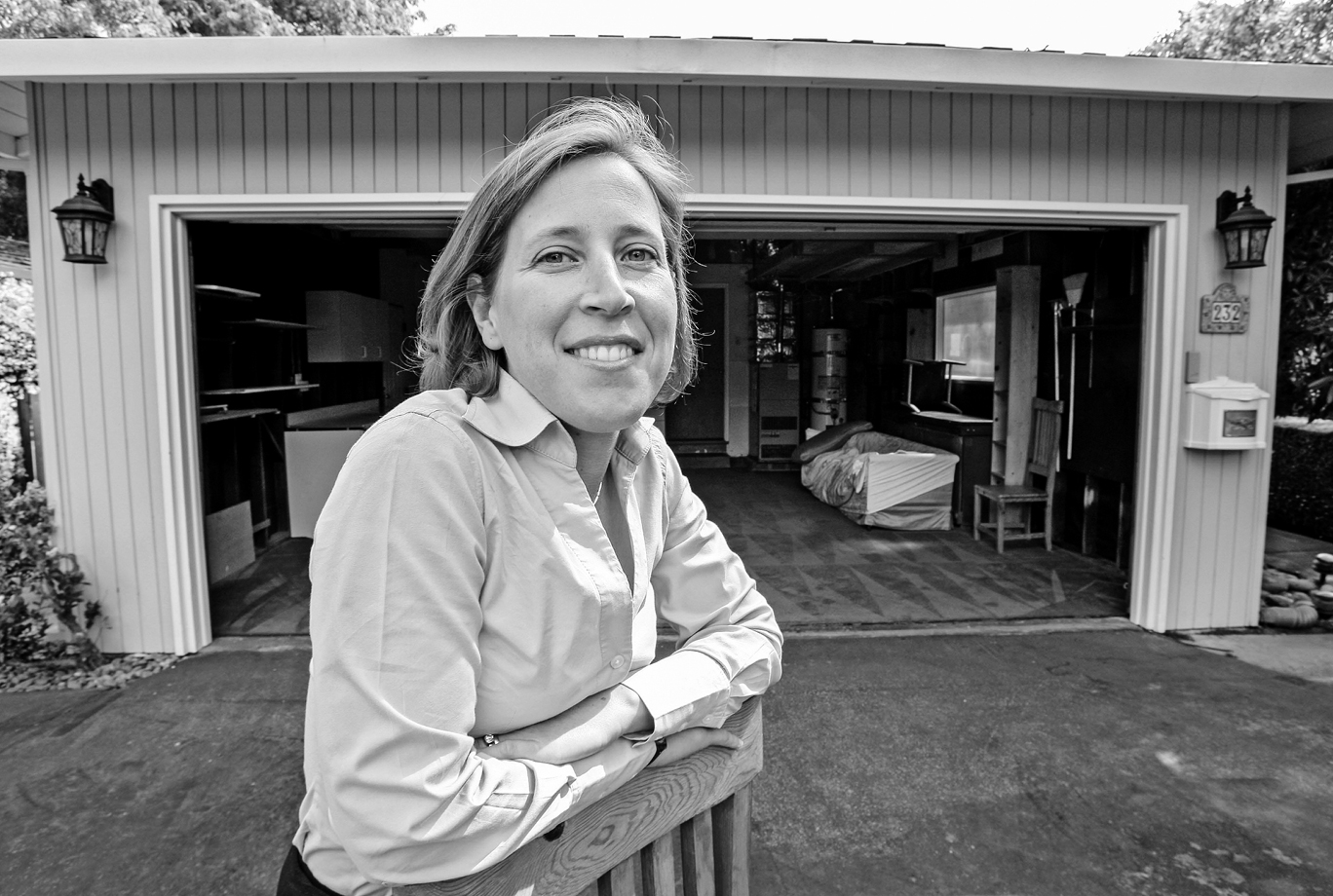
Susan Wojcicki and her Menlo Park garage, where it all began.
By 2012, YouTube had become a market leader and one of the biggest video platforms in the world. But its furious pace of innovation had slowed—and once you brake, it’s not easy to reaccelerate. By that point, Susan had risen to senior vice president of advertising and commerce, where she reimagined AdWords and envisioned a new way to monetize the web with AdSense. (Basically, she drove the success of Google’s two main revenue streams.) In 2014, as the new CEO of YouTube, she inherited one of the most aggressive goals anytime, anywhere. Over a span of four years, the mission was to reach a billion hours of people watching YouTube every day—to grow by a factor of ten. But Susan didn’t want to grow at any cost—she wanted to do this responsibly. Susan and a veteran YouTube engineering leader, Cristos Goodrow, had their work cut out for them. They would rely on OKRs every step of the way.
Stretch goals are invigorating. By committing to radical, qualitative improvement, an established organization can renew its sense of urgency and reap tremendous dividends. YouTube’s once struggling web video business has scaled to more than a billion users, nearly a third of the total population on the internet. Its site can be navigated in more than seventy different languages in more than eighty countries. Its mobile platform alone reaches more eighteen-to-forty-nine-year-olds than any cable or broadcast network.
None of this happened by accident, or by the grace of a single insight. It took years of rigorous execution, meticulous attention to detail, and the structure and discipline of OKRs. And one more thing: Before YouTube could begin to chase its monumentally audacious objective, first it had to figure out how to measure what mattered.
Susan Wojcicki: When I leased my garage to Larry and Sergey, I had no interest in Google as a company. I just wanted them to pay the rent. But then I got to know them and how they thought about things. I had ideas for starting my own company, but it dawned on me that Larry and Sergey were better positioned to execute them. And then there was the day Google Search went down and I couldn’t get my work done. Google, I realized, had become an indispensable tool; I couldn’t live without it. And I thought, This is going to be important for everyone.
I was there when John Doerr came to talk to us about OKRs in the fall of 1999. By then we’d outgrown my garage and moved to 2400 Bayshore in Mountain View, an old Sun Microsystems plant. The whole building might have been 42,000 square feet, and we operated in less than half of it. We had the OKR meeting in the other half, the part reserved for all-hands. I can remember John explaining the concept: “This is an objective. This is a key result.” And using the football analogy to demonstrate how OKRs were implemented. The other day, sorting through some files, I came across John’s presentation—on plastic laminate sheets for an overhead projector. That’s how old it was.
Larry and Sergey were good at listening to people who knew what they were talking about. I’m sure they argued with John, but they listened. They had never run a company or even worked in a company before. John came in and said, “This is a way you can run your business, and it’s measurable and trackable.” Measurables were intuitive to Larry and Sergey, and they had to be impressed by the fact that Intel used OKRs. Intel was such a great company, and we were so small by comparison.
Judging from our experience at Google, I’d say that OKRs are especially useful for young companies just starting to build their culture. When you’re little, with fewer resources, it’s even more vital to be clear on where you’re going. It’s like raising kids. If you bring them up with no structure, and then you tell them as teenagers, “Okay, now here are the rules”—well, that’s going to be hard. If possible, it’s better to have rules from the start. At the same time, I’ve seen mature companies do turnarounds and change people and processes. No company is too young to adopt OKRs, and for no company is it too late.
OKRs require organization. You need a leader to embrace the process and a lieutenant to ride herd over scoring and reviews. When I ran OKRs for Larry, I sat in on four-hour meetings with his leadership team, where he’d debate all the company objectives and people were expected to be able to defend them and make sure they were clear. The guidance for OKRs at Google was often top-down, but with lots of discussion with experts on the team and significant give-and-take on key results: This is the direction we want to go, now tell us how you’re going to get there. Those long meetings enabled Larry to emphasize things he cared about, and also to vent frustrations, especially around service on our product OKRs. He’d say, “Tell me your speed now.” And then: “Why can’t you cut that in half?”
We still conduct our all-hands, top-level OKR meeting in a special videocast each quarter, though Google is now so large and multifaceted that it’s hard to communicate everything we do to everyone. At one memorable all-hands, Salar Kamangar, my predecessor as YouTube CEO, did an amazing job running through the company’s entire OKR roster. (Salar can put anything into context.) But in general, the more detailed discussions take place within our teams. And you’ll still find OKRs posted on the company and team pages on Google’s intranet, updated in real time, where any contributor can access and review them.
If You Can’t Beat ’Em . . .
Google Videos, our free video-sharing website, launched in 2005, one month before YouTube. When I ran it, the first clip we uploaded for users was a purple Muppet singing a nonsense song from an Italian movie about sex in Sweden. Sergey and I weren’t sure what to make of it. But then my kids shouted, “Play it again!” The light bulb went on. We saw a next-generation opportunity, a new way for people to create video for global distribution. We went about building an interface, and had our surprising first hit: two kids singing Backstreet Boys in their dorm room, with a roommate studying in the background. We carried some professional videos, too, but the user-generated content did better.
The main flaw in Google Videos was a delay in our upload process. It broke a company rule for product development: Make it fast. User-uploaded videos weren’t immediately available to watch, whereas on YouTube they were—a big problem. By the time we fixed it, we’d lost significant market share. YouTube was out-streaming us three to one, but financially they were struggling. Swamped by demand, they urgently needed capital to build infrastructure. It was clear they would have to sell.
I saw an opportunity to combine the two services. I worked up some spreadsheets to justify the $1.65 billion purchase price, to show that Google could make its money back, and convinced Larry and Sergey. At the last minute, the founders asked me to bring my spreadsheets to the board meeting. There were lots of questions. The board gave us the green light, though they weren’t totally sold on my assumption for year-on-year user growth. And it’s funny, because rapid growth is the one thing that YouTube has consistently delivered to this day.
Big Rocks
Cristos Goodrow: In February 2011, when I came over from Google Product Search, three years before Susan joined the team, YouTube’s OKRs needed work. The company—around eight hundred people at the time—was producing hundreds of them each quarter. A team would open a Google doc and start typing in objectives, and they’d wind up with thirty or forty for ten people, and less than half would actually get done.
Engineers struggle with goal setting in two big ways. They hate crossing off anything they think is a good idea, and they habitually underestimate how long it takes to get things done. I’d lived through this at Product Search, where they’d insist: “Come on, I’m a smart person. I can surely get more done than that.” It took discipline for people to narrow their lists to three or four objectives for their team, but it made a huge difference. Our OKRs became more rigorous. Everybody knew what counted most. After I took responsibility for search and discovery at YouTube, it only made sense to do the same thing there.
Then Salar Kamangar turned over day-to-day leadership for the tech side of YouTube to Shishir Mehrotra, and Shishir helped bring focus to the whole company. He used a metaphor called the Big Rocks Theory, which was popularized by Stephen Covey. Say you have some rocks, and a bunch of pebbles, and some sand, and your goal is to fit as much of everything as you can into a wide-mouth, one-gallon jar. If you start with the sand, and then the pebbles, the jar will run out of room for all the rocks. But when you start with the rocks, add the pebbles, and save the sand for last, the sand fills the spaces between the rocks—everything fits. In other words, the most important things need to get done first or they won’t get done at all.
But what were YouTube’s big rocks? People did their own things and let a thousand flowers bloom, but no one could identify the top-level OKRs. Now leadership was saying, “All of your ideas are wonderful. But could we please identify a few of them as our big rocks for this quarter, and for the year?” After that, everyone at YouTube knew our top priorities. All of our big rocks would make it into the jar.
That was a giant step toward the goal that swallowed the next four years of my life.
A Better Metric
YouTube had figured out how to make money, but they still weren’t sure how to grow viewership. Fortunately for the company and me, an engineer in Google Research Group was out in front of us. On a dedicated team named Sibyl, Jim McFadden was building a system for selecting “watch next” recommendations, aka related videos or “suggestions.” It had tremendous potential to boost our overall views. But were views what we really wanted to boost?
As Microsoft CEO Satya Nadella has pointed out: In a world where computing power is nearly limitless, “the true scarce commodity is increasingly human attention.” When users spend more of their valuable time watching YouTube videos, they must perforce be happier with those videos. It’s a virtuous circle: More satisfied viewership (watch time) begets more advertising, which incentivizes more content creators, which draws more viewership.
Our true currency wasn’t views or clicks—it was watch time. The logic was undeniable. YouTube needed a new core metric.
Watch Time, and Only Watch Time
In September 2011, I sent a provocative email to my boss and the YouTube leadership team. Subject line: “Watch time, and only watch time.” It was a call to rethink how we measured success: “All other things being equal, our goal is to increase [video] watch time.” For many folks at Google, it smacked of heresy. Google Search was designed as a switchboard to route you off the site and out to your best destination as quickly as possible. Maximizing watch time was antithetical to its purpose in life. Moreover, watch time would be negative for views, the critical metric for both users and creators. Last (but not least), to optimize for watch time would incur a significant money hit, at least at the start. Since YouTube ads were shown exclusively before videos started, fewer starts meant fewer ads. Fewer ads meant less revenue.*
My argument was that Google and YouTube were different animals. To make the dichotomy as stark as possible, I made up a scenario: A user goes to YouTube and types the query “How do I tie a bow tie?” And we have two videos on the topic. The first is one minute long and teaches you very quickly and precisely how to tie a bow tie. The second is ten minutes long and is full of jokes and really entertaining, and at the end of it you may or may not know how to tie a bow tie. I’d ask my colleagues: Which video should be ranked as our first search result?
For those at Google Search, the answer was easy: “The first one, of course. If people come to YouTube to tie a bow tie, we surely want to help them tie a bow tie.”
And I’d say, “I want to show them the second video.”
And the Search cohort would protest, “Why would you do that? These poor people just want to tie their bow ties and get to their event!” (They were probably thinking: This guy’s insane.) But my point was that YouTube’s mission was fundamentally divergent. It’s fine for viewers to learn to tie bow ties, and if that’s all they want, they’ll choose the one-minute manual. But that’s not what YouTube was about, not really. Our job was to keep people engaged and hanging out with us. By definition, viewers are happier watching seven minutes of a ten-minute video (or even two minutes of a ten-minute video) than all of a one-minute video. And when they’re happier, we are, too.
It took six months, but I won the argument. On the Ides of March, 2012, we launched a watch-time-optimized version of our recommendation algorithm aimed at improving user engagement and satisfaction. Our new focus would make YouTube a more user-friendly platform, particularly for music, how-to videos, and entertainment and late-night comedy clips.
A Big Round Number
In November 2012, at our annual YouTube Leadership Summit in Los Angeles, Shishir gathered a few of us together. He said he was about to announce a big stretch goal to kick off the coming year: one billion hours in daily user watch time. (There is power in simplicity, and round numbers are simple.) He asked us, “When can we get this done? What’s the time frame?” A billion hours represented a 10x increase, and we knew it would take years, not months. We thought 2015 was too soon, and 2017 sounded weird. (Prime numbers, in general, sound weird.) Just before Shishir took the stage, we settled on the end of 2016, a four-year OKR with a set of rolling, annual objectives and quarterly, incremental key results.
OBJECTIVE
Reach 1 billion hours of watch time per day [by 2016], with growth driven by:
KEY RESULTS
-
Search team + Main App (+XX%), Living Room (+XX%).
-
Grow kids’ engagement and gaming watch time (X watch hours per day).
-
Launch YouTube VR experience and grow VR catalog from X to Y videos.
Principled Stretching
Stretch goals can be crushing if people don’t believe they’re achievable. That’s where the art of framing comes in. Clever manager that he is, Shishir cut our BHAG down to size. While one billion daily hours sounded like an awful lot, it represented less than 20 percent of the world’s total television watch time. Introducing that context was helpful and clarifying, at least for me. We weren’t gunning to be arbitrarily big. Rather: There was another thing out there way bigger than us, and we were trying to scale up to it.
In pursuing our mission over the next four years, we weren’t 10x absolutists. In fact, we’d commit to some watch-time-negative decisions for the benefit of our users. For example, we made it a policy to stop recommending trashy, tabloid-style videos—like “World’s Worst Parents,” where the thumbnail showed a baby in a pot on the stove. Three weeks in, the move proved negative for watch time by half a percent. We stood by our decision because it was better for the viewer experience, cut down on click bait, and reflected our principle of growing responsibly. Three months in, watch time in this group had bounced back and actually increased. Once the gruesome stuff became less accessible, people sought out more satisfying content.
Once the billion-hour BHAG was set, however, we never did anything without measuring impact on watch time. If a change might slow our progress, we’d be scrupulous about estimating just how much. Then we’d build internal consensus before going through with it.
Getting Up to Speed
Susan: Salar Kamangar most enjoys the earlier stages of companies. He likes taking them to the next level; he’s really good at that. By 2012, YouTube had grown into a big organization, and Salar decided to move on. The company had split into two factions, business and technology, and needed someone to bring them together. After leading AdWords for a decade, I was used to complex ecosystems. I was eager to take on the challenge of unifying YouTube.
When YouTube leadership set the one-billion-hour daily watch time goal, most of our people judged it impossible. They thought it would break the internet! But it seemed to me that such a clear and measurable objective would energize people, and I cheered them on.
By February 2014, when I came over, YouTube was nearly a third of the way through the four-year, mega-stretch OKR. But while the objective was well planted, it wasn’t quite on pace. Watch-time growth had dropped significantly below what we needed to make our deadline, a source of stress for all involved. While Google aims for a grade of 0.7 (or 70 percent attainment) on stretch goals in aggregate, and there are times people totally fail, no team goes into an OKR saying, “Let’s settle for 70 percent and call it a success.” Everyone tries to get to 100 percent, especially once an objective seems within reach. It’s safe to say that no one at YouTube would have been satisfied to reach 700 million daily watch-time hours.
In all honesty, though, I wasn’t certain we’d reach the billion hours on time. I thought it would be okay if we missed by a little bit, as long as everyone stayed united and aligned. I’d seen us miss objectives at Google, and we’d renew our focus and roll them forward. In 2007, when we introduced AdSense to monetize the whole web, the launch was a quarterly OKR. We worked really hard to release it to the actual day but wound up two days late. No harm was done.
Maybe the best thing about OKRs is how they track your progress to a target, especially when you’re behind schedule. When I ran Google’s mid-quarter OKR updates, the point was to figure out how to fix things and get back on track. The updates were opportunities to gather the leadership team and say, “Okay, I want each of you to name five projects you can implement to bring us closer to our goal.” We’d extend the OKR and promote positive behavior. So I wasn’t super-worried about hitting the billion hours before the clock struck twelve.
Cristos Goodrow, the OKR’s guardian, had another perspective. The billion daily hours had become his white whale. Not long after I joined the company, at our “up-to-speed” meeting, Cristos presented me with a deck of forty-six slides. By number five, he’d made his point loud and clear: We needed to catch up.
Cristos: I was very concerned. Each year we announced our annual objectives and areas of focus. From 2013 through 2016, the billion-hour OKR headlined the presentation. We also had clear interim milestones to stay on track. When I first met with Susan, I thanked her for keeping our 10x goal. Then I said, “By the way, we’re way behind. I’m freaked out and I hope that you’re at least a little freaked out. And when you’re making decisions about what to prioritize and where to lean, please keep in mind that we are not going to meet this watch-time OKR if we don’t do something about it.”
Susan: I had some pressing concerns. One was a rearguard action with Google’s machine people, to make sure we had the infrastructure to support our goal. It takes a flood of bytes to get YouTube videos from our data centers to the user, way more than what’s required for email or social media. (The technical term is “egress bandwidth.”) We do everything we can to guarantee in advance that Google will have enough servers to route all those bytes to deliver your cat video to your phone or laptop.
After announcing the billion-hour OKR, YouTube’s leadership team went on a charm offensive to reserve the bandwidth we’d need through 2016. When I took the reins, Google’s server group asked to renegotiate what must have seemed like an exorbitant spend. I was in a tough spot: I was new, and we were lagging our projected usage. But if we cut back on our machines, I knew it wouldn’t be easy to recover. So I kicked the can down the road. I said to those high-powered technical people, “Let’s just stay with the plan for now and meet again in three months.” I wanted to hang on to our reservations until we knew where things stood. Three months later, we had more data and more growth and an easier case to make.
The billion-hour OKR was a religion at YouTube, to the exclusion of nearly all else. It’s important to respect people’s religion, and I wanted to support that big stretch goal. But it was so black-and-white that I feared it could be detrimental if not properly managed. My job was to keep an eye on the gray, the nuances that might get overlooked. Daily watch time is driven by two factors: the average number of daily active viewers (or DAVs) and the average amount of time those viewers spend watching. YouTube was doing a good job on the second variable—but that was lower-hanging fruit. It’s easier to expand a relationship than to get a new one started. Our research showed a lot more growth potential in enlarging our user base than in getting teenage boys to watch twice as much YouTube. We wanted new users—and so did our advertisers.
Mutual Support
Cristos: Whenever you get new leadership, everything’s up for review. When Susan took over YouTube, she wasn’t obligated to get behind the billion-hour OKR. That was the previous administration’s goal. She could have reverted to a views goal, or one more oriented toward revenue. Or she could have kept the watch-time OKR but added three others of equal or greater priority. Had she done any of those things, we would never have reached the billion hours on time. We’d have gotten distracted and never caught up.
After Susan arrived, we began putting people’s names next to our YouTube company goals, with colored bars denoting progress: green, yellow, or red. “Cristos” was listed cheek by jowl with “one billion hours” at every weekly staff meeting—quarter after quarter, year after year. I felt personally responsible for that OKR.
I appreciated the Google creed of setting risky, aggressive goals, and making it okay to fail against them. And I knew some good things had already happened. Since declaring the BHAG, my team had significantly improved video search and recommendations. We were the tip of an OKR spear that had raised YouTube’s profile and stature throughout Google. The company’s morale had never been higher. I’d hear marketing people discussing watch time with real fervor, something I never would have expected.
Even so, this OKR was different, for the company and for me. Early on I told Shishir that if we failed to make our four-year deadline, I’d resign from Google—and I meant it. I know that sounds melodramatic, but it’s how I felt. And maybe that intensity of commitment helped me stick with it.
By New Year’s 2016, the beginning of our gun lap, we were on schedule, but just barely. Then the warm-weather doldrums kicked in, with people spending more time outside and watching fewer videos. Would they ever come back? As late as July, our growth rate was lagging our year’s-end goal. I was nervous enough to ask my team to think about reordering their projects to reaccelerate watch time.
In September, folks returned from their summer travels. As old viewers resumed their habits and new ones tuned in, all of our search and recommendations improvements were amplified. Reaching one billion hours was a game of inches; our engineers were hunting for changes that might yield as little as 0.2 percent more watch time. In 2016 alone, they would find around 150 of those tiny advances. We’d need nearly all of them to reach our objective.
By early October, daily watch time was growing well beyond our target rate. That’s when I knew we were going to make it. Still, I kept checking our watch time graph every day, seven days a week. When I was on vacation. When I was sick. And then, one glorious Monday that fall, I checked again—and saw that we’d hit a billion hours over the weekend. We’d achieved the stretch OKR many thought was impossible, ahead of schedule.
The next day, for the first time in more than three years, I did not check the graph.
Our landmark OKR had some unanticipated consequences. Through the four-year push to reach the billion hours of daily watch time, our daily views soared in parallel. Stretch OKRs tend to set powerful forces into motion, and you can never be sure where they’ll lead. Another big lesson, for me, was the importance of support from the top—from Susan, of course, but also from Larry and Sergey.
The founders weren’t personally enmeshed in YouTube’s business. They had no way to be certain we had chosen the best possible course, though I think they were happy it was ambitious and clear. But when lots of people in Google Search were openly skeptical about our OKR, both Larry and Sergey were willing to say onstage, “YouTube has this billion-hour goal, and they’re still working toward it, and I support that.” They gave us the autonomy we needed to meet the objective we’d set.
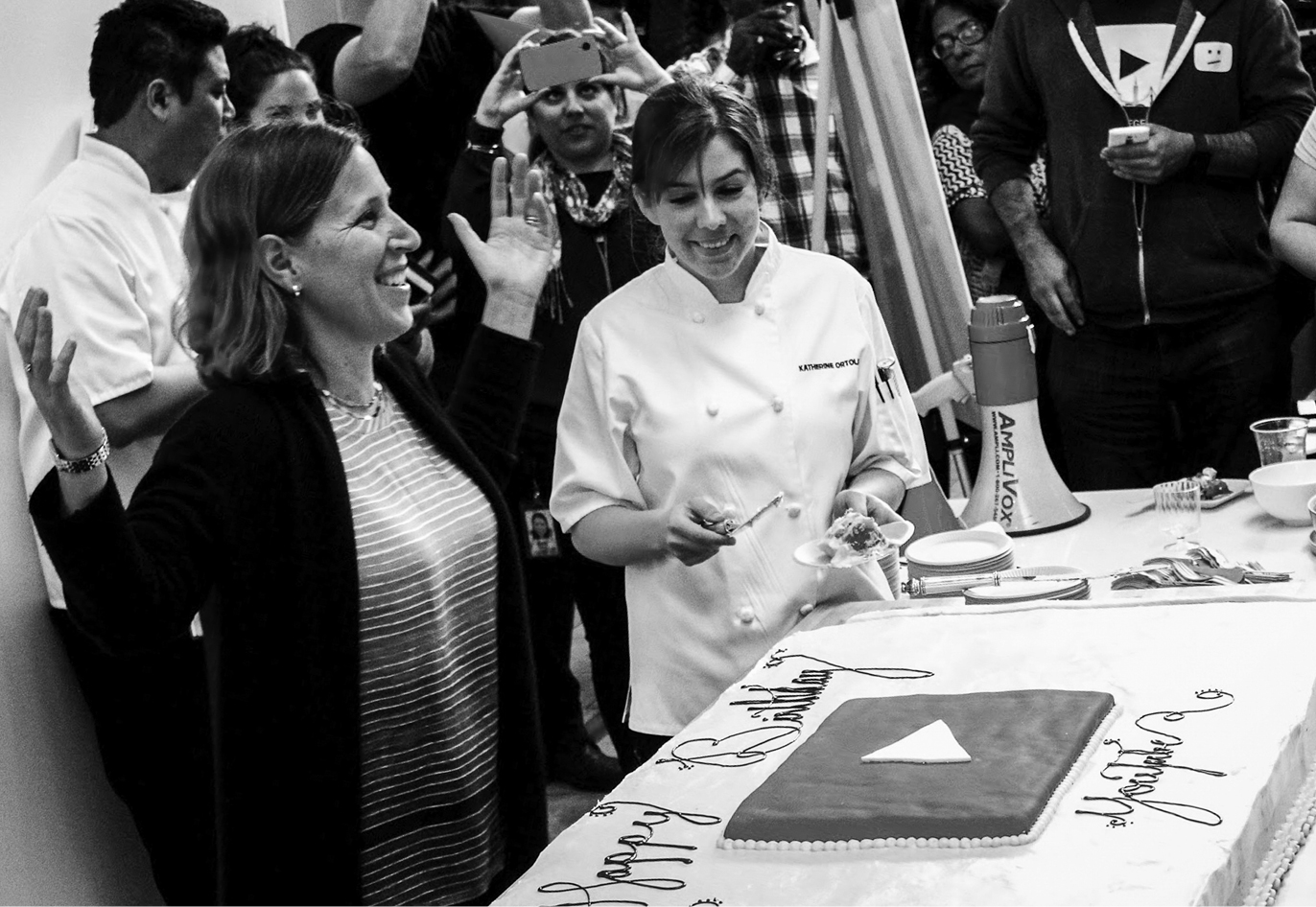
Susan Wojcicki celebrating YouTube’s tenth birthday, 2015.
Thinking Bigger
Susan: Aspirational goals can prompt a reset for the entire organization. In our case, it inspired infrastructure initiatives throughout YouTube. People started saying, “If we’re going to be that big, maybe we need to redesign our architecture. Maybe we need to redesign our storage.” It became a prod for the whole company to better prepare for the future. Everybody started thinking bigger.
Looking back, I doubt we could have reached the goal in four years without the process, structure, and clarity of that stretch OKR. In a fast-growing company, it’s a challenge to get everybody to align and focus around the same objective. People need a benchmark to know how they’re performing against it. The catch is to find the right one. The billion hours of daily watch time gave our tech people a North Star.
But nothing stays the same. In 2013, the watch-time metric was the best way to gauge the quality of the YouTube experience. Now we’re looking at other variables, from web-added videos and photos to viewer satisfaction and a focus on social responsibility. If you watch two videos for ten minutes apiece, the watch time is the same—but which one makes you happier?
So by the time this book is published, we may have found a whole new metric to grow by. As early as 2015, we began to advance beyond watch time by factoring user satisfaction into our recommended videos. By asking users about the content they found most satisfying, and measuring “likes” and “dislikes,” we could better ensure that they’d feel their time on YouTube was well spent. In 2017, we introduced a breaking news shelf on the homepage, which focused on surfacing the most prominent and relevant content from authoritative news sources. To this day, we are working to incorporate a broader array of new and meaningful signals into our recommendations. As our business grows, and YouTube’s role in society evolves, we will continue to hunt for the right metrics for our services—and with them, the right OKRs.