15
Continuous Performance Management: OKRs and CFRs
Talking can transform minds, which can transform behaviors, which can transform institutions.
—Sheryl Sandberg
Annual performance reviews are costly, exhausting, and mostly futile. On average, they swallow 7.5 hours of manager time for each direct report. Yet only 12 percent of HR leaders deem the process “highly effective” in driving business value. Only 6 percent think it’s worth the time it takes. Distorted recency bias, burdened by stack rankings and bell curves, these end-of-year evaluations can’t possibly be fair or well measured.
What business leaders have learned, very painfully, is that individuals cannot be reduced to numbers. Even Peter Drucker, the champion of well-measured goals, understood the limits of calibration. A manager’s “first role,” Drucker said, “is the personal one. It’s the relationship with people, the development of mutual confidence . . . the creation of a community.” Or as Albert Einstein observed, “Not everything that can be counted counts, and not everything that counts can be counted.”
To reach goals almost beyond imagining, people must be managed at a higher level. Our systems for workplace communication cry out for an upgrade. Just as quarterly OKRs have rendered pro forma annual goals obsolete, we need an equivalent tool to revolutionize outdated performance management systems. In short, we need a new HR model for the new world of work. That transformational system, the contemporary alternative to annual reviews, is continuous performance management. It is implemented with an instrument called CFRs, for:
-
Conversations: an authentic, richly textured exchange between manager and contributor, aimed at driving performance
-
Feedback: bidirectional or networked communication among peers to evaluate progress and guide future improvement
-
Recognition: expressions of appreciation to deserving individuals for contributions of all sizes
Like OKRs, CFRs champion transparency, accountability, empowerment, and teamwork, at all levels of the organization. As communication stimuli, CFRs ignite OKRs and then boost them into orbit; they’re a complete delivery system for measuring what matters. They capture the full richness and power of Andy Grove’s innovative method. They give OKRs their human voice.
Best of all, OKRs and CFRs are mutually reinforcing. Doug Dennerline is CEO of BetterWorks, the pioneer in bringing both of these tools to the cloud and smartphones and in helping hundreds of organizations make the processes their own. “It’s the marriage between the two—that’s the real home run,” Doug says. “If a conversation is limited to whether you achieved the goal or not, you lose context. You need continuous performance management to surface the critical questions: Was the goal harder to achieve than you’d thought when you set it? Was it the right goal in the first place? Is it motivating? Should we double down on the two or three things that really worked for us last quarter, or is it time to consider a pivot? You need to elicit those insights from all over the organization.
“On the other hand, if you don’t have goals, what the heck are you talking about? What did you achieve, and how? In my experience, people are more likely to feel fulfilled when they have clear and aligned targets. They’re not wandering and wondering about their work; they can see how it connects and helps the organization.”
To hazard another football analogy: Let’s say objectives are the goalposts, the targets you’re aiming for, and key results the incremental yard markers for getting there. To flourish as a group, players and coaches need something more, something vital to any collective endeavor. CFRs embody all the interactions that tie the team together from one game to the next. They’re the Monday videotape postmortems, the midweek intrasquad meetings, the preplay huddles—and the end-zone celebrations for jobs well done.
Reinventing HR
The good news: A change is in the breeze. Ten percent of Fortune 500 companies have already ditched the old once-a-year performance review system, and their numbers are growing. Countless smaller start-ups, less tied to tradition, are doing the same. We’re at the point where nearly every HR custom needs to be reimagined. A mobile, agile workforce—and a nonhierarchical workplace—demands no less.
When companies replace—or at least augment—the annual review with ongoing conversations and real-time feedback, they’re better able to make improvements throughout the year. Alignment and transparency become everyday imperatives. When employees are struggling, their managers don’t sit and wait for some scheduled day of reckoning. They jump into tough discussions like firefighters, without hesitation.
It might sound almost too easy, but continuous performance management will lift every individual’s achievement. It elevates performance, bottom to top. It works wonders for morale and personal development, for leaders and contributors alike. And when leveraged with the quarterly goals and built-in tracking of OKRs, it can be even more powerful.
In this transitional moment, more organizations are broadening their evaluations with alternative criteria, like competencies and team play. Many are now riding parallel tracks, with annual reviews set alongside continuous performance management and ongoing conversations. This balance of old and new thinking can work well for larger companies in particular, some of whom may be happy to live there forever. Others will cut the cord and drop ratings and rankings for more transparent, collaboratively developed, multidimensional review criteria.
Table 15.1: Annual Performance Management Versus Continuous Performance Management
|
Annual Performance Management |
Continuous Performance Management |
|
Annual feedback |
Continuous feedback |
|
Tied to compensation |
Decoupled from compensation |
|
Directing/autocratic |
Coaching/democratic |
|
Outcome focused |
Process focused |
|
Weakness based |
Strength based |
|
Prone to bias |
Fact driven |
Continuous Performance Management at Pact
Pact, the Washington, D.C.–based international trade and development nonprofit, has seen firsthand the synergy between OKRs and continuous performance management. Tim Staffa, a Pact director, says:
“We embraced OKRs because our performance management process was moving to a more frequent cadence. When Pact adopted OKRs, we officially killed our annual performance review. We replaced it with a set of more frequent touch points between managers and employees. Internally, we’ve dubbed this ‘Propel.’ It consists of four elements:
“The first is a set of monthly one-on-one conversations between employees and their managers about how things are going.
“The second is a quarterly review of progress against our OKRs. We sit down and say, ‘What did you set out to accomplish this quarter? What were you able to do—and what weren’t you able to do? Why or why not? What can we change?’
“Third, we have a semiannual professional development conversation. Employees talk about their career trajectory—where they’ve been, where they are, where they want to go. And how their managers and the organization can support their new direction.
“The fourth bit is ongoing, self-driven insight. We’re constantly surrounded by positive reinforcement and feedback, but many of us haven’t been trained to seek it out. Say you give a presentation to your team. After the fact, somebody comes up to you and says, ‘Hey, nice job.’ Most of us would say, ‘Oh great, thanks,’ and move on. But we want to probe a little deeper: ‘Thank you. What one thing did you like about it?’ The idea is to capture more specific feedback in real time.”
An Amicable Divorce
For companies moving to continuous performance management, the first step is blunt and straightforward: Divorce compensation (both raises and bonuses) from OKRs. These should be two distinct conversations, with their own cadences and calendars. The first is a backward-looking assessment, typically held at year’s end. The second is an ongoing, forward-looking dialogue between leaders and contributors. It centers on five questions:
-
What are you working on?
-
How are you doing; how are your OKRs coming along?
-
Is there anything impeding your work?
-
What do you need from me to be (more) successful?
-
How do you need to grow to achieve your career goals?
Now, I’m not proposing that performance reviews and goals can or should be completely severed. A data-driven summary of what someone has achieved can be a welcome antidote to ratings biases. And since OKRs reflect a person’s most meaningful work, they’re a source of reliable feedback for the cycle to come. But when goals are used and abused to set compensation, employees can be counted on to sandbag. They start playing defense; they stop stretching for amazing. They get bored for lack of challenge. And the organization suffers most of all.
Let’s say Contributor A set extreme stretch goals and somehow attained 75 percent of them. Does her outperformance merit 100 percent of her bonus—or even 120 percent? Contributor B, by contrast, reaches 90 percent of his key results, but his manager knows he didn’t push himself—and, what’s more, that he blew off several important team meetings. Should he get a larger bonus than Contributor A?
The short answer is no, not if you want to preserve initiative and morale.
At Google, according to Laszlo Bock, OKRs amount to a third or less of performance ratings. They take a backseat to feedback from cross-functional teams, and most of all to context. “It’s always possible—even with a goal-setting system—to get the goals wrong,” Laszlo says. “Maybe the market does something crazy, or a client leaves their job and suddenly you have to rebuild from scratch. You try to keep all of that in consideration.” Google is careful to segregate raw goal scores from compensation decisions. Their OKR numbers are actually wiped from the system after each cycle!
The formula has yet to be invented for complex human behavior, because that’s where human judgment comes in. In today’s workplace, OKRs and compensation can still be friends. They’ll never totally lose touch. But they no longer live together, and it’s healthier that way.
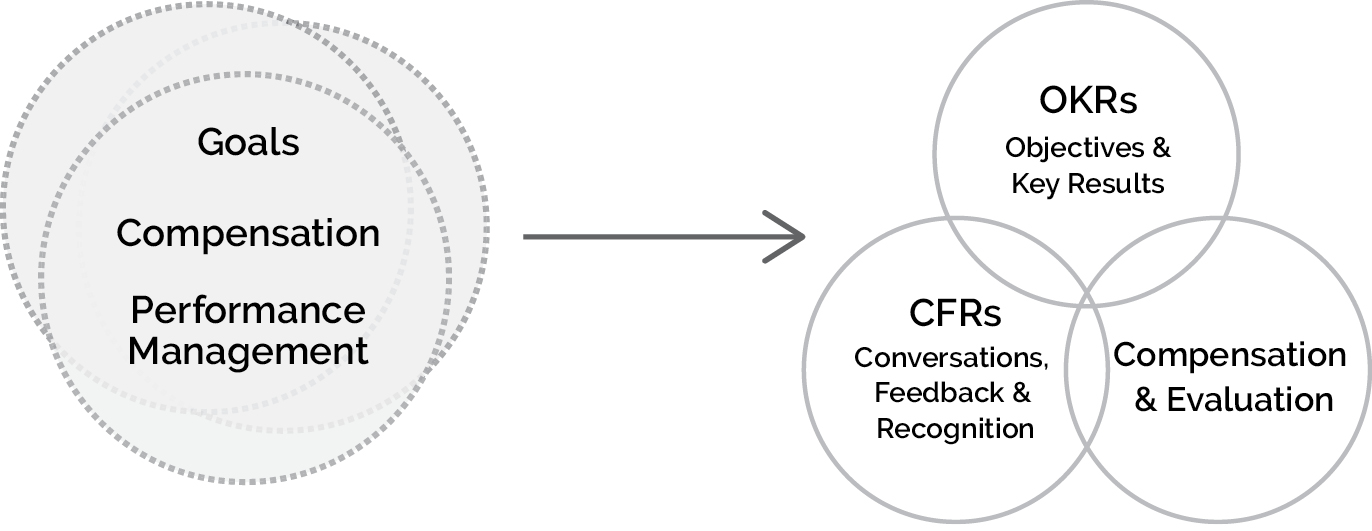
As companies transition to continuous performance management, OKRs and CFRs become mostly independent from compensation and formal evaluations.
Conversations
Peter Drucker was one of the first to stress the value of regular one-on-one meetings between managers and their direct reports. Andy Grove estimated that ninety minutes of a manager’s time “can enhance the quality of your subordinate’s work for two weeks.” Ahead of the curve, as usual, Andy made one-on-ones mandatory at Intel. The point of the meeting, he wrote,
is mutual teaching and exchange of information. By talking about specific problems and situations, the supervisor teaches the subordinate his skills and know-how, and suggests ways to approach things. At the same time, the subordinate provides the supervisor with detailed information about what he is doing and what he is concerned about. . . . A key point about a one-on-one: It should be regarded as the subordinate’s meeting, with its agenda and tone set by him. . . . The supervisor is there to learn and coach.*
The supervisor should also encourage the discussion of heart-to-heart issues during one-on-ones, because this is the perfect forum for getting at subtle and deep work-related problems affecting his subordinate. Is he satisfied with his own performance? Does some frustration or obstacle gnaw at him? Does he have doubts about where he is going?
With contemporary tools to track and coordinate frequent conversations, Grove’s tenets are more timely than ever.* Effective one-on-ones dig beneath the surface of day-to-day work. They have a set cadence, from weekly to quarterly, depending on need. Based on BetterWorks’ experience with hundreds of enterprises, five critical areas have emerged of conversation between manager and contributor:
Goal setting and reflection, where the employee’s OKR plan is set for the coming cycle. The discussion focuses on how best to align individual objectives and key results with organizational priorities.
Ongoing progress updates, the brief and data-driven check-ins on the employee’s real-time progress, with problem solving as needed.*
Two-way coaching, to help contributors reach their potential and managers do a better job.
Career growth, to develop skills, identify growth opportunities, and expand employees’ vision of their future at the company.
Lightweight performance reviews, a feedback mechanism to gather inputs and summarize what the employee has accomplished since the last meeting, in the context of the organization’s needs. (As noted earlier, this conversation is held apart from an employee’s annual compensation/bonus review.)
As workplace conversations become integral, managers are evolving from taskmasters to teachers, coaches, and mentors. Say the head of product has waffled over a design decision, putting a product release date in jeopardy. Before the next executive team meeting, an effective CEO/coach might say, “Can you think about how to be more decisive in this setting? What if you laid out the two best options but made your own preference clear? Do you think you could do that?” If the product head agrees, there is a plan. Unlike negative criticism, coaching trains its sights on future improvement.
Feedback
In her instant classic, Lean In: Women, Work, and the Will to Lead, Sheryl Sandberg notes: “Feedback is an opinion, grounded in observations and experiences, which allows us to know what impression we make on others.” To reap the full benefits of OKRs, feedback must be integral to the process. If you don’t know how well you’re performing, how can you possibly get better?
Today’s workers “want to be ‘empowered’ and ‘inspired,’ not told what to do. They want to provide feedback to their managers, not wait for a year to receive feedback from their managers. They want to discuss their goals on a regular basis, share them with others, and track progress from peers.” Public, transparent OKRs will trigger good questions from all directions: Are these the right things for me/you/us to be focused on? If I/you/we complete them, will it be seen as a huge success? Do you have any feedback on how I/we could stretch even more?
Feedback can be highly constructive—but only if it is specific.
Negative feedback: “You started the meeting late last week, and it came off as disorganized.”
Positive feedback: “You did a great job with the presentation. You really grabbed their attention with your opening anecdote, and I loved how you closed with next action steps.”
In developing organizations, feedback is generally led by HR and often scheduled. In more mature organizations, feedback is ad hoc, real-time, and multidirectional, an open dialogue between people anywhere in the organization. If we can rate our Uber drivers (and vice versa), and even rate the raters on Yelp, why can’t a workplace support two-way feedback between managers and employees? Here’s the precious opportunity for people to say to their leaders, What do you need from me to be successful? And now let me tell you what I need from you.
Not so many years ago, employees made their voices heard by slipping unsigned notes into the office suggestion box. Today, progressive companies have replaced the box with always-on, anonymous feedback tools, from quick-hitting employee surveys to anonymous social networks and even rating apps for meetings and meeting organizers.
Peer-to-peer (or 360-degree) feedback is an added lens for continuous performance management. It can be anonymous or public or somewhere in between. Is the feedback designed to help employees move forward in their careers? (If so, it’s channeled privately to the individuals.) Is it meant to reveal an organization’s problem areas? (Here it goes straight to HR.) It’s all a matter of context and purpose.
By fostering connections among teams, peer feedback is especially valuable in cross-functional initiatives. When horizontal communication blows open, interdepartmental teamwork becomes the new normal. As OKRs are combined with 360-degree feedback, the silo will soon be a relic of the past.
Recognition
Here is the most underestimated component of CFRs, and the least well understood. Gone are the days when gold watches were coveted awards for simple longevity. Modern recognition is performance-based and horizontal. It crowdsources meritocracy. When JetBlue installed a value-driven, peer-to-peer recognition system, and leaders began noticing people who’d flown under their radar, metrics for employee satisfaction nearly doubled.
Continuous recognition is a powerful driver of engagement: “As soft as it seems, saying ‘thank you’ is an extraordinary tool to building an engaged team. . . . ‘[H]igh-recognition’ companies have 31 percent lower voluntary turnover than companies with poor recognition cultures.” Here are some ways to implement it:
-
Institute peer-to-peer recognition. When employee achievements are consistently recognized by peers, a culture of gratitude is born. At Zume Pizza, the Friday all-hands “roundup” meeting concludes with a series of unsolicited, unedited shout-outs from anyone in the organization to anyone else who’s done something remarkable.
-
Establish clear criteria. Recognize people for actions and results: completion of special projects, achievement of company goals, demonstrations of company values. Replace “Employee of the Month” with “Achievement of the Month.”
-
Share recognition stories. Newsletters or company blogs can supply the narrative behind the accomplishment, giving recognition more meaning.
-
Make recognition frequent and attainable. Hail smaller accomplishments, too: that extra effort to meet a deadline, that special polish on a proposal, the little things a manager might take for granted.
-
Tie recognition to company goals and strategies. Customer service, innovation, teamwork, cost cutting—any organizational priority can be supported by a timely shout-out.
OKR platforms are custom-built for peer-to-peer recognition. Quarterly goals establish and reestablish the areas where feedback and recognition are most valued. Transparent OKRs make it natural for coworkers to celebrate big wins and smaller triumphs alike. All deserve their share of the limelight.
Once teams and departments start connecting in this fashion, more and more people get on board, and a recognition engine revs up an entire company. Anyone can cheer anyone else’s goal, irrespective of title or department. And mark this: Every cheer is a step toward operating excellence, the crowning purpose of OKRs and CFRs.