17
Baking Better Every Day: The Zume Pizza Story
Julia Collins and Alex Garden
Cofounders and Co-CEOs
As we’ve seen, OKRs and CFRs are proven vehicles for high performance and exponential growth. They also have more subtle, internal, quotidian effects—like grooming better executives, or giving less vocal contributors an opportunity to shine. On the long and demanding road to operating excellence, they help organizations improve each and every day. Leaders become better communicators and motivators. Contributors grow into more disciplined, rigorous thinkers. When imbued with meaningful conversations and feedback, structured goal setting teaches people how to work within constraints even as they push against them—an especially critical lesson for smaller, scaling operations.
The Zume Pizza story vividly illustrates these internal dynamics. It’s about a start-up using OKRs and CFRs—plus a few robots—to take on the giants of its industry.
For some time now, the $10 billion U.S. pizza delivery market has been controlled by three national chains: Domino’s, Pizza Hut, and Papa John’s. They aren’t life-altering pizzas, but their brands are well established and own the great advantage of economy of scale. In the spring of 2016, when Zume Pizza opened for business in an out-of-the-way concrete bunker in Silicon Valley, the skeptics came out in droves. “Roboticized, artisanal pizza” was derided as a Left Coast gimmick. The odds for success seemed long.
Going on two years later, Zume is beating those odds by making world-class pizza at a competitive price. The company assigns rote tasks to machines, freeing its people for creative jobs that add more value. Dollars saved on manual labor get plowed into higher-quality ingredients: dough from non-GMO flours, organically grown tomatoes, locally sourced vegetables, and healthfully cured meats. The result is a tastier pie that’s actually good for you—and that arrives, still hot, as little as five minutes after you input your order.
As online or mobile app orders link into Zume’s conveyor belt, robots stretch and shape the dough, apply the sauce, and safely slide the pizzas into an 800-degree oven. With robotics technology continuing to mature, the company plans to automate the entire process, from adding cheese and custom toppings to loading the partly baked pies into Zume’s fleet of algorithmically operated, baking-on-the-way trucks. (In the future, there’s a fair chance those trucks will be driverless.)
Within three months of launch, Zume had achieved 10 percent market share in its local trade area. In 2018, it began disrupting the pizza oligopoly across the Bay Area. Soon it will roll out across the West Coast, and then nationally; by 2019, the founders hope to be overseas. “We’re going to be the Amazon of food,” says cofounder Alex Garden, who first met OKRs as president of Zynga Studios.
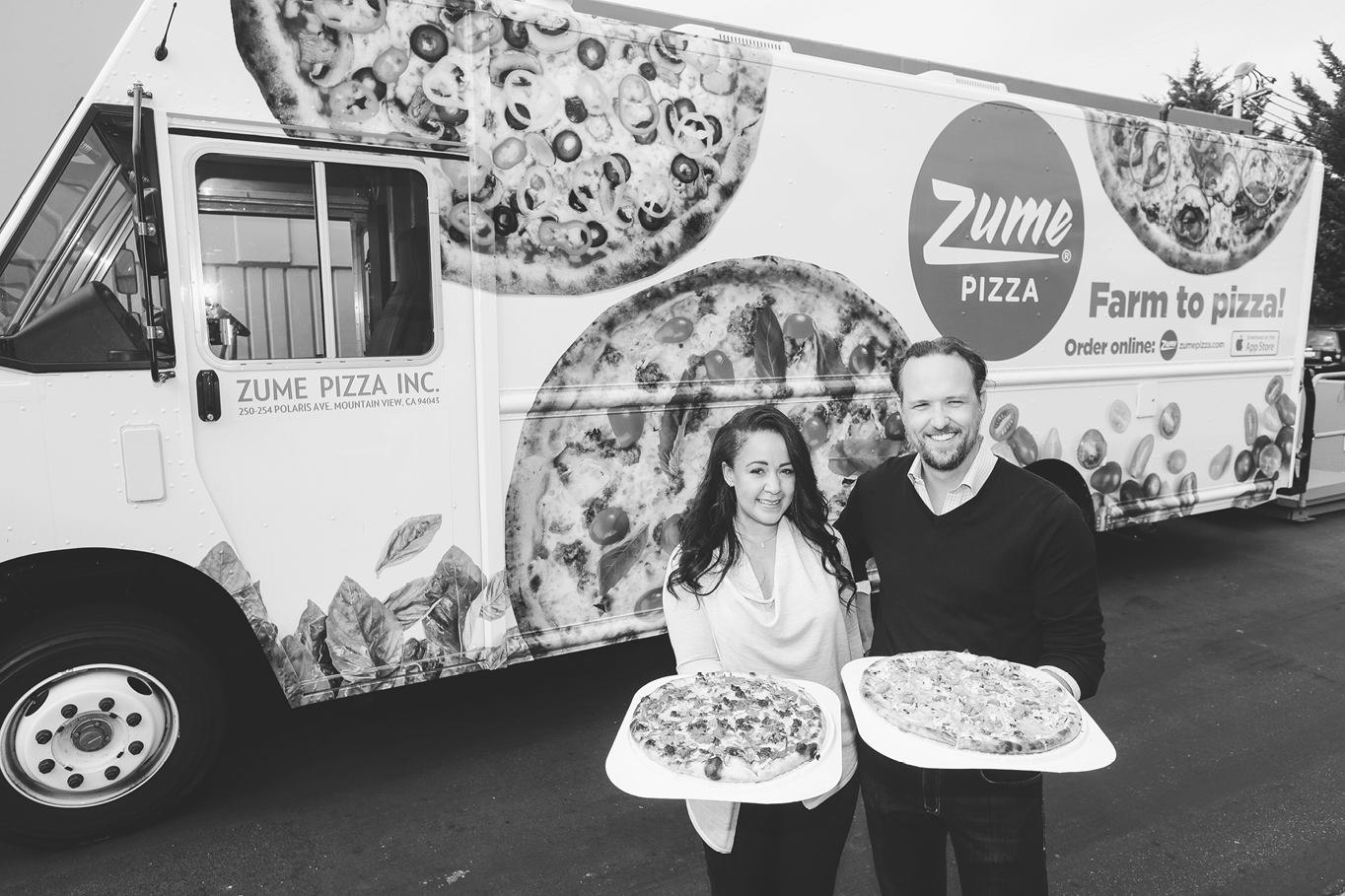
Zume cofounders Julia Collins and Alex Garden with their baking-on-the-way pizza truck.
When you’re David taking on Goliath, time and opportunity are of the essence. There’s no margin for unfocused operations or misaligned staff. As Zume’s leaders will tell you, OKRs have helped their young company to thrive in ways they could not have foreseen.
Julia Collins: In the beginning, Zume lived in our two heads. If you asked Alex and me any question, we would give you the same answer; we spent so much time together that everything was understood. That works fine with two people. After our CTO came on board and we became “the three cheeses,” it still worked really well. But once we added Parmigiano-Reggiano to the mozzarella, Romano, and provolone, something changed. By the time we had seven people, if you asked us, “What’s the main thing we need to accomplish today?”—well, you’d get eight different answers.
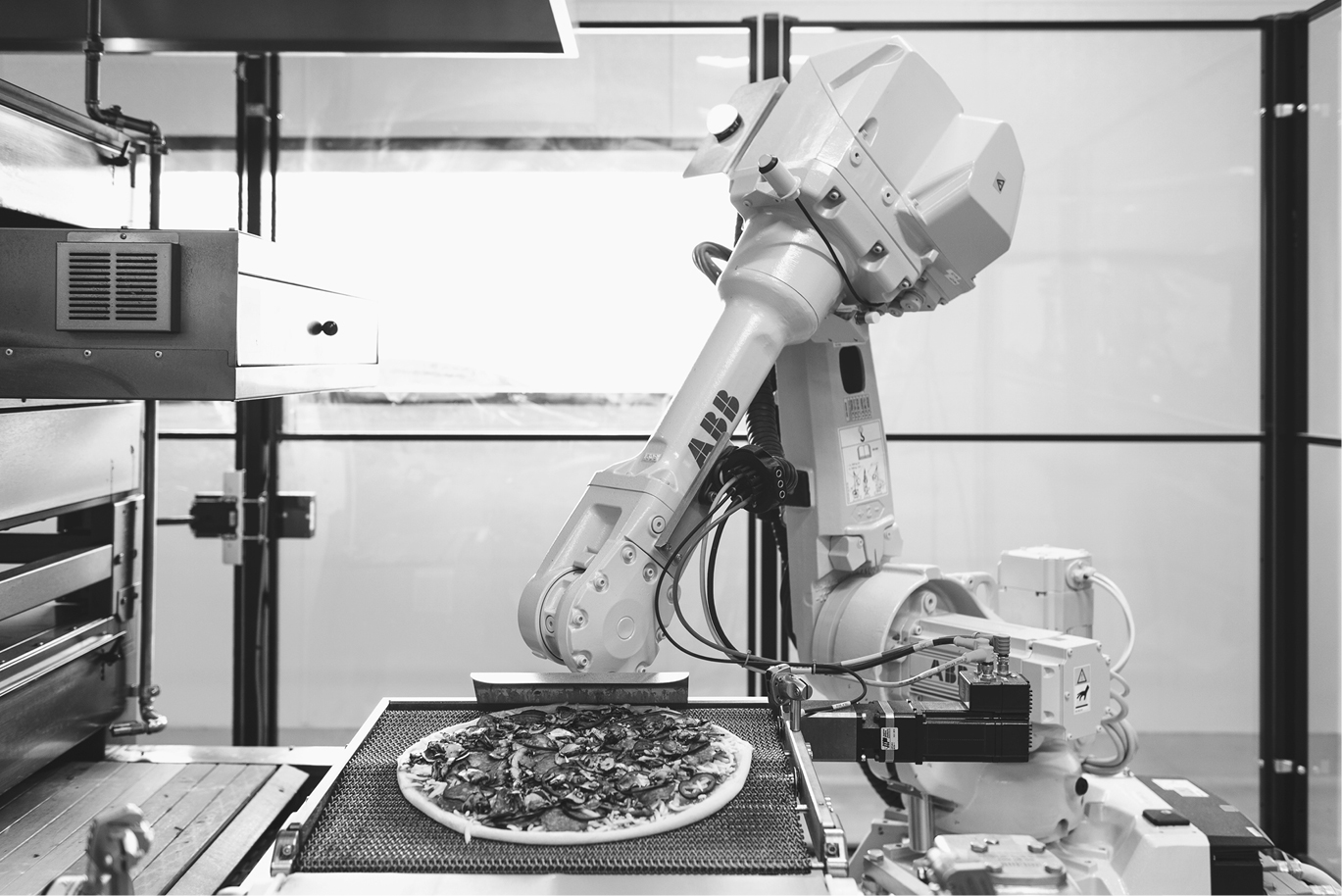
A Zume Pizza robot in action.
We started with the project management software called LiquidPlanner, a “waterfall” methodology. It really helped build out our kitchen. First you pour the concrete and let it dry; then you put on the epoxy and let that dry; then you cover it and install the walk-in refrigerator box, right? For a linear process, it’s fantastic.
But by June 2016, as we prepared to launch, Zume was a more complex operation. We were up to sixteen salaried employees, plus another three dozen hourly kitchen workers and “pilots,” the indispensable people who deliver our pizza. We’d ventured into large-scale manufacturing, plus integrating robots, plus developing software, plus creating a menu . . . and the waterfall stopped flowing so smoothly. Too many things were happening at once, with lots of layers of interdependencies. We knew we had to stay agile, and our engineers checked in on JIRA’s project management software each morning for their two-week sprints. But neither JIRA nor LiquidPlanner could answer one big question: What’s the most important thing to do?
Zume’s biggest asset is our talented and creative team. Left to their own devices, our folks would jump into what they thought was most important. Their ideas were often good but not always in sync. We implemented OKRs early in our life cycle, three weeks after the first pizza went out the door, because we wanted to be sure that everyone knew our top priorities. In the beginning, to make sure that mission-critical things got done, Alex and I set a standard of 100 percent top-down alignment. The two of us created Zume’s objectives for our first two OKR cycles. Going forward, as survival becomes less of an issue, we’ll loosen up a little bit.
Achieving What’s Real
Alex Garden: It’s hard to deny the explicit value of OKRs, like how they help tie an organization to the leadership’s true ambitions. But for young companies like Zume, especially, there’s an equally important implicit value that gets overlooked. OKRs are a superb training tool for executives and managers. They teach you how to manage your business within existing limits. It’s important to push the envelope, but the envelope is real. Everybody faces resource constraints: time, money, people. And the bigger an organization, the more entropy—it’s like thermodynamics. During my stint as a general manager at Microsoft’s Xbox Live, I worked with some visionary executives. But we struggled from a misalignment between the leaders’ desires and the capabilities of the organization. The “hows”—and most of the “whats,” as well—were left to me and some other divisional foot soldiers. It was our job to execute an impractically framed mandate for an overscoped mission. If we’d had a well-constructed goal-setting process from the start, it might have saved everyone a lot of grief.
Old-school business models suggest that your role as an executive gets more abstract as you rise in the ranks. Your middle managers buffer you from the operational day-to-day, freeing you to focus on the big picture. Maybe that worked in a slower-paced era. But in my experience, OKRs can’t be effective unless the people at the top are unconditionally committed—like a religious calling. And proselytizing is hard and thankless work. Your people may not like you very much through the adoption curve, which can take up to a year. But it’s worth it.
Better Discipline
Julia: If we’re talking about the intrinsic value of OKRs, what comes before anything is the discipline that they instill in us as co-CEOs.
Alex: They train us to be thoughtful about what we can actually achieve, and to instill the same outlook in our executive team and their teams. Early on in your career, when you’re an individual contributor, you’re graded on the volume and quality of your work. Then one day, all of a sudden, you’re a manager. Let’s assume you do well and move up to manage more and more people. Now you’re no longer paid for the amount of work you do; you’re paid for the quality of decisions you make. But no one tells you the rules have changed. When you hit a wall, you think, I’ll just work harder—that’s what got me here.
What you should do is more counterintuitive: Stop for a moment and shut out the noise. Close your eyes to really see what’s in front of you, and then pick the best way forward for you and your team, relative to the organization’s needs. What’s neat about OKRs is that they formalize reflection. At least once each quarter, they make contributors step back into a quiet place and consider how their decisions align with the company. People start thinking in the macro. They become more pointed and precise, because you can’t write a ninety-page OKR dissertation. You have to choose three to five things and exactly how they should be measured. Then when the day comes and someone says, “Okay, you’re a manager,” you’ve already learned how to think like one. And that’s huge.
Most start-ups aren’t too eager to plunge into structured goal setting: We don’t need that. We go super-fast. We just figure stuff out. And often they do figure it out. But I think they’re missing an opportunity to teach people how to be executives before the company scales. If those habits aren’t ingrained early on, one of two things happens: Unsuccessful companies scale beyond the leadership team’s capacity, and they die. Successful companies scale beyond the team’s abilities and the team gets replaced. Those are both sad outcomes. The better way is to train people to think like leaders from the start, when their departments have a staff of one.
So OKRs forge your people. They mint stronger executives and help them avoid rookie mistakes. They implant the rigor and rhythm of a very large company into the framework of a very small company. When we implemented OKRs at Zume, the immediate benefit was the process itself. The simple act of forcing people to think about the business—thoughtfully, transparently, interdependently—was a huge accelerant to their performance.
Better Engagement
Alex: OKRs take out the ambiguity. And when you do that, some people will say, “This isn’t what I thought I signed up for, and I’m leaving.” But others will say, “I’m inspired because I finally know what we’re trying to do.” Either way, there’s clarity. For those who stay, you’ve laid the foundation for engagement. Everybody’s bought in to the mission. Team sports don’t work unless the whole team plays together.
Julia: As people get more familiar with the OKR process, it naturally gets more collaborative. In Q3 of 2016, Alex and I wrote the top company OKRs, and the department heads converted some of our key results into their own objectives. We just cascaded them down. In Q4, the two of us still wrote the company objectives, but our team jumped in and KRed them from the top, which was great. They took on a more creative role, and the OKRs got better. Our goals were still stretched, but people felt they were more realistic.
Zume calls its key technology “baking on the way.” That’s where we disrupt the industry and create the most delight for our customers. In Q4, a top company objective was to deploy our big guys, the twenty-six-foot trucks with fifty-six ovens linked to a sophisticated logistics and order prediction system. They enable us to finish your pizza algorithmically, in as little as five minutes after your online order, and have it ready—and still steaming—as we pull up to your door. Vaibhav Goel, our product manager, owned an OKR to order, coordinate, and fulfill the first flotilla of our baking-on-the-way fleet. It was airtight. If Vaibhav attained his three KRs, we knew we’d reach our objective.
OBJECTIVE
Complete the Truck Delivery Fleet for 250 Polaris (Mountain View HQ).
KEY RESULTS
-
Deliver 126 fully certified ovens by 11/30.
-
Deliver 11 fully certified racks by 11/30.
-
Deliver 2 fully certified full-format delivery vehicles by 11/30.
Every organization has people who are more vocal in asserting themselves. If they don’t win their point the first time, they’re comfortable saying it again. But quieter folks may not be heard so well, and their needs can get neglected. The OKR framework gives equal voice and weight to each department. No one needs to suffer in silence—truthfully, no one has that option. Your objectives will get their turn up on the screen, like everyone else’s, for comment and support.
I’d add that a really good company values different opinions. It mines for dissent, and it finds a way to bring it up to the surface and mine it out. That’s how we foster a meritocracy.
Alex: Before rolling OKRs out to our individual contributors, we put in two full quarters at the exec level. We had to establish the culture first. What we’ve found, oddly enough, is that our most active participants are the ones who were initially most skeptical.
Joseph Suzuki (director of marketing): I thought it another diet program—Just follow this process and you’ll be thin and beautiful. It felt like bookkeeping, one more administrative exercise. But OKRs had an effect on me I didn’t expect. When I did my biweekly check-ins, it gave me a couple minutes to think about what I was doing, and how my goals rolled up to what the company needed for the quarter.
At a start-up, you can get lost in tactical minutiae—especially in my department, where we wear so many hats. That’s dangerous, because you’re swimming in tumultuous seas and it’s easy to lose sight of land. But those OKR meditations helped me reset my compass: How do I contribute to the scheme of things? Then it’s not just another report or campaign or field event. It connects to something bigger and more meaningful.
Better Transparency
Julia: From the beginning, the process forced us to clarify who’s in charge of what. When a fly ball is hit between two outfielders, somebody’s got to call for it—or else the ball drops in, or both people dive for it and crash into each other. Early on, our fielders were marketing and product—but who was responsible for Zume’s revenue targets? The two leads had been with us one month apiece. Not only were they new to OKRs, but they were also new to Zume, and Zume was new to itself. When Alex and I saw their confusion, we broke the objective out into new revenue (marketing) and repeat revenue (product), and the department heads drilled down from there. That was an important conversation. It wasn’t linked to an objective, per se, but it was absolutely a by-product of an early-stage OKR process. When something isn’t clearly delineated, it shows up right away. You can’t miss it.
Better Teamwork
Alex: In eight months we launched a food company, a logistics company, a robotics company, and a manufacturing company—from a standing start. We used OKRs as a teaching tool to impart a culture of consideration. They make you start thinking reflexively about how the work you’re doing affects those around you, and how you’re dependent on them, too.
Julia: Our team is very eclectic. Our executive chef, Aaron Butkus, came up through mom-and-pop restaurants around New York City. Our fleet manager, Mike Bessoni, worked in movie production. We’ve got a product wonk and a software engineer, and everyone came in speaking different languages. OKRs were our Esperanto, our shared vocabulary. The seven-member leadership team meets over lunch every Monday, and about every other week we discuss our OKRs. You hear people saying things like “Who owns the customer?” or “How would you key-result that goal?” And everyone knows just what they mean.
The most delicious pie in the world won’t make people happy if it gets to them cold. Mike and Aaron own a shared objective for customer satisfaction. Mike might say, “I’ve got a key result for expanding our delivery radius, and now it’s at risk.” Maybe the manufacturing team was delayed in getting a vehicle online. So now we’ll have a collective conversation on how the late deployment is affecting our service area and revenue stream. Which also ties in to Joe Suzuki, our marketing lead, and his OKR to increase top-line revenue.
In another life, Mike might have called out the manufacturing lead: “What the hell, can you hurry up and get this done? I’ve been waiting forever!” When you say instead, “My KR is at risk,” it’s less charged and more constructive. Since our company has total alignment, the entire team has already agreed to the key result and the dependency it entails. There’s no judgment, just a problem to be solved. And guess what else happens? The two leads will advocate for each other to get more resources from Alex and me.
Aaron Butkus (executive chef): If I’m creating a new seasonal pie, I can’t do it on the spur. Marketing needs to know at least a week ahead of time, and then photo and design have to take pictures. It affects every department—the product manager’s website, the tech team and their mobile app. The OKRs keep me centered and on track. They guarantee that I get the recipe done in time for everyone who’s waiting on it. My deadline’s built into a key result. I can see the bigger picture more clearly.
It’s definitely a team-building process. It reminds you that you’re a part of this little, weird community. It’s easy to get caught up in your own issues, especially when you’re working in the kitchen. But OKRs get people to think, Oh yeah, we’re working together on this, we’re working together on everything.
Better Conversations
Alex: Every two weeks, each person at Zume has a one-hour, one-on-one conversation with whomever they report to. (Julia and I converse with each other.) It’s a sacred time. You cannot be late; you cannot cancel. There’s only one other rule: You don’t talk about work. The agenda is you, the individual, and what you are trying to accomplish personally over the next two to three years, and how you’re breaking that into a two-week plan. I like to start with three questions: What makes you very happy? What saps your energy? How would you describe your dream job?
Then I say, “Look, I want to tell you what my expectations are. Number one, always tell the truth. Number two, always do the right thing. If you meet those expectations, we’ll unconditionally back you, one hundred percent of the time. And I will personally guarantee you that you’re going to achieve your next set of personal and professional goals over the next three years.” And we go from there.
People might see this as altruism, but it’s actually a powerful way to get people connected to the business—and to keep them from churning out. It gives them insights around obstacles. A leader might say, “This goal seems very important to you, but you didn’t make a lot of progress on it the last two weeks. Why is that?” It may seem paradoxical, but these nonwork, touchpoint one-on-ones are a forum for ongoing performance feedback. In talking about people’s pursuit of personal goals, you end up learning a lot about what moves them forward—or holds them back—in their careers.
When you’re having regular, deeper conversations, you get a sense of when you need to turn the dial and give people a chance to charge their batteries. After the organization has completed an all-out sprint, you might dial up contributors’ time for personal development goals—say, from 5 percent to 15 or 20 percent—the next quarter. It might sound like a huge tax, but it will set up the company’s two or three quarters of execution.
Better Culture
Julia: Culture is the common language that allows for individuals in an organization to be sure they’re all talking about the same thing—and that what they’re talking about has meaning. Beyond that, culture establishes a common framework for decision making. In its absence, people are at a loss for how to make key functions replicable and scalable.
Then there’s the more aspirational layer of culture: the values conversation. Who do we want to be as an organization? How do we want people to feel about their work, and about our product? What’s the impact we want to make on the world?
Alex: Zume’s founding principles—our mission—are two things Julia said to me on the phone when we were first introduced. They made such an impression on me that we put them up on a giant poster on our kitchen wall. The first was: Serving food to people is a sacred trust. And the second: Every American has a right to delicious, affordable, healthy food.
Here’s an OKR that flowed directly from our mission:
OBJECTIVE
Delight customers.
DETAIL
Feeding people is a sacred trust. To maintain that trust, we have to deliver the very best customer service and the very best food quality. To succeed as a business, we must ensure that our customers are so happy with our service and product that they have no choice but to order more pizza and to rave about the experience with their friends.
KEY RESULTS
-
Net Promoter Score of 42 or better.
-
Order Rating of 4.6/5.0 or better.
-
75% of customers prefer Zume to competitor in blind taste test.
Julia: There are so many daily decisions that are governed by our mission. It would be easy to use a tiny bit more salt in our pizzas. Or add a little bit of sugar to the sauce rather than going the extra mile to find the freshest tomatoes. Those are the small, insidious compromises that can creep into an organization and undermine who you are.
Every new employee goes through mission and values training as part of their onboarding. Alex and I are very clear about what we expect from people. And our clarity forces us to be highly accountable, as an organization and as individuals. We have a best-idea-wins culture, and people are free to call out anybody, including the CEO.
Alex: Especially the CEO, that’s the best call-out there is. When people challenge us in an open forum, we always stop and make a huge big deal about how impressive it is that the person spoke up. We try to overdo it, to create permission for people to lean in.
Better Leaders
Julia: I’ve worked for some great leaders in my day. They were all very different, but one thing they had in common was this cold, sober focus. If you sat down with them for twenty minutes, they were completely uncluttered in their thinking. They could drill down very clearly on what needed to be done. When you’re fund-raising and making pizza with robots and building out kitchens, there’s a lot of rapid context switching. It can feel a little frenetic at times. But when you know your company objectives like you know your last name, it’s very calming. OKRs help me to be that focused, clear-headed leader. No matter how crazy things get, I can always default back to what matters.