18
Culture
You need a culture that high-fives small and innovative ideas.
—Jeff Bezos
Culture, as the saying goes, eats strategy for breakfast. It’s our stake in the ground; it’s what makes meaning of work. Leaders are rightly obsessed with culture. Founders ask how they can protect their companies’ cultural values as they grow. Chiefs of large companies are turning to OKRs and CFRs as tools for culture change. And growing numbers of job seekers and career builders are making the right cultural fit their top criterion.
As you have seen throughout this book, OKRs are clear vessels for leaders’ priorities and insights. CFRs help ensure that those priorities and insights get transmitted. But goals cannot be attained in a vacuum. Like sound waves, they require a medium. For OKRs and CFRs, the medium is an organization’s culture, the living expression of its most cherished values and beliefs.
And so the question becomes: How do companies define and build a positive culture? While I have no simple answer, OKRs and CFRs provide a blueprint. By aligning teams to work toward a handful of common objectives, then uniting them through lightweight, goal-oriented communications, OKRs and CFRs create transparency and accountability, the tent poles for sustained high performance. Healthy culture and structured goal setting are interdependent. They’re natural partners in the quest for operating excellence.
Andy Grove understood the paramount importance of this interplay. “Put simply,” he wrote in High Output Management, culture is “a set of values and beliefs, as well as familiarity with the way things are done and should be done in a company. The point is that a strong and positive corporate culture is absolutely essential.” As an engineer, Grove equated culture with efficiency, a manual for quicker, more reliable decisions. When a company is culturally coherent, the way forward is understood:
Someone adhering to the values of a corporate culture—an intelligent corporate citizen—will behave in consistent fashion under similar conditions, which means that managers don’t have to suffer the inefficiencies engendered by formal rules, procedures, and regulations. . . . [M]anagement has to develop and nurture the common set of values, objectives, and methods essential to the existence of trust. How do we do that? One way is by articulation, by spelling [them] out. . . . The other even more important way is by example.
As an executive, Grove role-modeled Intel’s highest cultural standards. In his iOPEC seminars, he endeavored to instill them in the company’s new employees. On the following page you’ll find two original slides from 1985, an outline of Andy’s teachings on Intel’s seven core cultural values:
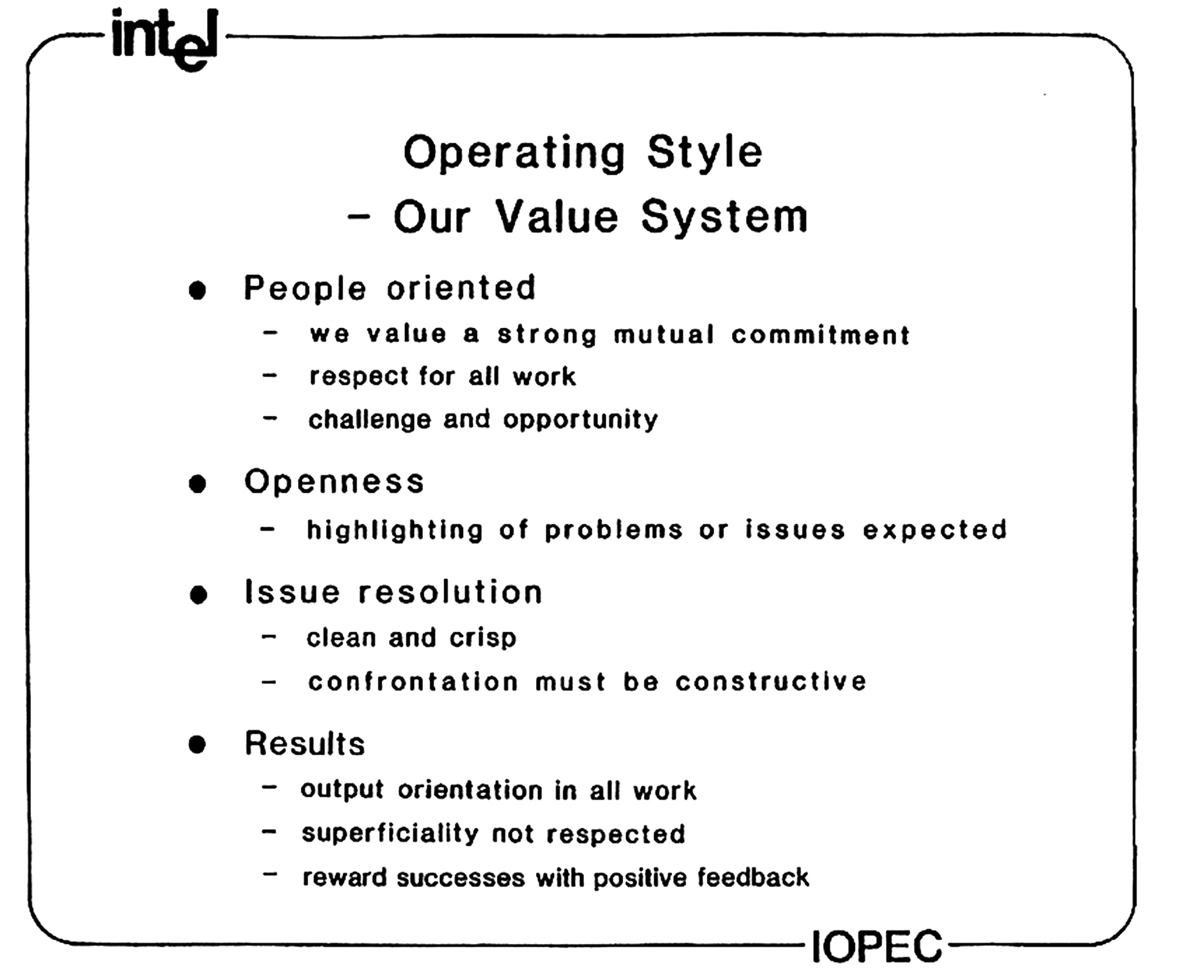
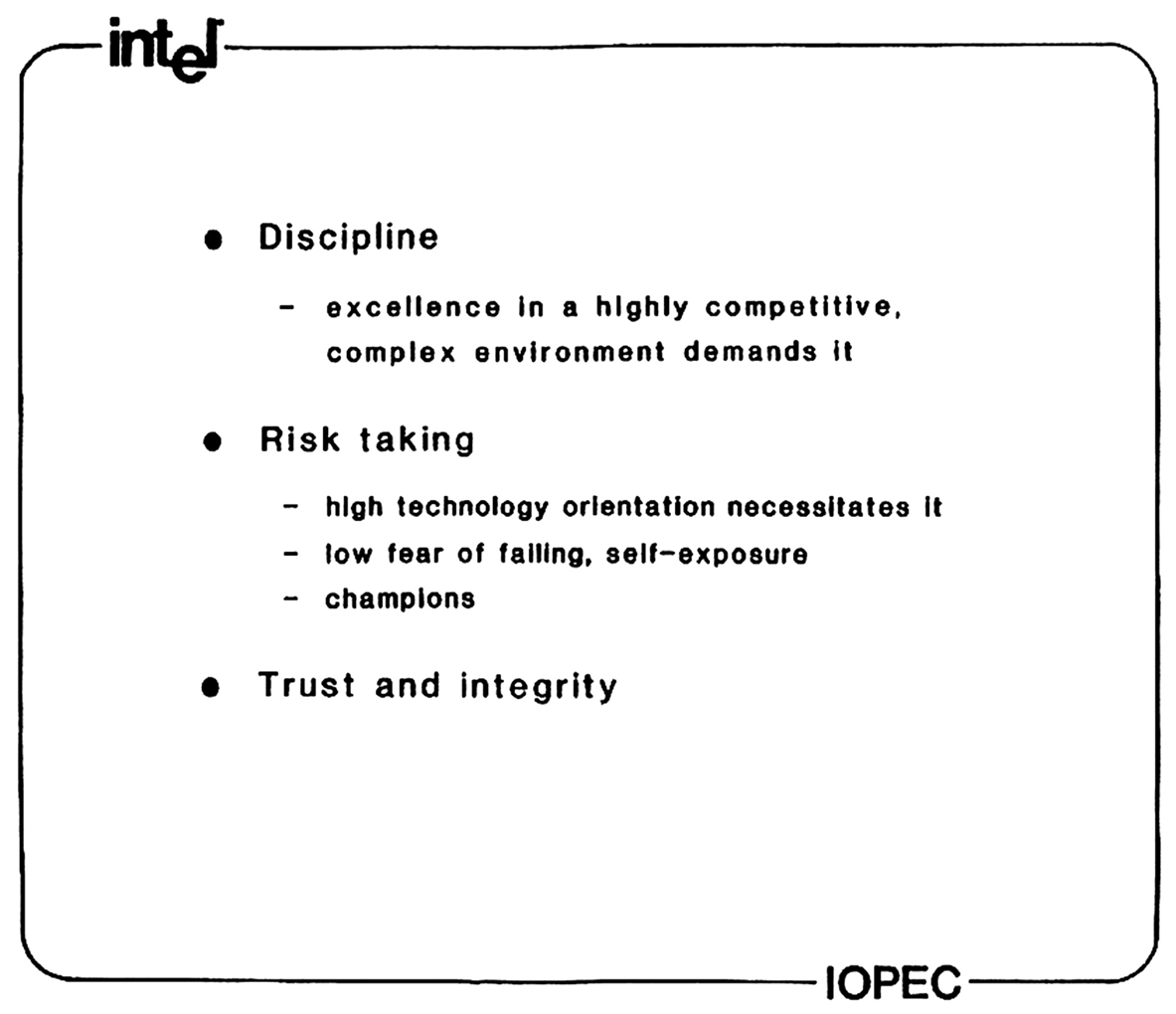
Intel Slide—Operating Style
The qualities prized by Andy Grove—collective accountability, fearless risk taking, measurable achievement—are also highly esteemed at Google. In Project Aristotle, an internal Google study of 180 teams, standout performance correlated to affirmative responses to these five questions:
-
Structure and clarity: Are goals, roles, and execution plans on our team clear?
-
Psychological safety: Can we take risks on this team without feeling insecure or embarrassed?
-
Meaning of work: Are we working on something that is personally important for each of us?
-
Dependability: Can we count on each other to do high-quality work on time?
-
Impact of work: Do we fundamentally believe that the work we’re doing matters?
The first item on this list—structure and clarity—is the raison d’être for objectives and key results. The others are all key facets of a healthy workplace culture, and tie directly to OKR superpowers and CFR communication tools. Consider peer-to-peer “dependability.” In a high-functioning OKR environment, transparency and alignment make people more diligent in meeting their obligations. At Google, teams assume collective responsibility for goal achievement—or for failures. At the same time, individuals are held responsible for specific key results. Peak performance is the product of collaboration and accountability.
An OKR culture is an accountable culture. You don’t push toward a goal just because the boss gave you an order. You do it because every OKR is transparently important to the company, and to the colleagues who count on you. Nobody wants to be seen as the one holding back the team. Everybody takes pride in moving progress forward. It’s a social contract, but a self-governed one.
In The Progress Principle, Teresa Amabile and Steven Kramer analyzed 26 project teams, 238 individuals, and 12,000 employee diary entries. High-motivation cultures, they concluded, rely on a mix of two elements. Catalysts, defined as “actions that support work,” sound much like OKRs: “They include setting clear goals, allowing autonomy, providing sufficient resources and time, helping with the work, openly learning from problems and successes, and allowing a free exchange of ideas.” Nourishers—“acts of interpersonal support”—bear a striking resemblance to CFRs: “respect and recognition, encouragement, emotional comfort, and opportunities for affiliation.”
In the high-stakes arena of culture change, OKRs lend us purpose and clarity as we plunge into the new. CFRs supply the energy we need for the journey. Where people have authentic conversations and get constructive feedback and recognition for superior accomplishment, enthusiasm becomes infectious. The same goes for stretch thinking and a commitment to daily improvement. The companies that treat their people as valued partners are the ones with the best customer service. They have the best products and strongest sales growth. They’re the ones who are going to win.
As continuous performance management rises to the fore, once-a-year employee surveys are giving way to real-time feedback. One frontier is pulsing, an online snapshot of your workplace culture. These signal-capturing questionnaires may be scheduled weekly or monthly by HR or made part of an ongoing “drip” campaign. Either way, pulses are simple, quick, and wide-ranging. For example: Are you getting enough sleep? Have you met recently with your manager to discuss goals and expectations? Do you have a clear sense of your career path? Are you getting enough challenge and motivation and energy—are you feeling “in the zone”?
Feedback is a listening system. In the new world of work, leaders cannot wait for negative critiques on Glassdoor, or for valued contributors to exit for another job. They need to listen and capture signals as they are emitted. What if a goal-setting platform could pulse two or three questions to employees whenever they log in? What if it merged quantitative data on goal progress with qualitative input from frequent conversations and pulsing feedback? We’re not far away from software that will prompt a manager: “Talk to Bob, something’s going on with his team.”
As OKRs build goal muscle, CFRs make those sinews more flexible and responsive. Pulsing gauges the organization’s real-time health—body and soul, work and culture.
Leading the world in online higher education, Coursera jumped into OKRs in 2013, just one year after its founding. With timely input from then-president Lila Ibrahim, an Intel alumna who revered Andy Grove, the organization tried something rare and exemplary. They connected OKRs explicitly to the company’s values and lofty mission statement, a clear expression of its culture: “We envision a world where anyone, anywhere, can transform their lives by accessing the world’s best learning experience.” Coursera rolled up its team-level objectives to top-line strategic objectives, which in turn rolled up to five core values:
-
Students first. Engage and increase value to students; extend reach to new students.
-
Great partners. Be a great partner to universities.
-
Think big and advance pedagogy. Develop an innovative, world-class education platform.
-
Care for teammates and be human, be humble. Build a strong, healthy organization.
-
Do good, do well. Experiment and develop a sustainable business model.
Each core value was mapped to a corresponding set of OKRs. As an example, here is an OKR for “students first”:
OBJECTIVE
Extend Coursera’s reach to new students.
KEY RESULTS
-
Perform A/B tests, learn, and iterate on ways to acquire new students and engage existing students.
-
Increase mobile monthly active users (MAU) to 150k.
-
Create internal tools to track key growth metrics.
-
Launch features to enable instructors to create more engaging videos.
OKRs furnished the pathway for Coursera’s mission. They enabled teams to articulate their goals and to align with the company’s objectives—and with its broader values, as well. Years later, the company’s friendly, inclusive culture remains a welcome contrast to the blustery, combative personality of many Silicon Valley start-ups.
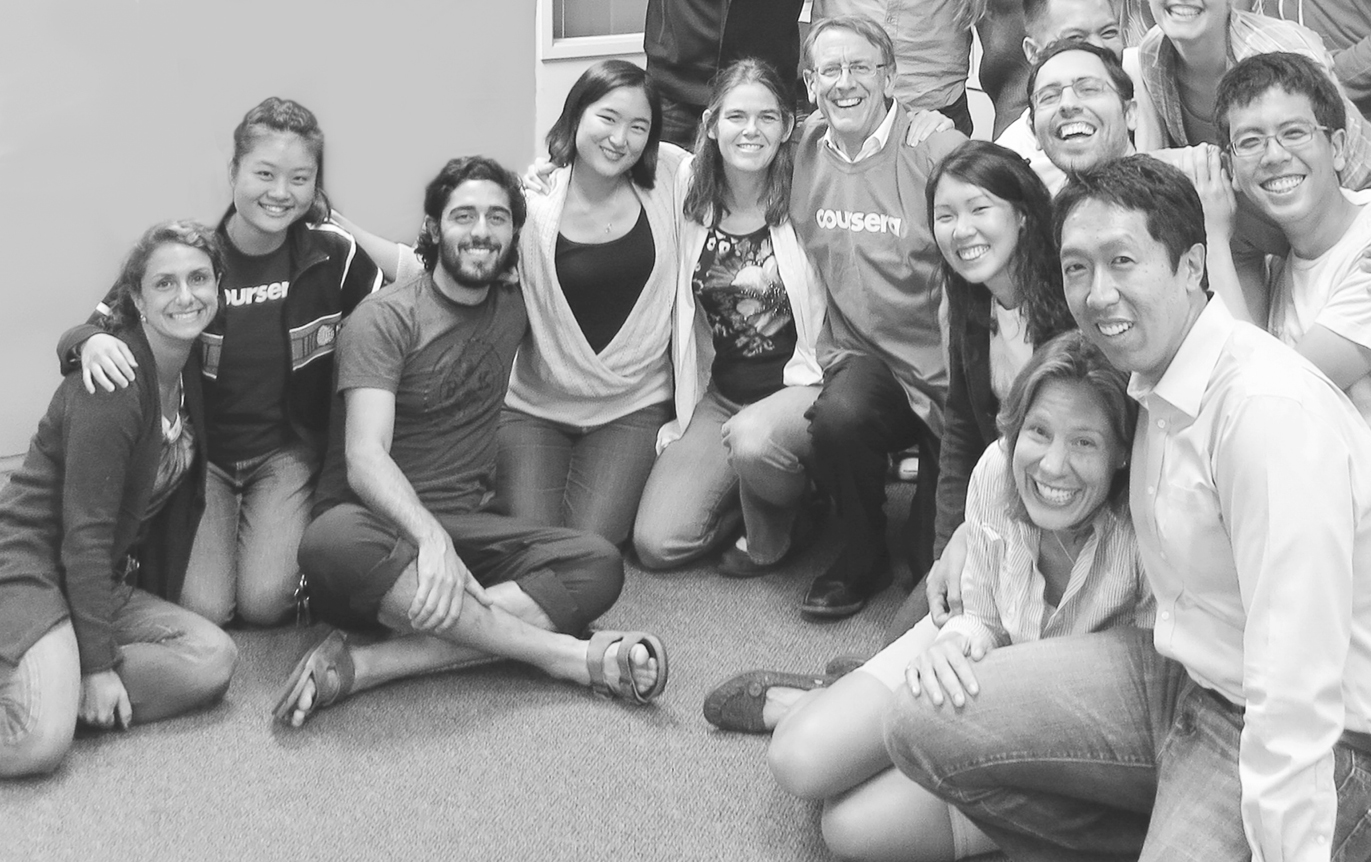
Coursera team with former president and COO Lila Ibrahim (left), cofounder Daphne Kohler (to the left of John Doerr), and cofounder Andrew Ng (far right), 2012.
As Rick Levin, Coursera’s former CEO, said, “I can’t imagine where we would be without OKRs. The discipline forces us to look back every quarter and hold ourselves accountable, and to look ahead every quarter to imagine how we can better live our values.”
In 2007, the preeminent business philosopher Dov Seidman published a groundbreaking book on culture, HOW: Why HOW We Do Anything Means Everything . . . in Business (and in Life). Dov started from the premise that culture guides people’s behaviors, or how things really happen in an organization. In our open-sourced, hyperconnected world, behavior defines a company more meaningfully than product lines or market share. As Dov said to me recently, “It’s the one thing that can’t be copied or commoditized.”
Dov’s big idea is that companies that “out-behave” their competition will also outperform them. He identified a value-driven model, the “self-governing organization,” a place where long-term legacy trumps the next quarter’s ROI. These organizations don’t merely engage their workers. They inspire them. They replace rules with shared principles; carrots and sticks are supplanted by a common sense of purpose. They are built around trust, which enables risk taking, which spurs innovation, which drives performance and productivity.
“In the past,” Dov told me, “when employees just needed to do the next thing right—to follow orders to the letter—culture didn’t matter so much. But now we’re living in a world where we’re asking people to do the next right thing. A rulebook can tell me what I can or can’t do. I need culture to tell me what I should do.”
That was a majestic, potentially transformative idea. But as Dov has acknowledged, it’s one thing to proclaim values like courage or compassion or creativity. It’s another to scale them. Scaling requires a system, with metrics. “What we choose to measure is a window into our values, and into what we value,” Dov says. “Because if you measure something, you’re telling people that it matters.”
To validate his argument and test his observations, Dov needed data—lots of it. His team at LRN embarked upon a rigorous empirical analysis that has been refined over the years and published in a series of annual HOW reports.
Where Andy Grove added qualitative goals to balance quantitative ones, Dov has found a way to quantify seemingly abstract values like trust. His “trust index” measures specific behaviors—the direct “hows” of transparency, for example. “I avoid asking people about their perceptions,” Dov told me. “I don’t ask, ‘Do you feel your company is honest with you?’ I look at information flows. Does the company hoard information, does it mete it out on a need-to-know basis, or is it flowing freely? If you go around your boss and talk to somebody more senior, are you punished or celebrated?”
As of 2016, the HOW report covered seventeen countries and more than sixteen thousand employees. It found that self-governing organizations had grown to 8 percent of the pie, up from 3 percent in 2012. Of those value-driven companies, 96 percent scored high in systematic innovation. Ninety-five percent had superior employee engagement and loyalty. “Out-behavior” did indeed equate to outperformance; 94 percent reported increased market share.
When Dov told me there was no more powerful cultural force than “active transparency,” where “human beings are opening up, sharing the truth, bringing others in, being vulnerable,” I could see Andy Grove smiling. An OKR/CFR culture is above all a transparent culture. It goes back to the lessons I first learned at Intel, and have seen affirmed countless times at Google and dozens of other forward-looking companies. Vision-based leadership beats command-and-control. The flatter the org chart, the more agile the organization. When performance management is a networked, two-way street, individuals grow into greatness.
At the end, it’s all about knitting ourselves to one another. As Dov observes, “Collaboration itself—our ability to connect—is an engine of growth and innovation.”
Given the chance, OKRs and CFRs will build top-down alignment, team-first networking, and bottom-up autonomy and engagement—the pillars of any vibrant, value-driven culture. But in some scenarios, as you’re about to see in the following tale about Lumeris, culture change may need to be initiated before OKRs are deployed. In others, as Bono and his ONE Campaign will show, a charismatic CEO/founder (in this case, a literal rock star) can call on OKRs to transform culture from the top. And so our final two stories explore this rich interrelationship between culture change and structured goal setting.