19
Culture Change: The Lumeris Story
Andrew Cole
Chief HR/Organizational Development Officer
When an organization isn’t yet ready for total openness and accountability, culture work may be needed before OKRs are implemented. As Jim Collins observes in Good to Great, first you need to get “the right people on the bus, the wrong people off the bus, and the right people in the right seats.” Only then do you turn the wheel and step on the gas.
Not too long ago, a leader in value-based health care stood at a crossroads. Lumeris is a St. Louis–based technology and solutions firm that provides software, services, and know-how to health care providers and payers. Its clientele ranges from university hospital networks to traditional insurers. The company had started in 2006 by partnering with a group of 200 St. Louis–area physicians through a federally regulated insurance company, Essence Healthcare, to serve 65,000 Missouri seniors with a Medicare Advantage plan.
Tapping into a vast trove of patient data, Lumeris helps partner organizations convert traditional, fee-for-service, volume-based “sick care” into something else entirely: a health care delivery system that incentivizes prevention and discourages needless tests or detrimental hospital stays. Under this value-based model, primary-care doctors take responsibility for their patients, cradle to grave. The goal is to improve quality of life while conserving precious resources and dollars. At Lumeris they’ve shown how those objectives can work hand in hand.
According to CEO Mike Long, the moonshot goal is to rationalize the nation’s health care supply chain: “In every other industry, success is based on transparent cost, quality, service, and the availability of choices. None of those principles work in health care, because the system is completely opaque. Doctors have difficulty knowing what services are requisitioned on your behalf, much less what they cost. So how then can you hold them accountable for financial outcomes?” It’s a transformational challenge, and Lumeris—aided by OKRs—is leading the charge.
Given its reliance on transparent data, Lumeris seemed a natural fit for Andy Grove’s goal-setting system. But as Andrew Cole, the former head of HR, will tell you, adaptation was anything but simple. If cultural barriers go unaddressed, as Andrew says, “The antibodies will be set loose and the body will reject the donor organ of OKRs.” As an experienced architect of sweeping organizational change, Andrew was the right person in the right seat to make sure the OKR transplant took.
Andrew Cole: When I came to Lumeris, they had been working with OKRs for three quarterly cycles—on paper. They had an outstanding employee participation rate, or so I was told. But after a deep-dive analysis, I realized the process was superficial. At the end of the quarter, a lone HR person ran around like a Jack Russell, nipping at managers’ heels to get updated numbers before the board meeting. People dropped into the software platform, conveniently adjusted an objective’s metrics, and said, “Oh yeah, I got that done.” They’d slap on a date and check off a box. It looked great on PowerPoint, but it wasn’t real.
Few of our people understood the business rationale behind OKRs. We were missing explicit buy-in from executive leadership. Most of all, nobody held anybody accountable for getting the system right. When I examined people’s objectives, they weren’t connected to the actual work. I’d go to managers and ask, “Why does this show up in your OKRs?” In many cases, they had no idea how their objectives linked up to what we were working to achieve. It was so much window dressing.
I try to understand an organization before I charge in, breaking things. But two quarters later, I still wasn’t sure the OKR process could be saved. In a closed board session, I asked John Doerr, “If I don’t think this tool is right for us, then we won’t do it, right?” And he said, “Absolutely.” By then I’d diagnosed our root problem, a passive-aggressive approach. No one had addressed a basic question everyone at Lumeris was asking: “What’s in this for me?” Though the OKR program was sincerely intended to improve goal setting and collaborative communication, people didn’t trust it. Unless we changed the environment, it couldn’t possibly succeed.
Transformation doesn’t happen overnight. The executive team had brought in OKRs to help integrate two clashing internal cultures. Essence, the health insurance company formed by the St. Louis doctors’ group, was risk averse, per Hippocrates; Lumeris pushed to the edge to find the next big tech and data insights. Essence nurtured a proprietary model within a hypercompetitive industry; Lumeris took those learnings and shared them with the world.
As demand for our services began surging, this culture gap was slowing us down. In May 2015, eleven weeks after I arrived, we announced a total reorganization under the Lumeris umbrella. (One company, our reasoning went, should have one name.) I knew that OKRs could eventually be our lingua franca, a way to connect everyone’s goals, but that would need to wait. Without cultural alignment, the world’s best operational strategy will fail.
HR Transformation
People watch what you do more than what you say. Lumeris had some senior leaders with an old-school, autocratic approach. They weren’t living our core values: ownership, accountability, passion for the job, loyalty to the team. Nothing else would matter until those leaders exited the organization. We made sure they left us with their dignity and respect intact, a telling moment in any transformation project.
At each and every culture meeting, we told our employees: “You have the right—no, the obligation—to hold your executive team accountable for what we’re saying our culture should be. If we’re not following through, make an appointment or send an email. Or just walk up to us in the hallway and tell us we are not getting it done.”
It took three months for anyone to take us up on our invitation. Our CEO, Mike Long, engaged with a lunch group and said, “Why would anybody want to work in an environment with a fear of holding each other accountable?” That was a powerful inflection point, and people began to believe. But culture change can be very personal. It took one conversation at a time to convince our employees that collaboration, shared accountability, and transparency would be rewarded. And to show they had nothing to fear from the new Lumeris.
HR can be a potent vehicle for operating excellence. It’s also the place where culture change is crystallized—at the end of the day, culture is about the people you recruit and the values they bring to bear. While Lumeris had its share of A and B players in middle management, there were also C players and below who’d been hired with erroneous criteria and vague interviews. There is no tool, OKRs included, that will work with the wrong instruction manual.
Time is the enemy of transformation. We took less than eighteen months to replace 85 percent of our HR professionals. Once senior management and frontline employees were fully on board, we tackled the tougher nut: strengthening middle management. That’s typically a three-year process, from start to steady state. When it’s complete, your new culture is assured.
OBJECTIVE
Institute a culture that attracts and retains A players.
KEY RESULTS
-
Focus on hiring A player managers/leaders.
-
Optimize recruitment function to attract A player talent.
-
Scrub all job descriptions.
-
Retrain everyone engaged in the interviewing process.
-
Ensure ongoing mentoring/coaching opportunities.
-
Create a culture of learning for development of new and existing employees.
OKR Resurrection
Late in 2015, I asked my HR team to dissect the company’s earlier stab at OKRs. If we were to make another go of it, we’d need to retrain everybody in the company—and I meant everybody. We wouldn’t get a third chance.
The following April, we relaunched the platform with a sixty-day pilot program for a hundred employees in our operations group. Our senior vice president for operations and delivery, had his doubts going in. But with sharpened training, plus improvements to the software, he became an enthusiast. Within less than two weeks, he was shooting emails to the pilot group: Why did you write this objective that way? What’s the metric here? I don’t get this OKR, it isn’t what I’m seeing from client feedback. And his people were thinking, He’s paying attention! I’d better look at this more closely.
Winning our troops over to OKRs wasn’t easy or instantaneous, far from it. Transparency is scary. Admitting your failures—visibly, publicly—can be terrifying. We had to rewire people from how they’d been raised since kindergarten. It’s like your first scuba dive, when you go thirty-five feet down and the adrenaline is pumping and you’re scared out of your wits. But when you come back up, you’re exhilarated. You have a new insight into how things work beneath the surface.
It’s no different plunging into OKRs. Once you start having honest, vulnerable, two-way conversations with your direct reports, you begin to see what makes them tick. You feel their yearning to connect to things bigger than themselves. You hear their need for recognition that what they’re doing matters. Through the open window of objectives and key results, each of you gets to know the other’s weaknesses with no worry of getting caught out. (For managers, one particular benefit of OKRs is to lead them to hires who can compensate for their own limitations.) Our people stopped dancing around their setbacks. They began to realize there was no shame in trying your hardest and failing, not when OKRs help you fail smart and fail fast.
The tide turned. We began hearing comments like “I was a complete naysayer, but now I see how this can work for me.” Ninety-eight percent of the pilot group became active users of our OKR platform; 72 percent set at least one objective aligned to the company’s goals. And 92 percent of the pilot group said they now understood “what my manager expects of me.”
Transparency Without Judgment
By then I was working with Art Glasgow, who came on board in the spring of 2016 as our president and COO. The two of us agreed there was no point to OKRs unless we went all the way. Art volunteered to be executive sponsor, our goal-setting shepherd. He stood up in front of an all-hands meeting and said, “OKRs are how we’re going to run the company, and we’re going to use them to measure your bosses.” (That was the carrot that balanced the stick.) Art’s role in the crusade cannot be overestimated. He set the tone for what he calls “brutal transparency without judgment.” And he made my job less lonely.
In Q3, as OKRs were rolled out to all 800 Lumeris employees, we created our own coaches’ training program. Over a period of five weeks, our reinvented HR department worked overtime to meet with every single manager—more than 250 of them—in classroom-size groups. We held open houses for them to come and talk to us one-on-one, and we told them up front there were no dumb questions. Those sessions became a golden opportunity. They were instrumental in building engagement and motivating people to deliver against expectations.
Goal setting is more art than science. We weren’t just teaching people how to refine an objective or a measurable key result. We had a cultural agenda, as well.
-
Why is transparency important? Why would you want people across other departments to know your goals? And why does what we’re doing matter?
-
What is true accountability? What’s the difference between accountability with respect (for others’ failings) and accountability with vulnerability (for our own)?
-
How can OKRs help managers “get work done through others”? (That’s a big factor for scalability in a growing company.) How do we engage other teams to adopt our objective as a priority and help assure that we reach it?
-
When is it time to stretch a team’s workload—or to ease off on the throttle? When do you shift an objective to a different team member, or rewrite a goal to make it clearer, or remove it completely? In building contributors’ confidence, timing is everything.
There is no handbook to address these questions. The wisdom resides in leaders with personal connections to their teams, to managers who can show what success looks like and know when to declare victory. (My advice: Not too soon.)
Our training investment paid dividends. In Q3 of 2016, our people’s first full crack at the system, 75 percent of them created at least one OKR. Our retention numbers began moving in the right direction. Lumeris has fewer involuntary exits these days. We’re hiring the right people and keeping the ones who can thrive here.
Selling Your Reds
Shortly after arriving, Art held a full-day, off-site business review for the Lumeris leadership team. Now it’s on the company’s monthly calendar. When our top-line OKRs are projected on a screen, it’s clear to see which leaders are making their objectives. Art doesn’t like yellows, so every OKR is either green (on track) or red (at risk). There’s no bell-curve ambiguity, no place for problems to hide.
The reviews run for three hours, with a dozen senior executives taking their turn. Little time is spent on people’s greens. Instead, they “sell” their reds. The team votes on the most important at-risk OKRs for the company as a whole, then brainstorms together as long as it takes to get the objectives back on track. In the spirit of cross-departmental solidarity, individuals volunteer to “buy” their colleagues’ reds. As Art says, “We’re all here to help. We’re all in the same bathwater.” As far as I know, “selling your reds” is a unique use of OKRs, and one well worth emulating.
Today’s transformed Lumeris values interdependence. It prizes intentional coordination. “OKRs make you focus on working on the business, instead of just working in the business,” says Jeff Smith, senior vice president for U.S. markets. “Our regional market heads are quarterbacking opportunities versus running them solo. We’re moving from hero culture to team culture.” Smith was happily surprised to find the operations and delivery team tying their objectives directly to Smith’s sales goals. In the past, Smith said, “You’d hear things like, ‘I’m in delivery, you’re in sales, just do your damn job.’ Now it’s more like calling in a wide receiver to run a play: ‘I’m here, let me help you.’ That was a result of the OKR process I never expected.”
First, Lumeris needed to nurture the right culture for OKRs to take root. Then it needed OKRs to sustain and deepen that new culture, to help it win people’s hearts and minds. That’s a campaign that never ends.
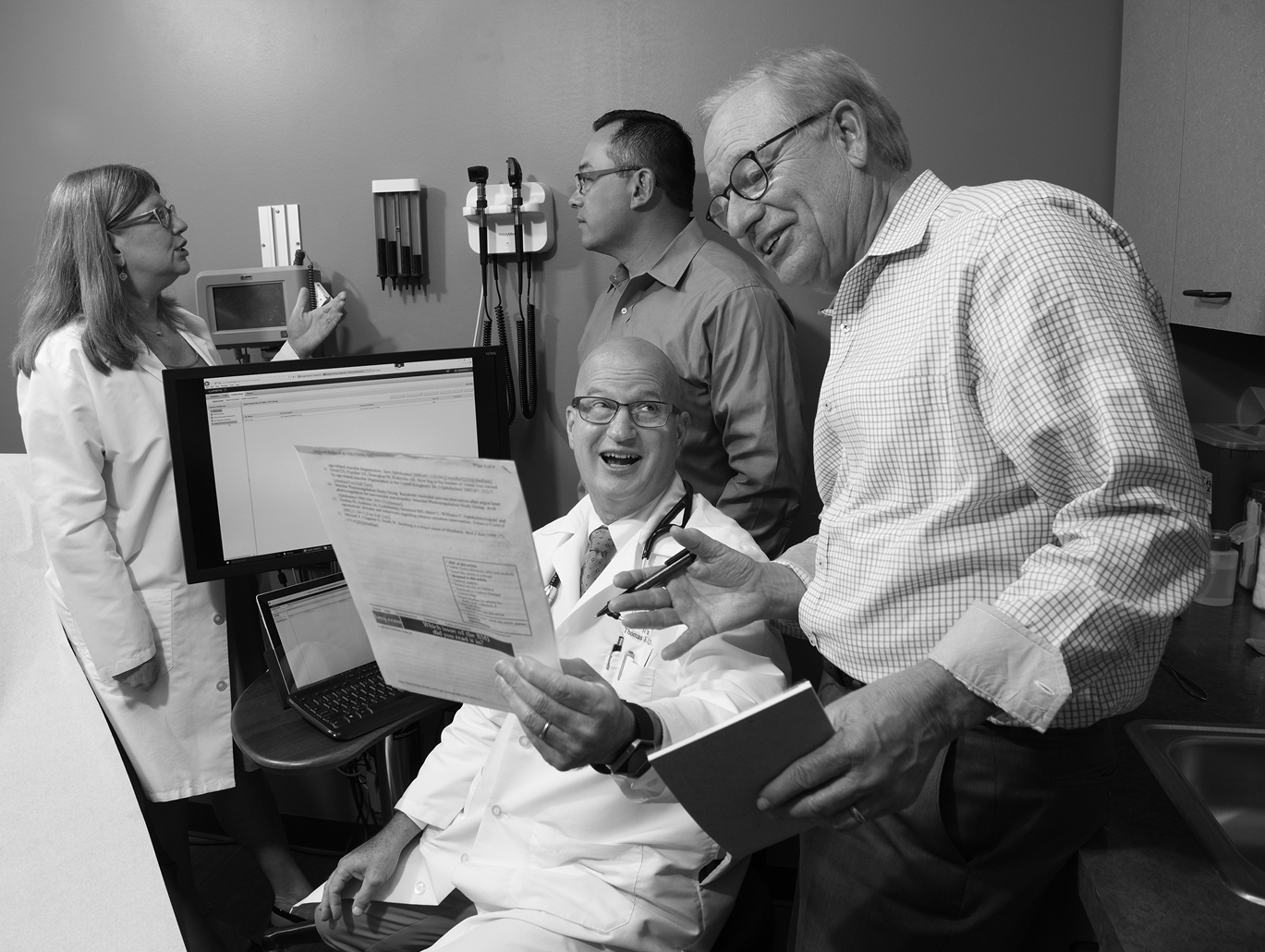
Lumeris physicians and leaders, 2017. Rear: Dr. Susan Adams, COO Art Glasgow. Front: Dr. Tom Hastings, CEO Mike Long.
By all the metrics, 2017 was a banner year for Lumeris, now the market leader for value-based care. “The market’s starting to shift,” Art Glasgow told me. “For the first time I feel like our sales plan could start to get realistic. I might actually have to put in some stretch goals.”
As of this writing, Lumeris has launched partnerships with payers, provider groups, and health systems in eighteen states, accounting for more than one million lives. The potential is staggering. If adopted nationwide, the company’s Missouri model could save up to $800 billion annually in wasteful medical expenditures. Most important, it would enhance our nation’s quality and quantity of life.
At today’s Lumeris, OKRs are part of the wallpaper. As Andrew Cole might say: Once people experienced the new company under the surface, they couldn’t resist the temptation to keep diving back into it.