20
Culture Change: Bono’s ONE Campaign Story
Bono
Cofounder
We’ve just seen how OKRs can lock in culture change post hoc. As Bono’s story shows structured goal setting can also springboard an enriching cultural reset.
For nearly two decades, the world’s biggest rock star has waged “an experiment in anti-apathy on a global scale.” Bono’s first Big Hairy Audacious Goal came out of the Jubilee 2000 global initiative, which led to $100 billion in debt relief for the world’s poorest countries. Two years later, with a start-up grant from the Bill & Melinda Gates Foundation, Bono cofounded DATA (Debt, AIDS, Trade, Africa), a global advocacy organization for public policy change. Its declared mission was to address poverty, disease, and development in Africa in alliance with government bodies and other multinational NGOs. (Bill Gates would say it was the best million dollars he ever spent.) In 2004, Bono launched the ONE Campaign to catalyze a nonpartisan, grassroots, activist coalition. It’s the outside-facing complement to DATA’s inside game.
From the time we first met, I was struck by Bono’s passion for “factivism,” or fact-based activism. In ONE’s hardheaded, analytical, results-oriented environment, OKRs were an easy sell. For the last ten years, they’ve helped clarify the organization’s priorities—a tall order when your mission is to change the world. According to David Lane, the organization’s former CEO, “We needed a process of discipline to keep us from trying to do everything.”
As ONE has grown, it has leaned on OKRs to achieve fundamental culture change. It is pivoting from working on Africa to working in and with Africa. As David told me, “There’s been a dramatic philosophical change in how people think about helping the developing world develop itself, to empower these countries to grow on their own. OKRs played a key role in how we did that.”
To improve the lives of the world’s most vulnerable, ONE has helped deliver nearly $50 billion in funding for historic health initiatives. In addition, it has lobbied successfully for transparency rules to fight corruption, and to channel resources from African oil and gas revenues into the war on extreme poverty. In 2005, alongside Bill and Melinda Gates, Bono was named Time magazine’s Person of the Year.
Bono: We had big goals for U2 from the start. (You could say megalomania set in from a very early age.) Edge was already an accomplished guitar player and Larry was a pretty good drummer, but I was a poor singer and Adam really couldn’t play the bass at all. But here’s what we thought: We’re not as good as those other groups. So we better be better.
We weren’t as polished or accomplished as the bands we’d go and see, but we had chemistry, whatever the thing is that makes it magic. We thought we could blow up the world if we didn’t blow ourselves up first. We felt we could go all the way. The other bands had everything, but we had it. That’s what we used to repeat to ourselves.
How did we measure effectiveness? Well, at the outset, we asked questions about our place in the world, beyond the pop charts or the clubs. Like: Can our music be useful? Can art inspire political change? In 1979, when we were just eighteen, one of our first jobs was an anti-apartheid show. Another was a pro-contraception show—in Ireland, that was a big deal. Later, in our early twenties, we deliberately became a nuisance to what you might call Irish terror groups and all the people who felt ambivalent about them. We felt compelled to say that blowing up kids in supermarkets can never be right. We gauged our political impact by the torrent of bile that came back at us.
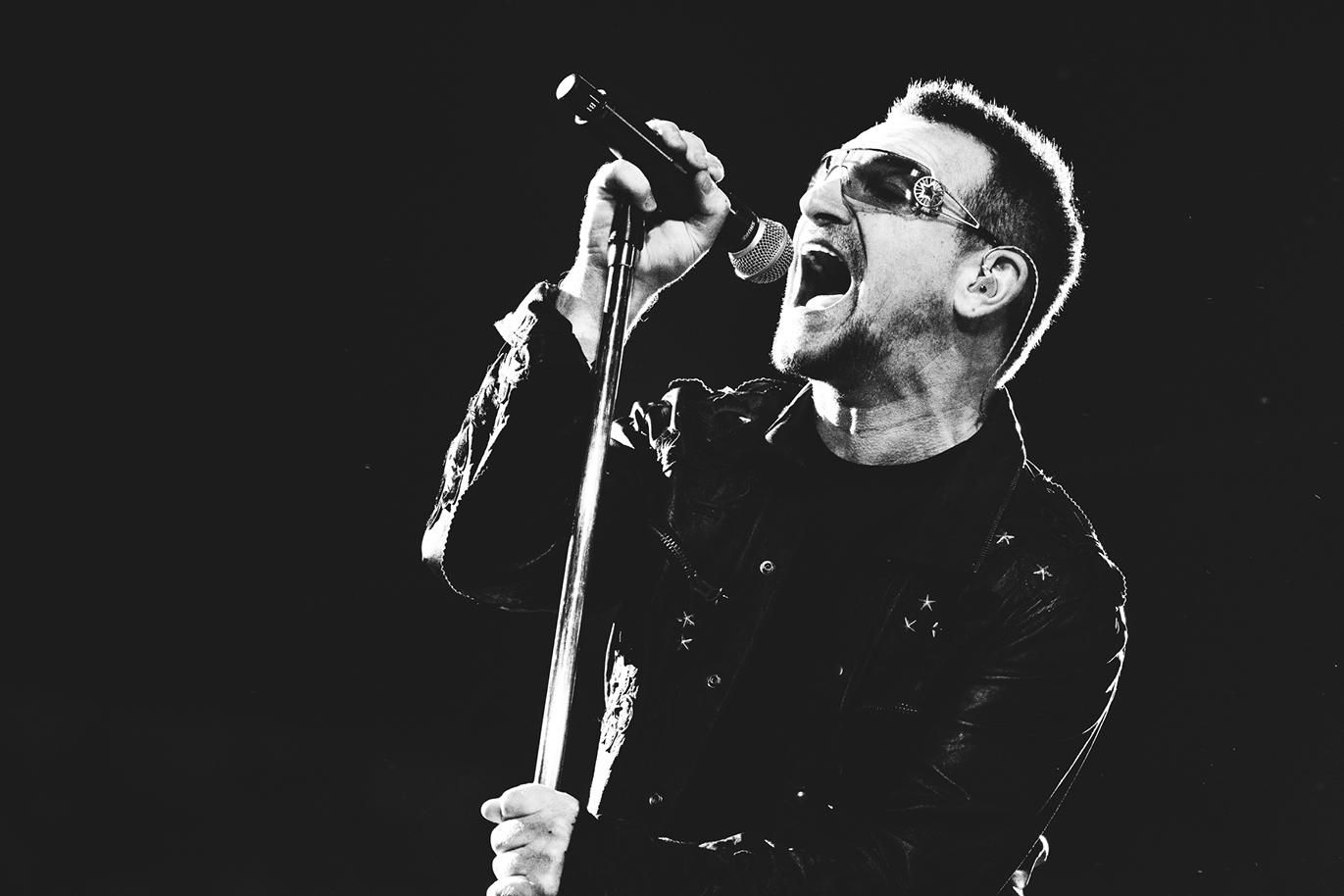
U2’s 360 Tour, 2009.
And then at some point, you want your songs to chart. We worked quite hard to break through to the mainstream, actually. We were a live phenomenon, but our singles didn’t do very well. So we judged our success by selling tickets, and then by selling albums.
Picking Our Fights
When we formed our nonprofit DATA, we went about it exactly the same as I had with U2. It was a band: Lucy Matthew, Bobby Shriver, Jamie Drummond, and myself. We didn’t know who was the singer or the bass player or the drummer or the guitar player. But we knew we weren’t a bunch of hippies and wishful thinkers. We were more punk rock. We were tough-minded opportunists. We were working on a single idea: debt cancellation for the poorest countries. We were good at that, choosing one fight at a time and going at it with a vicious schedule.
Then we went after universal access to anti-AIDS drugs, another clear goal, and I must say, people did laugh in our face: “You are out of your tiny mind. That’s impossible. Why fight the most expensive disease when you could have a go at malaria or river blindness? Or finish off polio?”
And I remember saying, “No, we’re picking a fight with this disease because these two pills”—it’s one pill now—“are a visual representation of inequality. If you live in Dublin or Palo Alto, you can get the pills. If you live in Lilongwe, Malawi, in Africa, you can’t get the pills. So because of an accident of longitude and latitude, you live or you die. That doesn’t feel right.”
Anyway, I was sure we could win that argument, because everyone knew such inequality was wrong. It was that simple. That was years before we used OKRs, but even then I used to say, “Picture Everest, then describe how difficult the climb is. Then describe how we’re going to reach the summit.” Like Everest, beating AIDS looked nearly impossible. First you needed to be able to describe it. Then you could climb it.
So now it’s 2017, and 21 million people are accessing the antiretroviral therapies. It’s amazing. And AIDS-related deaths are down 45 percent in the last ten years. New HIV infections in children are down by more than half. And we’re on pace to win the fight against mother-to-child transmission by 2020, to finish the disease off. I believe we will live to see an AIDS-free world in our lifetime.
Growing Up with OKRs
Our NGO band was entrepreneurial in spirit, and we tracked our goals internally. But you can only go so far without process. Once we started to have real impact and real access, DATA merited more data—more measurable procedures, more measurable outcomes. Then we brought eleven different groups together to form a coalition behind the ONE Campaign. We had so many brilliant, gifted people, but our problem was way too many goals. A green revolution in Africa. Girls’ education. Energy poverty. Global warming. We were all over the map.
DATA and ONE merged two very different cultures—it was tricky. We realized we were ourselves lacking in transparency. If you don’t have clear sign-offs to your goals, you get overlap and dissonance. People get confused about their jobs. For a time we had a real schism in our organization.
Here’s the thing: We never thought small. The stretch was always there. But our goals were so gigantic that we stretched too thin and got people worn out. OKRs saved us, really. Tom Freston, chairman of ONE’s board, saw their value, so they became part and parcel of the operation—he played a very important role. OKRs forced us to think clearly and agree on what we could achieve with the resources we had. They gave us a frame to hang our passion on. And you need that framework because, without it, your brain is just too abstract. The OKR traffic lights, the color coding—they transformed our board meetings. They sharpened our strategy, our execution, our results. They made us a more effective weapon in the fight against extreme poverty.
The Pivot
When John Doerr arrived at our very first ONE board meeting, he asked a simple and profound question: “Who are we working for? Who’s the client here?”
We said, “John, we’re working for the world’s poorest and most vulnerable.” And John said, “Well, then, do they have a seat at the table?”
We said, “Of course, the whole table’s there for them.”
But John persisted, which was important: “Can you visualize that person? Shouldn’t we think about them physically being at this table?”
That’s the thinking that seeded the pivot that eventually transformed our organization ONE. John’s prodding rhymed with a man we met in Paris once, a man from Senegal. He said, “Bono, do you know the Senegalese proverb ‘If you want to cut a man’s hair, it is better if he is in the room’?” He said it in a loving way, but we didn’t miss the message: Be careful if you think you know what we want. Because we know what we want. You’re not African, and this messiah complex hasn’t always turned out so well.
In 2002, in southeast Africa, I had seen people with HIV queuing up to die. Along with many other AIDS activists, I sent up dramatic flares about the scale and devastation of this pandemic. I encouraged everyone in our organization never to say the word AIDS without adding the word emergency. “The AIDS emergency.” By 2009, though, there was backlash. Some more well-heeled Africans took exception to the way we were characterizing AIDS, though we were right. An economist named Dambisa Moyo wrote a book called Dead Aid and led the charge among those who were thinking, “Shove your aid. We don’t need it. It’s doing more damage than good. We’re trying to rebrand the continent as a positive place to invest and live and work. You’re hurting that.”
I could see that ONE’s credibility was under threat here. We had focused on governments in the North because decisions in Washington, London, and Berlin had big consequences for many of the poorest countries. Jamie and other activist friends, like John Githongo, Ory Okolloh, and Rakesh Rajani, were on the ground reminding us of the same thing. Africa’s future had to be decided by Africans. We had called our organization ONE, yet we were only half the people necessary to fix these problems. It was fantasy to think those north of the equator could end extreme poverty without a full partnership with those south of the equator.
ONE committed to both organizational and cultural change. Even now, we’re still increasing our collaborative work with African leaders—grassroots, grass tops, and all in between. We’ve established a growing African office in Johannesburg and around the continent. The OKRs have kept us focused on the concrete changes we need to make—hiring staff in Africa, expanding our board, reconnecting with old Jubilee partners, and identifying new networks to turn to for advice. I guess we’ve become better listeners. And I don’t think we could have done it without objectives and key results.
OBJECTIVE
Proactively integrate a broad range of African perspectives into ONE’s work, align more closely with African priorities, and share and leverage ONE’s political capital to achieve specific policy changes in and toward Africa.
KEY RESULTS
-
Three African-based hires complete and onboard by April, and two African board members approved by July.
-
African Advisory Board in place by July and convened twice by December.
-
Relationships fully developed with a minimum of ten to fifteen leading African thinkers who actively and regularly challenge and guide ONE’s policy positions and external work.
-
Undertake four participatory trips to Africa over the course of 2010.
Measuring Passion
Having Sudanese businessman and philanthropist Mo Ibrahim on our board is just transformative. In Africa, he is the real deal, a proper rock star. He and his daughter, Hadeel, give us the intellectual static on the continent that we were missing—and that was so necessary to tune in to stronger channels. Before we met him, Mo was properly rude about some of our objectives. He steered us to transparency as a central goal—not just in Africa, but in Europe and America. We put in the research and found that corruption drains a trillion dollars a year from developing countries. “This is more important than HIV/AIDS,” Mo told us. “This will save more lives.”
With the impetus coming from Africans, ONE’s change has progressed. We lobbied side by side with the Publish What You Pay collective, and now it is illegal for any company on the New York Stock Exchange or in the EU to conceal what they’ve paid for mining rights. And last year, Aliko Dangote, whom I’ve heard dubbed the Bill Gates of Africa, joined the board.
That’s all well and good, but we’ve also got to be straight about the facts. For example: As of December 2017, ONE has 8.9 million members who have signed up online or have taken part in at least one action. (Over three million of them are now in Africa.) And I can see Bill Gates rolling his eyes and saying, “Big deal. Signers are not members. They’re just people who sign something.” He’s correct, of course. But that led us to a question: How do we measure membership engagement? And whatever metric we come up with, is the number static or can it grow? We needed to prove that we could take people from signers to members to activists to catalysts, so we found ways to thank and reward our members for doing more than one action. We flooded the districts of certain U.S. senators and congresspeople, and it became unnerving for them. For example, if you ask Kay Granger, a Republican congresswoman from Texas, she probably thinks there are people in ONE T-shirts everywhere, pressing her to take a stand. But we’re not everywhere; she was one of our strategic targets. And she really came through for ONE.
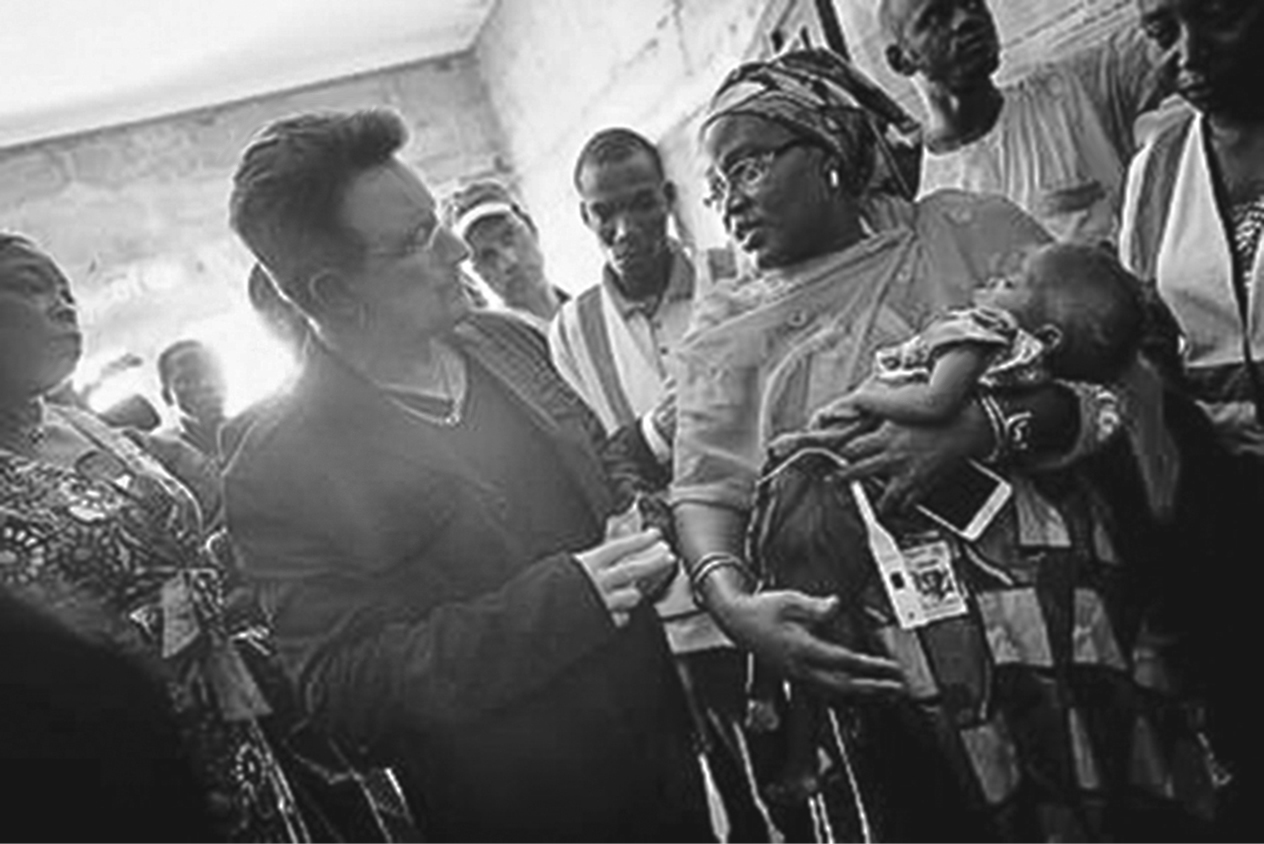
Bono brings the ONE Campaign to Dalori, Nigeria, to visit internally displaced persons camps, 2016.
Nobody has ever before measured activists’ passion. It sounds odd, but it’s totally OKR. So you’re passionate—how passionate? What actions does your passion lead you to do? And now when Bill Gates asks tough questions at our board meeting, we can bring out our OKRs and say, “Here is what we’ve done, and this is the impact it’s had.”
An OKR Framework
Is there a downside to OKRs? Well, if you read them incorrectly, I suppose you could get too organized. ONE mustn’t get institutional; we need to stay disruptive. I’m always scared that we’re going to go corporate and try to beat every quarterly goal. We needed John to remind us, “If everything’s at green, you failed.” That was counterintuitive for a lot of people, especially now that we’re financed up and have the best and the brightest working here. But John kept saying, “More red!” He was right. We needed more big ambitions because that’s what we’re good at. We’re less good at the incremental stuff.
ONE isn’t standing on our passion. We’re not standing on our moral outrage. We’re standing on a foundation built on certain principles, and with walls and floors—with a certain structure of thinking from the OKRs. And for that, we are very, very grateful. It takes intellectual rigor to effect change; it requires very serious strategies, indeed. If the heart doesn’t find a perfect rhyme with the head, then your passion means nothing. The OKR framework cultivates the madness, the chemistry contained inside it. It gives us an environment for risk, for trust, where failing is not a fireable offense—you know, a safe place to be yourself. And when you have that sort of structure and environment, and the right people, magic is around the corner.
And so: Edge was a really talented guitar player from the start, but I wasn’t the best singer. Adam wasn’t the best bass player. And Larry was just getting there as a drummer. But we had our goals, and a rough idea of how to reach them. We wanted to be the best band in the world.